
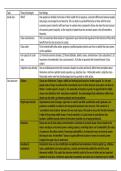
Topic Theory/Sociologist Key findings
Social class What? How people are divided on the basis of their wealth for tax purposes, economic differences between people
and groups are arranged in our hierarchy. This can lead to a pyramid hierarchy as those with the most
economic power (minority) will have fewer in number when compared to those who have the least amount
of economic power (majority). As the majority of people have less economic power, this will resemble a
hierarchy.
Class consciousness This is an awareness that society isn't organised in your interests but organised in the interests of those that
benefit from the class structure in society.
Class action To be involved with strike action, progress or political parties aimed to our form or abolish the class system
on the capitalism.
Four aspects of social (1) A shared economic situation, (2) Shared attitudes, beliefs, values, and behaviour (‘class subcultures’), (3)
class Awareness of membership (‘class consciousness’), (4) Action to promote their shared interests (‘class
action’)
Subjective class identity How an individual perceives their economic situation in society and how it affects their perception about
themselves and how capitalist society operates e.g. objective class – McDonalds worker, subjective class –
McDonalds worker who feels disadvantaged and may partake in strike action.
Class structure Giddens Classes are divided into 3 (upper, middle and working class) based on ‘market capacity’ (i.e. the way
people make a living). He endorsed the conventional view of a three-structure class system. He drew on
Weber’s ‘market capacity’ concept i.e. the ownership of property or goods. He argued that the middle
classes were defined by their ‘educational credentials’. He acknowledged that subdivisions within these
classes can also exist e.g. between graduates and non-graduates.
Wright (neo-Marxist) Organisational assets (manager, supervisor or worker) and skills/ qualification assets (graduate, non-
graduate or unskilled) are added to the bourgeoisie/proletariat class structure. This resulted in 12
‘contradictory class locations’ between the two main classes. This seeks to rescue the Marxist framework
in light of the growing middle classes. Formula resulted in a 12 grid matrix of contradictory class
locations. Unskilled manual workers at the bottom (another way of saying proletariat).
Runciman Classes are sets of roles whose current location is a function of economic power. Class is based on the
nature and degree of economic power: owning property, controlling labour and ‘marketability’ (the value
of someone in the labour market). Possessing marketability is an important means of economic power
that impacts class. He identified 7 classes occupying different locations in terms of economic power
(ranging from upper class to underclass).
Bourdieu (& Interested in how our class stratification was legitimised and maintained. Cultural capital (e.g. attitudes,
Southerton) tastes, qualifications) and social capital (e.g. contacts and networks) enabled the well off to avoid
downward mobility. This capital also becomes symbolic capital in the eyes of others and are important
markers of social class. Southerton argues that consumption and tastes are an important way for middle
Social class What? How people are divided on the basis of their wealth for tax purposes, economic differences between people
and groups are arranged in our hierarchy. This can lead to a pyramid hierarchy as those with the most
economic power (minority) will have fewer in number when compared to those who have the least amount
of economic power (majority). As the majority of people have less economic power, this will resemble a
hierarchy.
Class consciousness This is an awareness that society isn't organised in your interests but organised in the interests of those that
benefit from the class structure in society.
Class action To be involved with strike action, progress or political parties aimed to our form or abolish the class system
on the capitalism.
Four aspects of social (1) A shared economic situation, (2) Shared attitudes, beliefs, values, and behaviour (‘class subcultures’), (3)
class Awareness of membership (‘class consciousness’), (4) Action to promote their shared interests (‘class
action’)
Subjective class identity How an individual perceives their economic situation in society and how it affects their perception about
themselves and how capitalist society operates e.g. objective class – McDonalds worker, subjective class –
McDonalds worker who feels disadvantaged and may partake in strike action.
Class structure Giddens Classes are divided into 3 (upper, middle and working class) based on ‘market capacity’ (i.e. the way
people make a living). He endorsed the conventional view of a three-structure class system. He drew on
Weber’s ‘market capacity’ concept i.e. the ownership of property or goods. He argued that the middle
classes were defined by their ‘educational credentials’. He acknowledged that subdivisions within these
classes can also exist e.g. between graduates and non-graduates.
Wright (neo-Marxist) Organisational assets (manager, supervisor or worker) and skills/ qualification assets (graduate, non-
graduate or unskilled) are added to the bourgeoisie/proletariat class structure. This resulted in 12
‘contradictory class locations’ between the two main classes. This seeks to rescue the Marxist framework
in light of the growing middle classes. Formula resulted in a 12 grid matrix of contradictory class
locations. Unskilled manual workers at the bottom (another way of saying proletariat).
Runciman Classes are sets of roles whose current location is a function of economic power. Class is based on the
nature and degree of economic power: owning property, controlling labour and ‘marketability’ (the value
of someone in the labour market). Possessing marketability is an important means of economic power
that impacts class. He identified 7 classes occupying different locations in terms of economic power
(ranging from upper class to underclass).
Bourdieu (& Interested in how our class stratification was legitimised and maintained. Cultural capital (e.g. attitudes,
Southerton) tastes, qualifications) and social capital (e.g. contacts and networks) enabled the well off to avoid
downward mobility. This capital also becomes symbolic capital in the eyes of others and are important
markers of social class. Southerton argues that consumption and tastes are an important way for middle


