

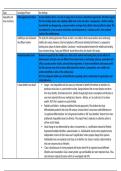
Topic Sociologist/Theory Key findings
Inequality and Embourgeoisement thesis As new industries led to a real rise in wages and an increase in educational opportunity, this thesis argued
class structures that the working classes were adopting middle class norms and values. Consequently, a distinct working-
class identity was disappearing, as manual workers no longer had a distinct cultural/political outlook. This
was replaced by a new consumer led identity and development of a ‘classless society’, that consisted
mainly of the middle classes.
Goldthorpe and Lockwood – The study the embourgeoisement thesis as there is no evidence that manual workers were embracing
the affluent worker middle class values. However, they had adopted a shift towards individual self-interest, as opposed to
working class values of shared solidarity. Conclusion = social boundaries between the middle and working
class remained strong. Young and Willmott- shared leisure time also found in this study.
Proletarianization thesis Braverman argued that the middle-class, white-collar workers were having their jobs de-skilled and
dehumanised. Such jobs were not different from manual work, as technology advances, automation will
affect a growing number of jobs. Jobs also being fragmented, to make work efficient and increase profit
but this removes some of the previous skills required by workers. Consequently, some middle-class
workers identified as ‘allies of the working class’.
BUT they displayed middle class self-identification regarding culture, membership of organisations and
voting behaviour.
Is class identity now dead? Savage - class inequalities exist but many are reluctant to identify themselves as members of a
particular social class. In a post-modern society, Savage believes that we now distance ourselves
from class identity. Postmodernism link - identity through high street consumption and lifestyles is
now more important than our working lives. Bauman – kitchen, w/c to cook but m/c to shown
wealth. BUT this is expensive so quite limited.
Pakulski and Walters - challenge traditional Marxist approaches. They believe that class
differentiation peaked in the early 20th century. Instead, there is now more subtle differences in
‘occupational differentiation’ and a fragmented workforce. Old ‘class identities’ distract from more
problematic inequalities based on ethnicity. They reject Marx’s emphasis on collective action to
achieve social change.
Social change is now determined by culture /consumerism i.e., stratification reduced to lifestyle;
fragmented/multiple identities; autonomisation i.e., individualistic society where people become
independent in terms of their values and ‘resignification’ where people change their opinions.
Individualism has now replaced social class as an identity. Our status in society is determined by
what we consume and our lifestyles.
Class is dead because it is being replaced with status where life is organised around different
lifestyles and consumption. Class is dead- gender, age and disability are more important class. Thus,
class has been replaced by status which can overlapped and shift.
, BUT inconsistent definitions of class, and Marxists argue they tend to ignore economic categories,
plus the ignore how class determines consumption and lifestyles. Bradley- superficial and lacking
evidence.
Globalisation and Post-modernist approach Society is defined by global based diversity and cooperation. Dealing with ecological crises (e.g. global
inequality warming, a pandemic, deforestation etc) requires transnational international agencies because nation states
unable to deal with risks themselves.
Marxist approach A global capitalist class can increase exploitation (which is no longer reduced to nation states) and avoid
taxes. Inequalities are increased as nation states and protections become weaker (trade unions).
Robinson's key points In the 20th century, nation states ensured capitalist wealth and power. This means that laws protecting
private property and infrastructure development enabled capitalists to make profits. After stagnation in
1970s, however, capitalism became re-organised via transnational corporations (international production of
goods or services, foreign investments, or asset management in more than one country) and a rolling back
on the welfare state and state run industries. Global companies combined with reduced welfare means
greater poverty and high inequality levels. E.g. high levels unemployment in the USA as steel imported
cheaply from China so steel workers lost their jobs. Production moved developing countries where it was
cheaper.
4 ways in which capitalism 1. Weakening trade unions and thus raising the level of exploitation - ability to negotiate for higher
reorganised itself wages increases poverty and increases the divide between the rich and the poor.
2. Capitalism becomes intensified by through commodifying health and security and expanding
markets to new areas of the globe - private companies control more areas of life such as in
education.
3. Creation of global legal and regulatory structure to facilitate profit accumulation (World Trade,
IMF, World Bank).
4. Imposition of neoliberal structural adjustment programmes on any nations who are unable to pay
international loans. In other words, these pro capitalist institutions demand countries to make
reforms e.g., deregulation and privatisation, in return for even more financial support and thus,
debt.
+ there's also been a creation of global legal and regulatory structure. This means that global banks loan
money to developing nations but often charge high rates of interest, keeping them further in poverty
rather than enabling them to develop and become an independent. E.g. Greece the IMF insisted on huge
reforms of privatisation and deregulation in return for baling them out.
Neoliberalism Neoliberalism (pioneered by Heyek and Friedman) are ‘anti-statists’ who have ideological commitment to
champion capitalism against socialism. They believe free trade is the most efficient way to distribute goods
and resources. They argue that welfarism weakens individual initiative and that private companies should
provide social services.
Inequality and Embourgeoisement thesis As new industries led to a real rise in wages and an increase in educational opportunity, this thesis argued
class structures that the working classes were adopting middle class norms and values. Consequently, a distinct working-
class identity was disappearing, as manual workers no longer had a distinct cultural/political outlook. This
was replaced by a new consumer led identity and development of a ‘classless society’, that consisted
mainly of the middle classes.
Goldthorpe and Lockwood – The study the embourgeoisement thesis as there is no evidence that manual workers were embracing
the affluent worker middle class values. However, they had adopted a shift towards individual self-interest, as opposed to
working class values of shared solidarity. Conclusion = social boundaries between the middle and working
class remained strong. Young and Willmott- shared leisure time also found in this study.
Proletarianization thesis Braverman argued that the middle-class, white-collar workers were having their jobs de-skilled and
dehumanised. Such jobs were not different from manual work, as technology advances, automation will
affect a growing number of jobs. Jobs also being fragmented, to make work efficient and increase profit
but this removes some of the previous skills required by workers. Consequently, some middle-class
workers identified as ‘allies of the working class’.
BUT they displayed middle class self-identification regarding culture, membership of organisations and
voting behaviour.
Is class identity now dead? Savage - class inequalities exist but many are reluctant to identify themselves as members of a
particular social class. In a post-modern society, Savage believes that we now distance ourselves
from class identity. Postmodernism link - identity through high street consumption and lifestyles is
now more important than our working lives. Bauman – kitchen, w/c to cook but m/c to shown
wealth. BUT this is expensive so quite limited.
Pakulski and Walters - challenge traditional Marxist approaches. They believe that class
differentiation peaked in the early 20th century. Instead, there is now more subtle differences in
‘occupational differentiation’ and a fragmented workforce. Old ‘class identities’ distract from more
problematic inequalities based on ethnicity. They reject Marx’s emphasis on collective action to
achieve social change.
Social change is now determined by culture /consumerism i.e., stratification reduced to lifestyle;
fragmented/multiple identities; autonomisation i.e., individualistic society where people become
independent in terms of their values and ‘resignification’ where people change their opinions.
Individualism has now replaced social class as an identity. Our status in society is determined by
what we consume and our lifestyles.
Class is dead because it is being replaced with status where life is organised around different
lifestyles and consumption. Class is dead- gender, age and disability are more important class. Thus,
class has been replaced by status which can overlapped and shift.
, BUT inconsistent definitions of class, and Marxists argue they tend to ignore economic categories,
plus the ignore how class determines consumption and lifestyles. Bradley- superficial and lacking
evidence.
Globalisation and Post-modernist approach Society is defined by global based diversity and cooperation. Dealing with ecological crises (e.g. global
inequality warming, a pandemic, deforestation etc) requires transnational international agencies because nation states
unable to deal with risks themselves.
Marxist approach A global capitalist class can increase exploitation (which is no longer reduced to nation states) and avoid
taxes. Inequalities are increased as nation states and protections become weaker (trade unions).
Robinson's key points In the 20th century, nation states ensured capitalist wealth and power. This means that laws protecting
private property and infrastructure development enabled capitalists to make profits. After stagnation in
1970s, however, capitalism became re-organised via transnational corporations (international production of
goods or services, foreign investments, or asset management in more than one country) and a rolling back
on the welfare state and state run industries. Global companies combined with reduced welfare means
greater poverty and high inequality levels. E.g. high levels unemployment in the USA as steel imported
cheaply from China so steel workers lost their jobs. Production moved developing countries where it was
cheaper.
4 ways in which capitalism 1. Weakening trade unions and thus raising the level of exploitation - ability to negotiate for higher
reorganised itself wages increases poverty and increases the divide between the rich and the poor.
2. Capitalism becomes intensified by through commodifying health and security and expanding
markets to new areas of the globe - private companies control more areas of life such as in
education.
3. Creation of global legal and regulatory structure to facilitate profit accumulation (World Trade,
IMF, World Bank).
4. Imposition of neoliberal structural adjustment programmes on any nations who are unable to pay
international loans. In other words, these pro capitalist institutions demand countries to make
reforms e.g., deregulation and privatisation, in return for even more financial support and thus,
debt.
+ there's also been a creation of global legal and regulatory structure. This means that global banks loan
money to developing nations but often charge high rates of interest, keeping them further in poverty
rather than enabling them to develop and become an independent. E.g. Greece the IMF insisted on huge
reforms of privatisation and deregulation in return for baling them out.
Neoliberalism Neoliberalism (pioneered by Heyek and Friedman) are ‘anti-statists’ who have ideological commitment to
champion capitalism against socialism. They believe free trade is the most efficient way to distribute goods
and resources. They argue that welfarism weakens individual initiative and that private companies should
provide social services.


