

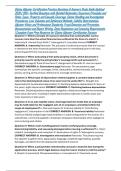
Claims Adjuster Certification Practice Questions & Answers Study Guide Updated
2026 | 200+ Verified Questions with Detailed Rationales | Insurance Principles and
Policy Types, Property and Casualty Coverage, Claims Handling and Investigation
Procedures, Loss Valuation and Settlement Methods, Liability Determination,
Adjuster Ethics and Professional Standards, Fraud Detection and Prevention,
Documentation and Report Writing, State Regulations and Licensing Requirements
| Complete Exam Prep Resource for Claims Adjuster Certification Success
Question 1: Which principle of insurance dictates that a policyholder cannot
recover more than the actual financial loss suffered at the time of a claim? A.
Indemnity B. Utmost Good Faith C. Subrogation D. Insurable Interest CORRECT
ANSWER: A. Indemnity Rationale: The principle of indemnity ensures that the insured
is restored to the same financial position they were in immediately prior to the loss,
preventing profit from insurance payouts.
Question 2: When evaluating a first-party property claim, which document is
primarily used to verify the policyholder's coverage limits and exclusions? A.
Declarations page B. Proof of loss form C. Assignment of benefits D. Loss run report
CORRECT ANSWER: A. Declarations page Rationale: The declarations page
summarizes the specific coverages, limits, deductibles, named insureds, and policy
period, serving as the primary reference for coverage verification.
Question 3: Which type of depreciation method applies a constant depreciation
rate to the declining book value of an asset over its useful life? A. Straight-line
depreciation B. Accelerated depreciation C. Declining balance depreciation D. Sum-of-
the-years'-digits depreciation CORRECT ANSWER: C. Declining balance depreciation
Rationale: Declining balance depreciation applies a fixed percentage to the remaining
book value each year, resulting in higher depreciation expenses in earlier years and
lower expenses in later years.
Question 4: In an auto liability claim, what legal doctrine holds that an employer
may be held liable for the negligent acts of an employee committed within the
scope of employment? A. Res ipsa loquitur B. Vicarious liability C. Contributory
negligence D. Assumption of risk CORRECT ANSWER: B. Vicarious liability Rationale:
Vicarious liability assigns legal responsibility to a supervising party for the actions of a
subordinate, commonly applied in employer-employee relationships when negligence
occurs during work duties.
Question 5: Which claim handling phase involves verifying policy coverage,
determining liability, and assessing damages before issuing a settlement? A. Claim
intake B. Investigation and evaluation C. Reservation of rights D. Subrogation recovery
CORRECT ANSWER: B. Investigation and evaluation Rationale: This phase requires
the adjuster to gather facts, apply policy language, establish legal liability, quantify
damages, and determine the appropriate settlement amount.
Question 6: When a policyholder intentionally conceals a material fact during the
application process, which legal defense may the insurer invoke to void the policy?
A. Breach of warranty B. Misrepresentation or concealment C. Proximate cause
,exclusion D. Concurrent causation CORRECT ANSWER: B. Misrepresentation or
concealment Rationale: Material misrepresentation or concealment during
underwriting allows the insurer to rescind the policy if it can be proven that the
undisclosed fact would have altered the underwriting decision.
Question 7: Which estimation software tool is widely recognized in the property
claims industry for generating standardized repair estimates using localized pricing
databases? A. CCC Estimating B. Xactimate C. Audatex D. Mitchell Estimating
CORRECT ANSWER: B. Xactimate Rationale: Xactimate is the industry-standard
estimating platform that uses localized, updated pricing data and standardized line
items to produce accurate property repair estimates.
Question 8: What is the primary purpose of a reservation of rights letter in claims
handling? A. To immediately deny coverage for the claim B. To preserve the insurer's
right to investigate and potentially deny coverage later C. To assign the claim to a third-
party administrator D. To notify the insured of a policy cancellation CORRECT ANSWER:
B. To preserve the insurer's right to investigate and potentially deny coverage later
Rationale: A reservation of rights letter informs the insured that the insurer is
investigating the claim while explicitly stating that coverage may be denied based on
policy exclusions or conditions discovered during the investigation.
Question 9: In workers' compensation claims, which medical assessment tool is
commonly used to determine permanent impairment ratings? A. AMA Guides to the
Evaluation of Permanent Impairment B. DSM-5 Diagnostic Criteria C. ICD-10 Coding
System D. OSHA Injury Severity Scale CORRECT ANSWER: A. AMA Guides to the
Evaluation of Permanent Impairment Rationale: The AMA Guides provide
standardized, evidence-based methodologies for evaluating and rating permanent
impairments, which are critical for calculating workers' compensation benefits.
Question 10: Which type of subrogation occurs when the insured's insurer pursues
recovery directly from the at-fault party without first compensating the insured? A.
Contractual subrogation B. Conventional subrogation C. Statutory subrogation D.
Equitable subrogation CORRECT ANSWER: A. Contractual subrogation Rationale:
Contractual subrogation arises from explicit policy language that grants the insurer the
right to pursue recovery from third parties after paying a claim, differing from equitable
subrogation which is implied by law.
Question 11: When adjusting a commercial general liability claim, what is the
trigger of coverage for an occurrence-based policy? A. The date the policy is renewed
B. The date the injury or damage actually occurred C. The date the claim is reported to
the insurer D. The date the lawsuit is filed CORRECT ANSWER: B. The date the injury
or damage actually occurred Rationale: Occurrence-based policies cover claims for
bodily injury or property damage that happened during the policy period, regardless of
when the claim is reported.
Question 12: Which investigative technique involves interviewing witnesses
separately to identify inconsistencies and corroborate the claimant's account? A.
,Polygraph administration B. Recorded statements C. Surveillance photography D.
Scene reconstruction CORRECT ANSWER: B. Recorded statements Rationale: Taking
recorded statements from involved parties and witnesses under controlled conditions
allows adjusters to capture detailed accounts, identify discrepancies, and establish a
reliable factual record.
Question 13: What is the legal standard used to determine whether a policyholder's
actions contributed to their own loss in a comparative negligence jurisdiction? A.
Pure contributory negligence B. Modified comparative negligence C. Absolute liability D.
Strict liability CORRECT ANSWER: B. Modified comparative negligence Rationale:
Modified comparative negligence reduces the claimant's recovery by their percentage
of fault, typically barring recovery if fault exceeds 50% or 51%, depending on state law.
Question 14: Which document must a policyholder sign to authorize a third-party
contractor to receive direct payments from the insurer for property repairs? A. Proof
of loss B. Assignment of benefits C. Release of liability D. Subrogation waiver CORRECT
ANSWER: B. Assignment of benefits Rationale: An assignment of benefits legally
transfers the insured's right to receive insurance proceeds to a contractor or service
provider, allowing direct payment for completed work.
Question 15: In property insurance, what does the term "betterment" refer to? A.
Upgrading damaged property to current building codes beyond pre-loss condition B.
Reducing the deductible through policy endorsements C. Recovering salvage value
from destroyed items D. Increasing policy limits after a loss CORRECT ANSWER: A.
Upgrading damaged property to current building codes beyond pre-loss condition
Rationale: Betterment applies when repairs or replacements improve the property
beyond its pre-loss condition, and insurers typically only pay for the value equivalent to
the pre-loss state.
Question 16: Which regulatory body oversees insurance licensing and market
conduct for adjusters at the state level? A. NAIC B. State Department of Insurance C.
FTC D. SEC CORRECT ANSWER: B. State Department of Insurance Rationale: Each
state's Department of Insurance regulates adjuster licensing, sets ethical standards,
and enforces market conduct rules within its jurisdiction.
Question 17: What is the primary purpose of a proof of loss form in first-party
claims? A. To establish the insurer's liability B. To formally document the claimant's
stated loss and requested payment amount C. To initiate subrogation proceedings D. To
cancel the insurance policy CORRECT ANSWER: B. To formally document the
claimant's stated loss and requested payment amount Rationale: A proof of loss is a
sworn statement submitted by the insured detailing the nature, cause, and extent of the
loss, along with supporting documentation and the claimed amount.
Question 18: Which type of fraud involves staging an accident to collect insurance
proceeds? A. Soft fraud B. Hard fraud C. Application fraud D. Premium diversion
CORRECT ANSWER: B. Hard fraud Rationale: Hard fraud involves deliberate,
, premeditated fabrication of a loss event, such as staging accidents, arson, or theft,
specifically to obtain insurance payouts.
Question 19: In auto physical damage claims, what does "actual cash value"
typically represent? A. Original purchase price minus taxes B. Replacement cost
minus depreciation C. Repair cost plus rental car expenses D. Agreed value stated in
the policy CORRECT ANSWER: B. Replacement cost minus depreciation Rationale:
Actual cash value reflects the current market worth of the damaged item, calculated by
subtracting depreciation from the cost to replace it with a similar item at the time of
loss.
Question 20: Which clause in a liability policy requires the insurer to defend the
insured against covered lawsuits, even if the suit is groundless? A. Supplementary
payments clause B. Duty to defend clause C. Severability clause D. No-fault provision
CORRECT ANSWER: B. Duty to defend clause Rationale: The duty to defend is broader
than the duty to indemnify and obligates the insurer to provide legal defense for any
claim alleging facts that could potentially fall within policy coverage.
Question 21: When investigating a suspicious workers' compensation claim, which
red flag most strongly indicates potential malingering? A. Consistent medical
documentation supporting the injury B. Refusal to attend independent medical
examinations C. Timely reporting of the incident to the employer D. Cooperation with
vocational rehabilitation services CORRECT ANSWER: B. Refusal to attend
independent medical examinations Rationale: Unwillingness to participate in
objective medical evaluations suggests the claimant may be avoiding scrutiny of injury
severity or legitimacy, warranting further investigation.
Question 22: Which principle states that only one proximate cause must be
covered for the insurer to provide coverage when multiple causes contribute to a
loss? A. Concurrent causation B. Anti-concurrent causation C. Efficient proximate
cause D. Efficient intervening cause CORRECT ANSWER: C. Efficient proximate cause
Rationale: The efficient proximate cause doctrine determines coverage based on the
dominant, triggering event in a chain of causation, allowing coverage if that primary
cause is covered.
Question 23: What is the standard timeframe for an insurer to acknowledge receipt
of a claim in most U.S. jurisdictions? A. 24 hours B. 5 business days C. 15 calendar
days D. 30 calendar days CORRECT ANSWER: C. 15 calendar days Rationale: Most
state regulations require insurers to acknowledge claim filings within 15 days to ensure
timely communication and initiate the investigation process without unreasonable
delay.
Question 24: Which type of commercial property policy covers loss caused by
specifically named perils only? A. Special form policy B. Broad form policy C. Named
perils policy D. Open perils policy CORRECT ANSWER: C. Named perils policy
Rationale: Named perils policies explicitly list covered causes of loss; any peril not
2026 | 200+ Verified Questions with Detailed Rationales | Insurance Principles and
Policy Types, Property and Casualty Coverage, Claims Handling and Investigation
Procedures, Loss Valuation and Settlement Methods, Liability Determination,
Adjuster Ethics and Professional Standards, Fraud Detection and Prevention,
Documentation and Report Writing, State Regulations and Licensing Requirements
| Complete Exam Prep Resource for Claims Adjuster Certification Success
Question 1: Which principle of insurance dictates that a policyholder cannot
recover more than the actual financial loss suffered at the time of a claim? A.
Indemnity B. Utmost Good Faith C. Subrogation D. Insurable Interest CORRECT
ANSWER: A. Indemnity Rationale: The principle of indemnity ensures that the insured
is restored to the same financial position they were in immediately prior to the loss,
preventing profit from insurance payouts.
Question 2: When evaluating a first-party property claim, which document is
primarily used to verify the policyholder's coverage limits and exclusions? A.
Declarations page B. Proof of loss form C. Assignment of benefits D. Loss run report
CORRECT ANSWER: A. Declarations page Rationale: The declarations page
summarizes the specific coverages, limits, deductibles, named insureds, and policy
period, serving as the primary reference for coverage verification.
Question 3: Which type of depreciation method applies a constant depreciation
rate to the declining book value of an asset over its useful life? A. Straight-line
depreciation B. Accelerated depreciation C. Declining balance depreciation D. Sum-of-
the-years'-digits depreciation CORRECT ANSWER: C. Declining balance depreciation
Rationale: Declining balance depreciation applies a fixed percentage to the remaining
book value each year, resulting in higher depreciation expenses in earlier years and
lower expenses in later years.
Question 4: In an auto liability claim, what legal doctrine holds that an employer
may be held liable for the negligent acts of an employee committed within the
scope of employment? A. Res ipsa loquitur B. Vicarious liability C. Contributory
negligence D. Assumption of risk CORRECT ANSWER: B. Vicarious liability Rationale:
Vicarious liability assigns legal responsibility to a supervising party for the actions of a
subordinate, commonly applied in employer-employee relationships when negligence
occurs during work duties.
Question 5: Which claim handling phase involves verifying policy coverage,
determining liability, and assessing damages before issuing a settlement? A. Claim
intake B. Investigation and evaluation C. Reservation of rights D. Subrogation recovery
CORRECT ANSWER: B. Investigation and evaluation Rationale: This phase requires
the adjuster to gather facts, apply policy language, establish legal liability, quantify
damages, and determine the appropriate settlement amount.
Question 6: When a policyholder intentionally conceals a material fact during the
application process, which legal defense may the insurer invoke to void the policy?
A. Breach of warranty B. Misrepresentation or concealment C. Proximate cause
,exclusion D. Concurrent causation CORRECT ANSWER: B. Misrepresentation or
concealment Rationale: Material misrepresentation or concealment during
underwriting allows the insurer to rescind the policy if it can be proven that the
undisclosed fact would have altered the underwriting decision.
Question 7: Which estimation software tool is widely recognized in the property
claims industry for generating standardized repair estimates using localized pricing
databases? A. CCC Estimating B. Xactimate C. Audatex D. Mitchell Estimating
CORRECT ANSWER: B. Xactimate Rationale: Xactimate is the industry-standard
estimating platform that uses localized, updated pricing data and standardized line
items to produce accurate property repair estimates.
Question 8: What is the primary purpose of a reservation of rights letter in claims
handling? A. To immediately deny coverage for the claim B. To preserve the insurer's
right to investigate and potentially deny coverage later C. To assign the claim to a third-
party administrator D. To notify the insured of a policy cancellation CORRECT ANSWER:
B. To preserve the insurer's right to investigate and potentially deny coverage later
Rationale: A reservation of rights letter informs the insured that the insurer is
investigating the claim while explicitly stating that coverage may be denied based on
policy exclusions or conditions discovered during the investigation.
Question 9: In workers' compensation claims, which medical assessment tool is
commonly used to determine permanent impairment ratings? A. AMA Guides to the
Evaluation of Permanent Impairment B. DSM-5 Diagnostic Criteria C. ICD-10 Coding
System D. OSHA Injury Severity Scale CORRECT ANSWER: A. AMA Guides to the
Evaluation of Permanent Impairment Rationale: The AMA Guides provide
standardized, evidence-based methodologies for evaluating and rating permanent
impairments, which are critical for calculating workers' compensation benefits.
Question 10: Which type of subrogation occurs when the insured's insurer pursues
recovery directly from the at-fault party without first compensating the insured? A.
Contractual subrogation B. Conventional subrogation C. Statutory subrogation D.
Equitable subrogation CORRECT ANSWER: A. Contractual subrogation Rationale:
Contractual subrogation arises from explicit policy language that grants the insurer the
right to pursue recovery from third parties after paying a claim, differing from equitable
subrogation which is implied by law.
Question 11: When adjusting a commercial general liability claim, what is the
trigger of coverage for an occurrence-based policy? A. The date the policy is renewed
B. The date the injury or damage actually occurred C. The date the claim is reported to
the insurer D. The date the lawsuit is filed CORRECT ANSWER: B. The date the injury
or damage actually occurred Rationale: Occurrence-based policies cover claims for
bodily injury or property damage that happened during the policy period, regardless of
when the claim is reported.
Question 12: Which investigative technique involves interviewing witnesses
separately to identify inconsistencies and corroborate the claimant's account? A.
,Polygraph administration B. Recorded statements C. Surveillance photography D.
Scene reconstruction CORRECT ANSWER: B. Recorded statements Rationale: Taking
recorded statements from involved parties and witnesses under controlled conditions
allows adjusters to capture detailed accounts, identify discrepancies, and establish a
reliable factual record.
Question 13: What is the legal standard used to determine whether a policyholder's
actions contributed to their own loss in a comparative negligence jurisdiction? A.
Pure contributory negligence B. Modified comparative negligence C. Absolute liability D.
Strict liability CORRECT ANSWER: B. Modified comparative negligence Rationale:
Modified comparative negligence reduces the claimant's recovery by their percentage
of fault, typically barring recovery if fault exceeds 50% or 51%, depending on state law.
Question 14: Which document must a policyholder sign to authorize a third-party
contractor to receive direct payments from the insurer for property repairs? A. Proof
of loss B. Assignment of benefits C. Release of liability D. Subrogation waiver CORRECT
ANSWER: B. Assignment of benefits Rationale: An assignment of benefits legally
transfers the insured's right to receive insurance proceeds to a contractor or service
provider, allowing direct payment for completed work.
Question 15: In property insurance, what does the term "betterment" refer to? A.
Upgrading damaged property to current building codes beyond pre-loss condition B.
Reducing the deductible through policy endorsements C. Recovering salvage value
from destroyed items D. Increasing policy limits after a loss CORRECT ANSWER: A.
Upgrading damaged property to current building codes beyond pre-loss condition
Rationale: Betterment applies when repairs or replacements improve the property
beyond its pre-loss condition, and insurers typically only pay for the value equivalent to
the pre-loss state.
Question 16: Which regulatory body oversees insurance licensing and market
conduct for adjusters at the state level? A. NAIC B. State Department of Insurance C.
FTC D. SEC CORRECT ANSWER: B. State Department of Insurance Rationale: Each
state's Department of Insurance regulates adjuster licensing, sets ethical standards,
and enforces market conduct rules within its jurisdiction.
Question 17: What is the primary purpose of a proof of loss form in first-party
claims? A. To establish the insurer's liability B. To formally document the claimant's
stated loss and requested payment amount C. To initiate subrogation proceedings D. To
cancel the insurance policy CORRECT ANSWER: B. To formally document the
claimant's stated loss and requested payment amount Rationale: A proof of loss is a
sworn statement submitted by the insured detailing the nature, cause, and extent of the
loss, along with supporting documentation and the claimed amount.
Question 18: Which type of fraud involves staging an accident to collect insurance
proceeds? A. Soft fraud B. Hard fraud C. Application fraud D. Premium diversion
CORRECT ANSWER: B. Hard fraud Rationale: Hard fraud involves deliberate,
, premeditated fabrication of a loss event, such as staging accidents, arson, or theft,
specifically to obtain insurance payouts.
Question 19: In auto physical damage claims, what does "actual cash value"
typically represent? A. Original purchase price minus taxes B. Replacement cost
minus depreciation C. Repair cost plus rental car expenses D. Agreed value stated in
the policy CORRECT ANSWER: B. Replacement cost minus depreciation Rationale:
Actual cash value reflects the current market worth of the damaged item, calculated by
subtracting depreciation from the cost to replace it with a similar item at the time of
loss.
Question 20: Which clause in a liability policy requires the insurer to defend the
insured against covered lawsuits, even if the suit is groundless? A. Supplementary
payments clause B. Duty to defend clause C. Severability clause D. No-fault provision
CORRECT ANSWER: B. Duty to defend clause Rationale: The duty to defend is broader
than the duty to indemnify and obligates the insurer to provide legal defense for any
claim alleging facts that could potentially fall within policy coverage.
Question 21: When investigating a suspicious workers' compensation claim, which
red flag most strongly indicates potential malingering? A. Consistent medical
documentation supporting the injury B. Refusal to attend independent medical
examinations C. Timely reporting of the incident to the employer D. Cooperation with
vocational rehabilitation services CORRECT ANSWER: B. Refusal to attend
independent medical examinations Rationale: Unwillingness to participate in
objective medical evaluations suggests the claimant may be avoiding scrutiny of injury
severity or legitimacy, warranting further investigation.
Question 22: Which principle states that only one proximate cause must be
covered for the insurer to provide coverage when multiple causes contribute to a
loss? A. Concurrent causation B. Anti-concurrent causation C. Efficient proximate
cause D. Efficient intervening cause CORRECT ANSWER: C. Efficient proximate cause
Rationale: The efficient proximate cause doctrine determines coverage based on the
dominant, triggering event in a chain of causation, allowing coverage if that primary
cause is covered.
Question 23: What is the standard timeframe for an insurer to acknowledge receipt
of a claim in most U.S. jurisdictions? A. 24 hours B. 5 business days C. 15 calendar
days D. 30 calendar days CORRECT ANSWER: C. 15 calendar days Rationale: Most
state regulations require insurers to acknowledge claim filings within 15 days to ensure
timely communication and initiate the investigation process without unreasonable
delay.
Question 24: Which type of commercial property policy covers loss caused by
specifically named perils only? A. Special form policy B. Broad form policy C. Named
perils policy D. Open perils policy CORRECT ANSWER: C. Named perils policy
Rationale: Named perils policies explicitly list covered causes of loss; any peril not


