
South Carolina Social Work
Law and Ethics: An Elite
Universal Test Bank
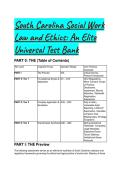
PART 0: THE (Table of Contents)
Tier Level Cognitive Focus Question Range Core Themes
Assessed
PART I The Preview N/A Critical Axioms,
Protocol Introduction
PART II: Tier 1 Foundational Syntax & Q1 – Q15 CEU Regulations,
Application Minor Consent, Scope
of Practice,
Disclosures,
Impairment, Record
Retention, Telehealth
Registration,
Subpoenas
PART II: Tier 2 Complex Application & Q16 – Q35 Duty to Warn,
Simulation Vulnerable Adult
Reporting, LISW-CP
Supervision, Interstate
Compact, Dual
Relationships, Privilege
Exceptions
PART II: Tier 3 Grandmaster Synthesis Q36 – Q60 Multi-jurisdictional
Telehealth, Competing
Legal Mandates,
Subpoena Duces
Tecum Defense,
Institutional Abuse
Protocols
PART I: THE Preview
The following assessment serves as an elite-level synthesis of South Carolina's statutory and
regulatory frameworks governing the ethical and legal practice of social work. Mastery of these
,legal boundaries translates directly to advanced clinical competence, mitigating liability, and
safeguarding public welfare in highly complex psychological and administrative environments.
● Jurisdictional Independence: A Licensed Master Social Worker (LMSW) is strictly
prohibited from private or independent practice; all clinical services in such settings
require Licensed Independent Social Worker-Clinical Practice (LISW-CP) credentialing.
● The Three-Year Prohibition: Sexual intimacy with a former client is explicitly prohibited
for a minimum of three years following the termination of clinical services.
● Age of Medical Consent: In South Carolina, a minor aged 16 years or older possesses
the statutory right to consent to health and mental health services independently,
excepting surgical operations.
● Permissive Duty to Warn: South Carolina establishes a permissive duty to warn only
when a specific threat of physical violence is directed toward a reasonably identifiable
victim, allowing limited disclosure.
● Mandatory Reporting Timelines: Suspicion of child or vulnerable adult abuse must be
reported within 24 hours or the next working day to the appropriate specific state agency
(e.g., DSS or SLED).
PART II: THE ELITE TEST BANK
Tier 1 - Foundational Syntax & Application
Q1: A Licensed Independent Social Worker - Clinical Practice (LISW-CP) submits
documentation for biennial license renewal. The practitioner completed 42 continuing education
(CE) hours: 39 hours of advanced clinical intervention training, 2 hours of professional ethics,
and 1 hour of general administrative updates. Based on the South Carolina Board of Social
Work Examiners continuing education regulations, which conclusion is the MOST ACCURATE?
A) The submission is acceptable because the total hours exceed the 40-hour biennial
requirement. B) The submission is rejected because the practitioner failed to meet the minimum
6-hour requirement for professional ethics. C) The submission is acceptable because clinical
intervention training legally substitutes for ethics requirements. D) The submission is rejected
because the practitioner failed to complete 15 hours of psychopharmacology.
● The Answer: B (The submission is rejected because the practitioner failed to meet the
minimum 6-hour requirement for professional ethics.)
● Distractor Analysis:
○ A is incorrect: While the total hours exceed 40, continuing education mandates
require precise categorical compliance.
○ C is incorrect: Clinical training cannot be legally substituted for dedicated
professional ethics coursework under state regulation.
○ D is incorrect: There is no 15-hour psychopharmacology requirement; however, 1
hour must be devoted to suicide assessment and management.
The Mentor's Analysis: Regulatory compliance is categorical, not cumulative. When facing
biennial license renewal, the immediate priority is verifying categorical minimums: exactly 40
total hours, of which 6 must be ethics, and 1 must be suicide assessment. By utilizing
categorical tracking, the practitioner bypasses the trap of failing an audit despite a surplus of
general hours. Professional/Academic Intuition: Surplus general hours never override
statutory categorical deficits.
Q2: A 16-year-old student independently seeks outpatient psychotherapy for severe anxiety.
,The adolescent requests that their parents not be informed. According to South Carolina
statutory law regarding minor consent, which action is the FIRST appropriate step? A) Refuse
treatment until parental consent is obtained, as minors under 18 cannot legally consent. B)
Initiate treatment, as a minor aged 16 or older may legally consent to health and mental health
services independently. C) Provide one emergency session, but mandate that parents be
notified within 24 hours. D) Require the minor to obtain a court order for emancipation before
proceeding.
● The Answer: B (Initiate treatment, as a minor aged 16 or older may legally consent to
health and mental health services independently.)
● Distractor Analysis:
○ A is incorrect: South Carolina Code § 63-5-340 legally empowers minors 16 and
older to consent to any health service other than operations.
○ C is incorrect: Arbitrarily overriding the minor's legal consent violates state statute
and professional ethics.
○ D is incorrect: Emancipation is unnecessary; the state statute explicitly grants
consent rights at age 16.
The Mentor's Analysis: Age variables dynamically alter informed consent architecture. When
facing a 16-year-old seeking care, the immediate priority is recognizing them as a fully
enfranchised medical decision-maker. By utilizing statutory age-of-consent rights, you bypass
the trap of unlawfully violating a minor's autonomy. Professional/Academic Intuition: In South
Carolina, the 16th birthday grants the legal authority to independently consent to outpatient
mental health treatment.
Q3: A Licensed Master Social Worker (LMSW) secures an office space, registers an LLC, and
begins accepting cash-pay clients while receiving weekly clinical supervision from an LISW-CP.
Under the South Carolina Social Work Practice Act, which statement is the MOST ACCURATE?
A) The practice is legal if the LMSW has a clinical supervision contract filed with the state board.
B) The practice is illegal because an LMSW is strictly prohibited from practicing in a private or
independent practice setting. C) The practice is legal provided the LMSW only accepts cash and
avoids third-party insurance billing. D) The practice is illegal because an LMSW must receive 4
hours of weekly supervision to operate an LLC.
● The Answer: B (The practice is illegal because an LMSW is strictly prohibited from
practicing in a private or independent practice setting.)
● Distractor Analysis:
○ A is incorrect: Filing a supervision contract does not grant an LMSW the authority to
own or operate a private practice.
○ C is incorrect: The method of reimbursement (cash vs. insurance) has no bearing
on the legal scope of practice.
○ D is incorrect: No amount of supervision legally authorizes an LMSW to operate an
independent practice.
The Mentor's Analysis: Licensure levels dictate environmental boundaries rigidly. When
operating as an LMSW, the immediate priority is securing employment within a structured
agency. By utilizing agency-based practice constraints, the practitioner bypasses the trap of
committing the unauthorized practice of independent social work. Professional/Academic
Intuition: An LMSW license is not a gateway to private practice; independent practice is the
exclusive domain of the LISW-CP.
Q4: A social worker provides a new client with a statement of professional disclosure outlining
their fee schedule, educational background, and areas of specialization. The Board later cites
the practitioner. Which essential, statutorily mandated element did the practitioner MOST
, LIKELY omit? A) A written guarantee of clinical outcomes. B) An explicit, written statement
denoting that sexual intimacy between a practitioner and a client is prohibited. C) A complete list
of all continuing education units completed over the past two years. D) The personal home
address of the practitioner's clinical supervisor.
● The Answer: B (An explicit, written statement denoting that sexual intimacy between a
practitioner and a client is prohibited.)
● Distractor Analysis:
○ A is incorrect: Guaranteeing outcomes is highly unethical and constitutes deceptive
practice.
○ C is incorrect: Clients are not required to receive continuing education audit logs.
○ D is incorrect: Disclosing a supervisor's private home address is not statutorily
mandated.
The Mentor's Analysis: Professional disclosure is a mechanism of structural transparency.
When drafting a disclosure statement, the immediate priority is integrating all elements
mandated by SC Code § 40-75-270, which uniquely requires boundary warnings. By utilizing
statutory disclosure templates, you bypass the trap of regulatory non-compliance.
Professional/Academic Intuition: The explicit written prohibition of sexual intimacy is a
non-negotiable legal requirement in all South Carolina professional disclosure statements.
Q5: A social worker observes a colleague repeatedly arriving at the agency smelling of alcohol
and demonstrating dangerously poor clinical judgment. Under South Carolina regulations, what
is the observing social worker's IMMEDIATE obligation? A) Confront the colleague privately to
protect the agency's reputation. B) Ignore the behavior, as substance abuse is protected by
privacy laws. C) Report the suspected impairment to the South Carolina Board of Social Work
Examiners within 48 hours. D) Contact the colleague's active clients to warn them of potential
negligence.
● The Answer: C (Report the suspected impairment to the South Carolina Board of Social
Work Examiners within 48 hours.)
● Distractor Analysis:
○ A is incorrect: Private confrontation does not satisfy the legal mandate to protect the
public.
○ B is incorrect: Clinical impairment overrides personal privacy when public safety is
threatened.
○ D is incorrect: Contacting clients directly causes widespread panic and circumvents
formal regulatory channels.
The Mentor's Analysis: Professional loyalty must never supersede public safety. When a
colleague demonstrates clear clinical impairment, the immediate priority is neutralizing the threat
by engaging regulatory channels within 48 hours. By utilizing official reporting mechanisms, you
bypass the trap of becoming complicit. Professional/Academic Intuition: South Carolina
regulations mandate that suspected impairment must be reported to the Board within 48 hours.
Q6: A client demands their entire clinical record be permanently destroyed. The client
successfully completed therapy four years ago. Based on South Carolina record retention
standards for adults, how should the practitioner FIRST respond? A) Comply with the demand
immediately to honor patient autonomy. B) Deny the request, as South Carolina law requires
that records be maintained for a minimum of five years after the last date of service. C) Mail the
sole copy of the record to the client. D) Transfer the records to the Department of Archives.
● The Answer: B (Deny the request, as South Carolina law requires that records be
maintained for a minimum of five years after the last date of service.)
● Distractor Analysis:
Law and Ethics: An Elite
Universal Test Bank
PART 0: THE (Table of Contents)
Tier Level Cognitive Focus Question Range Core Themes
Assessed
PART I The Preview N/A Critical Axioms,
Protocol Introduction
PART II: Tier 1 Foundational Syntax & Q1 – Q15 CEU Regulations,
Application Minor Consent, Scope
of Practice,
Disclosures,
Impairment, Record
Retention, Telehealth
Registration,
Subpoenas
PART II: Tier 2 Complex Application & Q16 – Q35 Duty to Warn,
Simulation Vulnerable Adult
Reporting, LISW-CP
Supervision, Interstate
Compact, Dual
Relationships, Privilege
Exceptions
PART II: Tier 3 Grandmaster Synthesis Q36 – Q60 Multi-jurisdictional
Telehealth, Competing
Legal Mandates,
Subpoena Duces
Tecum Defense,
Institutional Abuse
Protocols
PART I: THE Preview
The following assessment serves as an elite-level synthesis of South Carolina's statutory and
regulatory frameworks governing the ethical and legal practice of social work. Mastery of these
,legal boundaries translates directly to advanced clinical competence, mitigating liability, and
safeguarding public welfare in highly complex psychological and administrative environments.
● Jurisdictional Independence: A Licensed Master Social Worker (LMSW) is strictly
prohibited from private or independent practice; all clinical services in such settings
require Licensed Independent Social Worker-Clinical Practice (LISW-CP) credentialing.
● The Three-Year Prohibition: Sexual intimacy with a former client is explicitly prohibited
for a minimum of three years following the termination of clinical services.
● Age of Medical Consent: In South Carolina, a minor aged 16 years or older possesses
the statutory right to consent to health and mental health services independently,
excepting surgical operations.
● Permissive Duty to Warn: South Carolina establishes a permissive duty to warn only
when a specific threat of physical violence is directed toward a reasonably identifiable
victim, allowing limited disclosure.
● Mandatory Reporting Timelines: Suspicion of child or vulnerable adult abuse must be
reported within 24 hours or the next working day to the appropriate specific state agency
(e.g., DSS or SLED).
PART II: THE ELITE TEST BANK
Tier 1 - Foundational Syntax & Application
Q1: A Licensed Independent Social Worker - Clinical Practice (LISW-CP) submits
documentation for biennial license renewal. The practitioner completed 42 continuing education
(CE) hours: 39 hours of advanced clinical intervention training, 2 hours of professional ethics,
and 1 hour of general administrative updates. Based on the South Carolina Board of Social
Work Examiners continuing education regulations, which conclusion is the MOST ACCURATE?
A) The submission is acceptable because the total hours exceed the 40-hour biennial
requirement. B) The submission is rejected because the practitioner failed to meet the minimum
6-hour requirement for professional ethics. C) The submission is acceptable because clinical
intervention training legally substitutes for ethics requirements. D) The submission is rejected
because the practitioner failed to complete 15 hours of psychopharmacology.
● The Answer: B (The submission is rejected because the practitioner failed to meet the
minimum 6-hour requirement for professional ethics.)
● Distractor Analysis:
○ A is incorrect: While the total hours exceed 40, continuing education mandates
require precise categorical compliance.
○ C is incorrect: Clinical training cannot be legally substituted for dedicated
professional ethics coursework under state regulation.
○ D is incorrect: There is no 15-hour psychopharmacology requirement; however, 1
hour must be devoted to suicide assessment and management.
The Mentor's Analysis: Regulatory compliance is categorical, not cumulative. When facing
biennial license renewal, the immediate priority is verifying categorical minimums: exactly 40
total hours, of which 6 must be ethics, and 1 must be suicide assessment. By utilizing
categorical tracking, the practitioner bypasses the trap of failing an audit despite a surplus of
general hours. Professional/Academic Intuition: Surplus general hours never override
statutory categorical deficits.
Q2: A 16-year-old student independently seeks outpatient psychotherapy for severe anxiety.
,The adolescent requests that their parents not be informed. According to South Carolina
statutory law regarding minor consent, which action is the FIRST appropriate step? A) Refuse
treatment until parental consent is obtained, as minors under 18 cannot legally consent. B)
Initiate treatment, as a minor aged 16 or older may legally consent to health and mental health
services independently. C) Provide one emergency session, but mandate that parents be
notified within 24 hours. D) Require the minor to obtain a court order for emancipation before
proceeding.
● The Answer: B (Initiate treatment, as a minor aged 16 or older may legally consent to
health and mental health services independently.)
● Distractor Analysis:
○ A is incorrect: South Carolina Code § 63-5-340 legally empowers minors 16 and
older to consent to any health service other than operations.
○ C is incorrect: Arbitrarily overriding the minor's legal consent violates state statute
and professional ethics.
○ D is incorrect: Emancipation is unnecessary; the state statute explicitly grants
consent rights at age 16.
The Mentor's Analysis: Age variables dynamically alter informed consent architecture. When
facing a 16-year-old seeking care, the immediate priority is recognizing them as a fully
enfranchised medical decision-maker. By utilizing statutory age-of-consent rights, you bypass
the trap of unlawfully violating a minor's autonomy. Professional/Academic Intuition: In South
Carolina, the 16th birthday grants the legal authority to independently consent to outpatient
mental health treatment.
Q3: A Licensed Master Social Worker (LMSW) secures an office space, registers an LLC, and
begins accepting cash-pay clients while receiving weekly clinical supervision from an LISW-CP.
Under the South Carolina Social Work Practice Act, which statement is the MOST ACCURATE?
A) The practice is legal if the LMSW has a clinical supervision contract filed with the state board.
B) The practice is illegal because an LMSW is strictly prohibited from practicing in a private or
independent practice setting. C) The practice is legal provided the LMSW only accepts cash and
avoids third-party insurance billing. D) The practice is illegal because an LMSW must receive 4
hours of weekly supervision to operate an LLC.
● The Answer: B (The practice is illegal because an LMSW is strictly prohibited from
practicing in a private or independent practice setting.)
● Distractor Analysis:
○ A is incorrect: Filing a supervision contract does not grant an LMSW the authority to
own or operate a private practice.
○ C is incorrect: The method of reimbursement (cash vs. insurance) has no bearing
on the legal scope of practice.
○ D is incorrect: No amount of supervision legally authorizes an LMSW to operate an
independent practice.
The Mentor's Analysis: Licensure levels dictate environmental boundaries rigidly. When
operating as an LMSW, the immediate priority is securing employment within a structured
agency. By utilizing agency-based practice constraints, the practitioner bypasses the trap of
committing the unauthorized practice of independent social work. Professional/Academic
Intuition: An LMSW license is not a gateway to private practice; independent practice is the
exclusive domain of the LISW-CP.
Q4: A social worker provides a new client with a statement of professional disclosure outlining
their fee schedule, educational background, and areas of specialization. The Board later cites
the practitioner. Which essential, statutorily mandated element did the practitioner MOST
, LIKELY omit? A) A written guarantee of clinical outcomes. B) An explicit, written statement
denoting that sexual intimacy between a practitioner and a client is prohibited. C) A complete list
of all continuing education units completed over the past two years. D) The personal home
address of the practitioner's clinical supervisor.
● The Answer: B (An explicit, written statement denoting that sexual intimacy between a
practitioner and a client is prohibited.)
● Distractor Analysis:
○ A is incorrect: Guaranteeing outcomes is highly unethical and constitutes deceptive
practice.
○ C is incorrect: Clients are not required to receive continuing education audit logs.
○ D is incorrect: Disclosing a supervisor's private home address is not statutorily
mandated.
The Mentor's Analysis: Professional disclosure is a mechanism of structural transparency.
When drafting a disclosure statement, the immediate priority is integrating all elements
mandated by SC Code § 40-75-270, which uniquely requires boundary warnings. By utilizing
statutory disclosure templates, you bypass the trap of regulatory non-compliance.
Professional/Academic Intuition: The explicit written prohibition of sexual intimacy is a
non-negotiable legal requirement in all South Carolina professional disclosure statements.
Q5: A social worker observes a colleague repeatedly arriving at the agency smelling of alcohol
and demonstrating dangerously poor clinical judgment. Under South Carolina regulations, what
is the observing social worker's IMMEDIATE obligation? A) Confront the colleague privately to
protect the agency's reputation. B) Ignore the behavior, as substance abuse is protected by
privacy laws. C) Report the suspected impairment to the South Carolina Board of Social Work
Examiners within 48 hours. D) Contact the colleague's active clients to warn them of potential
negligence.
● The Answer: C (Report the suspected impairment to the South Carolina Board of Social
Work Examiners within 48 hours.)
● Distractor Analysis:
○ A is incorrect: Private confrontation does not satisfy the legal mandate to protect the
public.
○ B is incorrect: Clinical impairment overrides personal privacy when public safety is
threatened.
○ D is incorrect: Contacting clients directly causes widespread panic and circumvents
formal regulatory channels.
The Mentor's Analysis: Professional loyalty must never supersede public safety. When a
colleague demonstrates clear clinical impairment, the immediate priority is neutralizing the threat
by engaging regulatory channels within 48 hours. By utilizing official reporting mechanisms, you
bypass the trap of becoming complicit. Professional/Academic Intuition: South Carolina
regulations mandate that suspected impairment must be reported to the Board within 48 hours.
Q6: A client demands their entire clinical record be permanently destroyed. The client
successfully completed therapy four years ago. Based on South Carolina record retention
standards for adults, how should the practitioner FIRST respond? A) Comply with the demand
immediately to honor patient autonomy. B) Deny the request, as South Carolina law requires
that records be maintained for a minimum of five years after the last date of service. C) Mail the
sole copy of the record to the client. D) Transfer the records to the Department of Archives.
● The Answer: B (Deny the request, as South Carolina law requires that records be
maintained for a minimum of five years after the last date of service.)
● Distractor Analysis:


