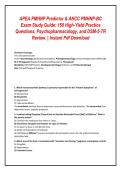
APEA PMHNP Predictor & ANCC PMHNP-BC
Exam Study Guide: 150 High-Yield Practice
Questions, Psychopharmacology, and DSM-5-TR
Review. | Instant Pdf Download
Overview Coverage:
This 150-question bank
covers Neurobiology (pathways/transmitters), Psychopharmacology (Lithium/Antipsychotics/NMS), DS
M-5-TR Diagnosis (Bipolar/Schizophrenia/Depression), Therapeutic
Modalities (CBT/DBT/Yalom), Developmental Stages (Erikson), and Professional/Legal
Role (Tarasoff/Scope of Practice).
1. Which neurotransmitter pathway is primarily responsible for the "Positive Symptoms" of
Schizophrenia?
A) Mesocortical
B) Mesolimbic
C) Nigrostriatal
D) Tuberoinfundibular
The mesolimbic pathway (excess dopamine) causes hallucinations and delusions. The mesocortical (low
dopamine) causes negative symptoms.
2. A patient taking Clozapine (Clozaril) has an Absolute Neutrophil Count (ANC) of 900/mm³. What is
the priority action?
A) Continue the medication but retest in 2 days
B) Discontinue Clozapine and monitor for signs of infection
C) Increase the dose to combat the drop
D) Switch to Risperidone immediately
An ANC below 1,000/mm³ requires immediate discontinuation due to the risk of life-threatening
agranulocytosis.
3. Which area of the brain is associated with "Executive Functioning," judgment, and impulse control?
A) Amygdala
B) Hippocampus
C) Prefrontal Cortex
,D) Basal Ganglia
The prefrontal cortex is the "CEO" of the brain; the amygdala handles raw emotion/fear.
4. A patient on Lithium presents with coarse tremors, confusion, and ataxia. Their lithium level is 2.1
mEq/L. This is:
A) A therapeutic level
B) Mild toxicity
C) Severe toxicity
D) Normal side effects
The therapeutic range is 0.6–1.2 mEq/L. Levels above 1.5 are toxic; levels above 2.0 are severe and can
be fatal.
5. Which antidepressant is the best choice for a patient with MDD who is concerned about weight
gain and sexual dysfunction?
A) Paroxetine (Paxil)
B) Bupropion (Wellbutrin)
C) Amitriptyline (Elavil)
D) Escitalopram (Lexapro)
Bupropion has the lowest risk of sexual side effects and weight gain among common antidepressants.
6. A patient taking an MAOI (e.g., Phenelzine) consumes a large amount of aged cheese and wine.
They are at risk for:
A) Serotonin Syndrome
B) Hypertensive Crisis
C) Neuroleptic Malignant Syndrome
D) Metabolic Syndrome
Tyramine-rich foods react with MAOIs to cause a massive release of norepinephrine, leading to
dangerous blood pressure spikes.
7. "EPS" (Extrapyramidal Symptoms) are caused by dopamine blockade in which pathway?
A) Mesolimbic
B) Mesocortical
C) Nigrostriatal
D) Tuberoinfundibular
Blockade in the nigrostriatal pathway leads to movement disorders like dystonia and parkinsonism.
8. Which medication is the "Gold Standard" for treating Bipolar Disorder with suicidal ideation?
A) Lithium
B) Valproic Acid
C) Lamotrigine
D) Quetiapine
Only Lithium and Clozapine have evidence-based results for reducing suicide risk in psychiatric
populations.
9. A patient taking Haloperidol (Haldol) develops high fever, lead-pipe muscle rigidity, and autonomic
instability. This is:
A) Serotonin Syndrome
, B) Tardive Dyskinesia
C) Neuroleptic Malignant Syndrome (NMS)
D) Acute Dystonia
NMS is characterized by "lead-pipe" rigidity and high fever (
). Serotonin syndrome features hyperreflexia and "wet" skin.
10. Which labs must be monitored for a patient starting Valproic Acid (Depakote)?
A) ANC and CBC
B) LFTs and CBC (platelets)
C) BUN and Creatinine
D) Lipid panel and A1C
Depakote can cause hepatotoxicity and thrombocytopenia (low platelets).
11. Lamotrigine (Lamictal) must be titrated slowly to avoid which life-threatening condition?
A) Agranulocytosis
B) Stevens-Johnson Syndrome (SJS)
C) Metabolic Syndrome
D) QT Prolongation
A fast titration of Lamotrigine significantly increases the risk of a dangerous necrotizing rash (SJS).
12. Which neurotransmitter is "Excitatory" and associated with neuroplasticity and memory?
A) GABA
B) Serotonin
C) Glutamate
D) Dopamine
Glutamate is the main excitatory neurotransmitter; GABA is the main inhibitory one.
13. A patient with a history of alcohol use disorder presents with confusion, ataxia, and nystagmus.
This suggests:
A) Alcohol Withdrawal
B) Delirium Tremens
C) Wernicke-Korsakoff Syndrome
D) Korsakoff Psychosis
Wernicke's is an acute thiamine (B1) deficiency. It is a medical emergency.
14. Which antidepressant is contraindicated in patients with a history of seizures or bulimia?
A) Fluoxetine
B) Sertraline
C) Bupropion
Exam Study Guide: 150 High-Yield Practice
Questions, Psychopharmacology, and DSM-5-TR
Review. | Instant Pdf Download
Overview Coverage:
This 150-question bank
covers Neurobiology (pathways/transmitters), Psychopharmacology (Lithium/Antipsychotics/NMS), DS
M-5-TR Diagnosis (Bipolar/Schizophrenia/Depression), Therapeutic
Modalities (CBT/DBT/Yalom), Developmental Stages (Erikson), and Professional/Legal
Role (Tarasoff/Scope of Practice).
1. Which neurotransmitter pathway is primarily responsible for the "Positive Symptoms" of
Schizophrenia?
A) Mesocortical
B) Mesolimbic
C) Nigrostriatal
D) Tuberoinfundibular
The mesolimbic pathway (excess dopamine) causes hallucinations and delusions. The mesocortical (low
dopamine) causes negative symptoms.
2. A patient taking Clozapine (Clozaril) has an Absolute Neutrophil Count (ANC) of 900/mm³. What is
the priority action?
A) Continue the medication but retest in 2 days
B) Discontinue Clozapine and monitor for signs of infection
C) Increase the dose to combat the drop
D) Switch to Risperidone immediately
An ANC below 1,000/mm³ requires immediate discontinuation due to the risk of life-threatening
agranulocytosis.
3. Which area of the brain is associated with "Executive Functioning," judgment, and impulse control?
A) Amygdala
B) Hippocampus
C) Prefrontal Cortex
,D) Basal Ganglia
The prefrontal cortex is the "CEO" of the brain; the amygdala handles raw emotion/fear.
4. A patient on Lithium presents with coarse tremors, confusion, and ataxia. Their lithium level is 2.1
mEq/L. This is:
A) A therapeutic level
B) Mild toxicity
C) Severe toxicity
D) Normal side effects
The therapeutic range is 0.6–1.2 mEq/L. Levels above 1.5 are toxic; levels above 2.0 are severe and can
be fatal.
5. Which antidepressant is the best choice for a patient with MDD who is concerned about weight
gain and sexual dysfunction?
A) Paroxetine (Paxil)
B) Bupropion (Wellbutrin)
C) Amitriptyline (Elavil)
D) Escitalopram (Lexapro)
Bupropion has the lowest risk of sexual side effects and weight gain among common antidepressants.
6. A patient taking an MAOI (e.g., Phenelzine) consumes a large amount of aged cheese and wine.
They are at risk for:
A) Serotonin Syndrome
B) Hypertensive Crisis
C) Neuroleptic Malignant Syndrome
D) Metabolic Syndrome
Tyramine-rich foods react with MAOIs to cause a massive release of norepinephrine, leading to
dangerous blood pressure spikes.
7. "EPS" (Extrapyramidal Symptoms) are caused by dopamine blockade in which pathway?
A) Mesolimbic
B) Mesocortical
C) Nigrostriatal
D) Tuberoinfundibular
Blockade in the nigrostriatal pathway leads to movement disorders like dystonia and parkinsonism.
8. Which medication is the "Gold Standard" for treating Bipolar Disorder with suicidal ideation?
A) Lithium
B) Valproic Acid
C) Lamotrigine
D) Quetiapine
Only Lithium and Clozapine have evidence-based results for reducing suicide risk in psychiatric
populations.
9. A patient taking Haloperidol (Haldol) develops high fever, lead-pipe muscle rigidity, and autonomic
instability. This is:
A) Serotonin Syndrome
, B) Tardive Dyskinesia
C) Neuroleptic Malignant Syndrome (NMS)
D) Acute Dystonia
NMS is characterized by "lead-pipe" rigidity and high fever (
). Serotonin syndrome features hyperreflexia and "wet" skin.
10. Which labs must be monitored for a patient starting Valproic Acid (Depakote)?
A) ANC and CBC
B) LFTs and CBC (platelets)
C) BUN and Creatinine
D) Lipid panel and A1C
Depakote can cause hepatotoxicity and thrombocytopenia (low platelets).
11. Lamotrigine (Lamictal) must be titrated slowly to avoid which life-threatening condition?
A) Agranulocytosis
B) Stevens-Johnson Syndrome (SJS)
C) Metabolic Syndrome
D) QT Prolongation
A fast titration of Lamotrigine significantly increases the risk of a dangerous necrotizing rash (SJS).
12. Which neurotransmitter is "Excitatory" and associated with neuroplasticity and memory?
A) GABA
B) Serotonin
C) Glutamate
D) Dopamine
Glutamate is the main excitatory neurotransmitter; GABA is the main inhibitory one.
13. A patient with a history of alcohol use disorder presents with confusion, ataxia, and nystagmus.
This suggests:
A) Alcohol Withdrawal
B) Delirium Tremens
C) Wernicke-Korsakoff Syndrome
D) Korsakoff Psychosis
Wernicke's is an acute thiamine (B1) deficiency. It is a medical emergency.
14. Which antidepressant is contraindicated in patients with a history of seizures or bulimia?
A) Fluoxetine
B) Sertraline
C) Bupropion