
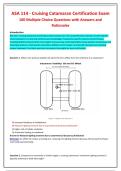
ASA 114 - Cruising Catamaran Certification Exam
100 Multiple Choice Questions with Answers and
Rationales
Introduction
ASA 114 - Cruising Catamaran Certification Exam practice set. This comprehensive collection of 100 multiple-
choice questions is to test and reinforce your knowledge of catamaran-specific systems and techniques,
including stability characteristics, twin-engine maneuvering, anchoring bridles, heavy-weather seamanship, and
docking procedures. Each question provides a bolded correct answer, an italicized rationale and a detailed
answer statement. Use these questions to prepare thoroughly for your certification.
Question 1. What is the primary stability risk when the CG is offset from the centerline in a catamaran?
Figure 1: diagram for Question 1
A) Increased tendency to hobbyhorse
B) Reduced righting moment due to asymmetrical buoyancy distribution
C) Higher risk of rudder cavitation
D) Automatic healing to windward
Answer B: Reduced righting moment due to asymmetrical buoyancy distribution
Rationale: An offset CG creates a heeling arm, reducing net righting moment because the leeward hull bears
more load asymmetrically.
Question 2. Compared to monohulls of similar length, a cruising catamaran's maximum righting moment is
typically achieved at what heel angle?
, A) 45-60°
B) 10-15°
C) 30-40°
D) 0-5°
Answer B: 10-15°
Rationale: Catamarans have high initial stability but reach maximum righting moment at low heel angles (10-
15°) before capsize risk rises sharply.
Question 3. What is the primary structural purpose of the trampoline netting between hulls?
Figure 3: diagram for Question 3
A) To increase interior ventilation
B) To prevent torsional flexing of the bridge deck
C) To store lightweight fenders
D) To serve as a secondary helm station
Answer B: To prevent torsional flexing of the bridge deck
Rationale: The trampoline acts as a tension diaphragm, resisting racking (torsional) loads that would otherwise
deform the bridge deck structure.
Question 4. While underway in a twin-engine catamaran, you experience a complete loss of steering (rudders
jammed amidships). How should you maintain directional control?
A) Use asymmetric sail trim only
B) Apply differential throttle - advance one engine, idle the other
C) Drop both anchors immediately
D) Deploy a sea anchor from the bow
, Answer B: Apply differential throttle - advance one engine, idle the other
Rationale: Differential thrust creates a turning moment that replaces rudder authority, allowing controlled
steering even with jammed rudders.
Question 5. You are docking a catamaran in a 20-knot crosswind blowing onto the slip. Which engine
configuration gives the best lateral control without sliding?
A) Both engines in forward, rudders centered
B) Inboard engine forward, outboard engine reverse
C) Both engines in reverse with high RPM
D) Outboard engine only, rudder hard to windward
Answer B: Inboard engine forward, outboard engine reverse
Rationale: The opposing thrust vectors create a pivot point near the center of the boat, countering wind lift
and enabling precise lateral movement.
Question 6. What is the recommended length ratio (bridle leg : water depth) when setting an anchoring bridle
for a catamaran?
A) 2:1
B) 5:1 to 7:1
C) 10:1
D) 1:1
Answer B: 5:1 to 7:1
Rationale: A 5:1 to 7:1 ratio minimizes vertical lift on the anchor and reduces yawing, while keeping the bridle
apex low for proper load distribution.
Question 7. What included angle between the two bridle legs most effectively reduces snatch loads in waves?
100 Multiple Choice Questions with Answers and
Rationales
Introduction
ASA 114 - Cruising Catamaran Certification Exam practice set. This comprehensive collection of 100 multiple-
choice questions is to test and reinforce your knowledge of catamaran-specific systems and techniques,
including stability characteristics, twin-engine maneuvering, anchoring bridles, heavy-weather seamanship, and
docking procedures. Each question provides a bolded correct answer, an italicized rationale and a detailed
answer statement. Use these questions to prepare thoroughly for your certification.
Question 1. What is the primary stability risk when the CG is offset from the centerline in a catamaran?
Figure 1: diagram for Question 1
A) Increased tendency to hobbyhorse
B) Reduced righting moment due to asymmetrical buoyancy distribution
C) Higher risk of rudder cavitation
D) Automatic healing to windward
Answer B: Reduced righting moment due to asymmetrical buoyancy distribution
Rationale: An offset CG creates a heeling arm, reducing net righting moment because the leeward hull bears
more load asymmetrically.
Question 2. Compared to monohulls of similar length, a cruising catamaran's maximum righting moment is
typically achieved at what heel angle?
, A) 45-60°
B) 10-15°
C) 30-40°
D) 0-5°
Answer B: 10-15°
Rationale: Catamarans have high initial stability but reach maximum righting moment at low heel angles (10-
15°) before capsize risk rises sharply.
Question 3. What is the primary structural purpose of the trampoline netting between hulls?
Figure 3: diagram for Question 3
A) To increase interior ventilation
B) To prevent torsional flexing of the bridge deck
C) To store lightweight fenders
D) To serve as a secondary helm station
Answer B: To prevent torsional flexing of the bridge deck
Rationale: The trampoline acts as a tension diaphragm, resisting racking (torsional) loads that would otherwise
deform the bridge deck structure.
Question 4. While underway in a twin-engine catamaran, you experience a complete loss of steering (rudders
jammed amidships). How should you maintain directional control?
A) Use asymmetric sail trim only
B) Apply differential throttle - advance one engine, idle the other
C) Drop both anchors immediately
D) Deploy a sea anchor from the bow
, Answer B: Apply differential throttle - advance one engine, idle the other
Rationale: Differential thrust creates a turning moment that replaces rudder authority, allowing controlled
steering even with jammed rudders.
Question 5. You are docking a catamaran in a 20-knot crosswind blowing onto the slip. Which engine
configuration gives the best lateral control without sliding?
A) Both engines in forward, rudders centered
B) Inboard engine forward, outboard engine reverse
C) Both engines in reverse with high RPM
D) Outboard engine only, rudder hard to windward
Answer B: Inboard engine forward, outboard engine reverse
Rationale: The opposing thrust vectors create a pivot point near the center of the boat, countering wind lift
and enabling precise lateral movement.
Question 6. What is the recommended length ratio (bridle leg : water depth) when setting an anchoring bridle
for a catamaran?
A) 2:1
B) 5:1 to 7:1
C) 10:1
D) 1:1
Answer B: 5:1 to 7:1
Rationale: A 5:1 to 7:1 ratio minimizes vertical lift on the anchor and reduces yawing, while keeping the bridle
apex low for proper load distribution.
Question 7. What included angle between the two bridle legs most effectively reduces snatch loads in waves?


