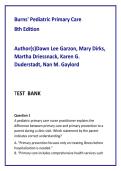
Burns' Pediatric Primary Care
8th Edition
Author(s)Dawn Lee Garzon, Mary Dirks,
Martha Driessnack, Karen G.
Duderstadt, Nan M. Gaylord
TEST BANK
Question 1
A pediatric primary care nurse practitioner is explaining the role
of pediatric primary care to a parent. Which statement best
describes pediatric primary care?
A. It focuses only on treatment of acute childhood illnesses
B. It provides comprehensive, continuous care that includes
prevention and health promotion
,C. It is limited to referral of complex conditions to specialists
D. It primarily addresses emergency stabilization of children
Correct Answer: B
Rationale:
Pediatric primary care emphasizes comprehensive and
continuous care that includes health promotion, disease
prevention, developmental surveillance, and management of
acute and chronic conditions.
• A is incorrect because pediatric primary care extends
beyond acute illness treatment.
• C is incorrect because management, not only referral, is
central.
• D is incorrect because emergency care is not the primary
focus of pediatric primary care.
Source:
Burns’ Pediatric Primary Care, 8th Edition – Chapter 1: Pediatric
Primary Care
Question 2
Which activity is an example of primary prevention in pediatric
care?
A. Performing a hearing screening at a well-child visit
B. Administering routine childhood immunizations
,C. Managing asthma with inhaled corticosteroids
D. Referring a child for developmental therapy
Correct Answer: B
Rationale:
Primary prevention aims to prevent disease before it occurs;
immunizations are a classic example.
• A is secondary prevention because it identifies problems
early.
• C is tertiary prevention involving chronic disease
management.
• D is intervention after a condition has been identified.
Source:
Burns’ Pediatric Primary Care, 8th Edition – Chapter 1: Pediatric
Primary Care
Question 3
A nurse practitioner recognizes that caring for a pediatric
patient often involves a “dual patient” concept. This means the
clinician must consider:
A. The child and school nurse
B. The child and healthcare payer
C. The child and parent or caregiver
D. The child and specialist physician
Correct Answer: C
, Rationale:
The two-generation or dual-patient model recognizes that care
often involves both the child and the parent/caregiver, whose
health and well-being affect the child.
• A, B, and D do not represent the textbook’s dual-patient
concept.
Source:
Burns’ Pediatric Primary Care, 8th Edition – Chapter 1: Pediatric
Primary Care
Question 4
Which factor most distinguishes pediatric primary care from
adult primary care?
A. Frequent use of radiographic studies
B. Consideration of developmental stage in assessment
C. Greater use of surgical intervention
D. Reduced caregiver involvement
Correct Answer: B
Rationale:
Children must be assessed in relation to age and developmental
stage because normal findings vary across childhood.
• A is not unique to pediatrics.
• C is incorrect because surgery is not a defining difference.
8th Edition
Author(s)Dawn Lee Garzon, Mary Dirks,
Martha Driessnack, Karen G.
Duderstadt, Nan M. Gaylord
TEST BANK
Question 1
A pediatric primary care nurse practitioner is explaining the role
of pediatric primary care to a parent. Which statement best
describes pediatric primary care?
A. It focuses only on treatment of acute childhood illnesses
B. It provides comprehensive, continuous care that includes
prevention and health promotion
,C. It is limited to referral of complex conditions to specialists
D. It primarily addresses emergency stabilization of children
Correct Answer: B
Rationale:
Pediatric primary care emphasizes comprehensive and
continuous care that includes health promotion, disease
prevention, developmental surveillance, and management of
acute and chronic conditions.
• A is incorrect because pediatric primary care extends
beyond acute illness treatment.
• C is incorrect because management, not only referral, is
central.
• D is incorrect because emergency care is not the primary
focus of pediatric primary care.
Source:
Burns’ Pediatric Primary Care, 8th Edition – Chapter 1: Pediatric
Primary Care
Question 2
Which activity is an example of primary prevention in pediatric
care?
A. Performing a hearing screening at a well-child visit
B. Administering routine childhood immunizations
,C. Managing asthma with inhaled corticosteroids
D. Referring a child for developmental therapy
Correct Answer: B
Rationale:
Primary prevention aims to prevent disease before it occurs;
immunizations are a classic example.
• A is secondary prevention because it identifies problems
early.
• C is tertiary prevention involving chronic disease
management.
• D is intervention after a condition has been identified.
Source:
Burns’ Pediatric Primary Care, 8th Edition – Chapter 1: Pediatric
Primary Care
Question 3
A nurse practitioner recognizes that caring for a pediatric
patient often involves a “dual patient” concept. This means the
clinician must consider:
A. The child and school nurse
B. The child and healthcare payer
C. The child and parent or caregiver
D. The child and specialist physician
Correct Answer: C
, Rationale:
The two-generation or dual-patient model recognizes that care
often involves both the child and the parent/caregiver, whose
health and well-being affect the child.
• A, B, and D do not represent the textbook’s dual-patient
concept.
Source:
Burns’ Pediatric Primary Care, 8th Edition – Chapter 1: Pediatric
Primary Care
Question 4
Which factor most distinguishes pediatric primary care from
adult primary care?
A. Frequent use of radiographic studies
B. Consideration of developmental stage in assessment
C. Greater use of surgical intervention
D. Reduced caregiver involvement
Correct Answer: B
Rationale:
Children must be assessed in relation to age and developmental
stage because normal findings vary across childhood.
• A is not unique to pediatrics.
• C is incorrect because surgery is not a defining difference.