

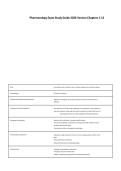
Pharmacology Exam Study Guide 2026 Version Chapters 1-13
Drug Any substance that is taken to cure, or reduce symptoms of a medical condition.
Pharmacology The study of medicine.
Pharmacotherapy/Pharmacotherapeutics Application of drugs for the purpose of disease prevention and treatment of
suffering.
Indications and Contraindications The conditions for which a drug is approved are its indications. Every drug has at
least one indication. Some drugs are used for conditions for which they have not
been approved; these are called unlabeled or off-label indications.
Therapeutic classification -Based on their usefulness in treating a specific disease
-The key to therapeutic classification is to simply state what condition is being
treated by the particular drug.
-The prefix anti-refers to therapeutic classification.
Pharmacologic Classification -Addresses a drugs mechanism of action or how a drug produces its effect in the
body.
-More specific than therapeutic
-Requires biochemistry and pathophysiology
Chemical name -Assigned using standard nomenclature.
-A drug has only one chemical name
-Helpful in predicting a drugs physical and chemical properties.
, Generic name Name assigned by the United States Adopted Name Council.
Less complicated and easy to remember.
Trade Name Sometimes called the proprietary product, or brand name is assigned by the
pharmaceutical company maketing the drug.
Exclusivity Typical length of exclusivity for a new drug is 5 years.
Combination drug Drugs with more than one active generic ingredient.
Pros and Cons of Generic Drugs Generic drugs are less expensive than brand name drugs, by they may differ in
bioavailability. (The rate at which drug produces its effect.)
The nurses responsibility for knowledge in regards to
Is what drug is ordered including name and drug classificationintended or proposed used,effects on
pharmacotherapeutics.. the body,contraindications,special considerations (how age,weight,body fat distribution, and
pathophysiologic states affect pharmacotheraputic response),expected and potential adverse events,
why the drug was prescribed how the drug is supplied by the pharmacy, administration of the drug,
and what considerations apply to the patient.
The major goal to study pharmacology... is to eliminate medication errors and to limit the number and severity of adverse drug events.
To prevent medication errors RN's can Routinely apply their experience and knowledge of pharmacotherapeutics to clinical practice. It
is vital the nurse be prepared to cognized and respond to potential adverse effects of the
medication.
Pharmacotherapy and the older adult Normal aging processes can alter pharmacokinetic and pharmacodynamics responses to
(pharmokinetic and pharmodynamics). drugs.
Pharmacotherapy and the older adult Overall, absorption of nutrients and drugs tend to slow with aging.
(absorption)
Pharmacotherapy and the older adult (plasma levels drug
concentration in tissues) Age related increases in fat storage cause lipid soluble drugs to be stored in the body for extended
periods, leading to lower plasma levels and increased drug concentrations in the tissues.
Age related changes in the liver Include reduced hepatic function, decreased liver mass, diminished blood flow,and
alteration in the activity of hepatic enzymes.
Frequency of administration for older adults Should be decreased to avoid toxicity due to drug accumulation.
Older adults and receptors Pharmacodynamic changes are usually associated with drug receptors.Evidence suggests that
older adults have a decreased number of receptors.
The government agency that is responsible for regulating drugs in FDA-Food and Drug Administration.
the United States. o Protect the public health.
o Speeding innovations that make medicines and food more effective.
o Helping the public get more accurate information.
Drug Any substance that is taken to cure, or reduce symptoms of a medical condition.
Pharmacology The study of medicine.
Pharmacotherapy/Pharmacotherapeutics Application of drugs for the purpose of disease prevention and treatment of
suffering.
Indications and Contraindications The conditions for which a drug is approved are its indications. Every drug has at
least one indication. Some drugs are used for conditions for which they have not
been approved; these are called unlabeled or off-label indications.
Therapeutic classification -Based on their usefulness in treating a specific disease
-The key to therapeutic classification is to simply state what condition is being
treated by the particular drug.
-The prefix anti-refers to therapeutic classification.
Pharmacologic Classification -Addresses a drugs mechanism of action or how a drug produces its effect in the
body.
-More specific than therapeutic
-Requires biochemistry and pathophysiology
Chemical name -Assigned using standard nomenclature.
-A drug has only one chemical name
-Helpful in predicting a drugs physical and chemical properties.
, Generic name Name assigned by the United States Adopted Name Council.
Less complicated and easy to remember.
Trade Name Sometimes called the proprietary product, or brand name is assigned by the
pharmaceutical company maketing the drug.
Exclusivity Typical length of exclusivity for a new drug is 5 years.
Combination drug Drugs with more than one active generic ingredient.
Pros and Cons of Generic Drugs Generic drugs are less expensive than brand name drugs, by they may differ in
bioavailability. (The rate at which drug produces its effect.)
The nurses responsibility for knowledge in regards to
Is what drug is ordered including name and drug classificationintended or proposed used,effects on
pharmacotherapeutics.. the body,contraindications,special considerations (how age,weight,body fat distribution, and
pathophysiologic states affect pharmacotheraputic response),expected and potential adverse events,
why the drug was prescribed how the drug is supplied by the pharmacy, administration of the drug,
and what considerations apply to the patient.
The major goal to study pharmacology... is to eliminate medication errors and to limit the number and severity of adverse drug events.
To prevent medication errors RN's can Routinely apply their experience and knowledge of pharmacotherapeutics to clinical practice. It
is vital the nurse be prepared to cognized and respond to potential adverse effects of the
medication.
Pharmacotherapy and the older adult Normal aging processes can alter pharmacokinetic and pharmacodynamics responses to
(pharmokinetic and pharmodynamics). drugs.
Pharmacotherapy and the older adult Overall, absorption of nutrients and drugs tend to slow with aging.
(absorption)
Pharmacotherapy and the older adult (plasma levels drug
concentration in tissues) Age related increases in fat storage cause lipid soluble drugs to be stored in the body for extended
periods, leading to lower plasma levels and increased drug concentrations in the tissues.
Age related changes in the liver Include reduced hepatic function, decreased liver mass, diminished blood flow,and
alteration in the activity of hepatic enzymes.
Frequency of administration for older adults Should be decreased to avoid toxicity due to drug accumulation.
Older adults and receptors Pharmacodynamic changes are usually associated with drug receptors.Evidence suggests that
older adults have a decreased number of receptors.
The government agency that is responsible for regulating drugs in FDA-Food and Drug Administration.
the United States. o Protect the public health.
o Speeding innovations that make medicines and food more effective.
o Helping the public get more accurate information.


