

Analytical Chemistry Hage/Carr
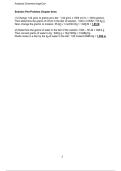
Solution Pen-Problem Chapter three
(1) Change 1.04 g/mL to grams per Liter: 1.04 g/mL x 1000 mL/1L = 1004 grams/L.
Then determine the grams of CH2O in the liter of solution: 1004 x 0.0552 = 55.42 g
Next, change the gram/L to moles/L: 55.42 x 1 mol/30.03g = 1.846 M = 1.85 M
(2) Determine the grams of water in the liter of the solution: 1004 – 55.42 = 948.6 g.
Then convert grams of water to kg: 948.6 g x 1Kg/1000g = 0.9486 Kg.
Divide moles in a liter by the kg of water in the liter: 1.85 moles/0.9486 Kg = 1.950 m
2
, Pen Problem Chapter 4
SOLUTIONS TO PEN PROBLEM CHAPTER 4:
(A) The value for five data points found for 99% confidence level in Table 4.9 is 0.959. The
experimental value for r (0.99) exceeds the table value therefore there is a 99% confidence that
the calculated line of best-fit does represent the data.
(B) Y1 = 0.0067 (410) – 2.4 = 0.347
Y2 = 0.0067 (420) – 2.4 = 0.414
Y3 = 0.0067 (440) – 2.4 = 0.548
Y4 = 0.0067 (450) – 2.4 = 0.615
Y5 = 0.0067 (500) – 2.4 = 0.950
(C) Residual values (Measured absorbance – calculated absorbance)
0.40 - .347 = +0.05
0.45 - .414 = +0.04
0.55 - .550 = 0
0.60 – 0.615 = - 0.02
1.0 – 0.95 = + 0.05
(D) The graph of this data (residual versus mg quercetin) reveals a non-random pattern. This
suggested pattern indicates a problem, for at least this range of the data, in assuming that the
linear line of best-fit should be used to represent this data. To be considered supportive of the
linear fit model, the residual graph should show a random pattern.
, Pen Problem Ch 5
SOLUTIONS FOR PEN PROBLEM Chapter 5
(A) sy = [(y – mx + b)2/n-2]1/2
(0.10 – 0.020(5.0) +0.0092)2 = 0.000085
(0.20 – 0.02(10.0) + 0.0092)2 = 0.000085
(0.39 – 0.02(20.0) + 0.0092)2 = 0.000369
(0.75 – 0.02(40.0) + 0.0092)2 = 0.00351
(1.60 – 0.020(80.0) + 0.0092)2 = 0.000085
0.00413;
0.00413/(5-2) = 0.001378
(0.00138)1/2 = 0.0371
(B) sb = ((xi2)/[nxi2 – (xi)2])1/2sy (See Table 4.8 for review of this equation)
= ((8525)/[5(8525) – (155)2])1/2 (0.037) = 0.0163
(C) Determine limit of detection (LOD) = 3.3 (sb/m) = 3.3 (0.0163/0.020) = 2.7 ppb. Since the
LOD for this technique is above 1 ppb this technique would not be suitable for determinations
below 1 ppb.
(D) LOQ = 10 (sb/m) = 10 (0.037/0.020) = 8.2 ppb
Solution Pen-Problem Chapter three
(1) Change 1.04 g/mL to grams per Liter: 1.04 g/mL x 1000 mL/1L = 1004 grams/L.
Then determine the grams of CH2O in the liter of solution: 1004 x 0.0552 = 55.42 g
Next, change the gram/L to moles/L: 55.42 x 1 mol/30.03g = 1.846 M = 1.85 M
(2) Determine the grams of water in the liter of the solution: 1004 – 55.42 = 948.6 g.
Then convert grams of water to kg: 948.6 g x 1Kg/1000g = 0.9486 Kg.
Divide moles in a liter by the kg of water in the liter: 1.85 moles/0.9486 Kg = 1.950 m
2
, Pen Problem Chapter 4
SOLUTIONS TO PEN PROBLEM CHAPTER 4:
(A) The value for five data points found for 99% confidence level in Table 4.9 is 0.959. The
experimental value for r (0.99) exceeds the table value therefore there is a 99% confidence that
the calculated line of best-fit does represent the data.
(B) Y1 = 0.0067 (410) – 2.4 = 0.347
Y2 = 0.0067 (420) – 2.4 = 0.414
Y3 = 0.0067 (440) – 2.4 = 0.548
Y4 = 0.0067 (450) – 2.4 = 0.615
Y5 = 0.0067 (500) – 2.4 = 0.950
(C) Residual values (Measured absorbance – calculated absorbance)
0.40 - .347 = +0.05
0.45 - .414 = +0.04
0.55 - .550 = 0
0.60 – 0.615 = - 0.02
1.0 – 0.95 = + 0.05
(D) The graph of this data (residual versus mg quercetin) reveals a non-random pattern. This
suggested pattern indicates a problem, for at least this range of the data, in assuming that the
linear line of best-fit should be used to represent this data. To be considered supportive of the
linear fit model, the residual graph should show a random pattern.
, Pen Problem Ch 5
SOLUTIONS FOR PEN PROBLEM Chapter 5
(A) sy = [(y – mx + b)2/n-2]1/2
(0.10 – 0.020(5.0) +0.0092)2 = 0.000085
(0.20 – 0.02(10.0) + 0.0092)2 = 0.000085
(0.39 – 0.02(20.0) + 0.0092)2 = 0.000369
(0.75 – 0.02(40.0) + 0.0092)2 = 0.00351
(1.60 – 0.020(80.0) + 0.0092)2 = 0.000085
0.00413;
0.00413/(5-2) = 0.001378
(0.00138)1/2 = 0.0371
(B) sb = ((xi2)/[nxi2 – (xi)2])1/2sy (See Table 4.8 for review of this equation)
= ((8525)/[5(8525) – (155)2])1/2 (0.037) = 0.0163
(C) Determine limit of detection (LOD) = 3.3 (sb/m) = 3.3 (0.0163/0.020) = 2.7 ppb. Since the
LOD for this technique is above 1 ppb this technique would not be suitable for determinations
below 1 ppb.
(D) LOQ = 10 (sb/m) = 10 (0.037/0.020) = 8.2 ppb


