
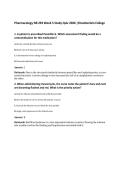
Pharmacology NR 293 Week 5 Study Quiz 2026 |Chamberlain College
1. A patient is prescribed Penicillin G. Which assessment finding would be a
contraindication for this medication?
A. History of mild diarrhea with previous use
B. Heart rate of 65 beats per minute
C. A documented severe allergy to cephalosporins
D. Elevated white blood cell count
Answer: C
Rationale: Due to the structural similarity between penicillins and cephalosporins, a cross-
sensitivity exists. A severe allergy to one increases the risk of an anaphylactic reaction to
the other.
2. When administering Vancomycin, the nurse notes the patient’s face and neck
are becoming flushed and red. What is the priority action?
A. Stop the infusion immediately and notify the provider
B. Slow the infusion rate to at least 60 minutes or more
C. Increase the infusion rate to finish the dose quickly
D. Apply cold compresses to the flushed areas
Answer: B
Rationale: Red Man Syndrome is a rate-dependent infusion reaction. Slowing the infusion
rate usually resolves the flushing and hypotension associated with it.
,3. Which teaching point is most important for a patient taking Tetracycline?
A. Take the medication with a glass of milk to prevent GI upset
B. Expect your urine to turn bright orange
C. Stop the medication as soon as symptoms disappear
D. Avoid direct sunlight and use sunscreen
Answer: D
Rationale: Tetracyclines cause photosensitivity. Patients should also avoid dairy products
as they interfere with absorption, but photosensitivity is a major safety concern.
4. A patient is receiving Gentamicin. Which laboratory values must the nurse
monitor closely?
A. Serum sodium and potassium
B. Blood urea nitrogen (BUN) and creatinine
C. Hemoglobin and hematocrit
D. Prothrombin time (PT) and INR
Answer: B
Rationale: Aminoglycosides like Gentamicin are highly nephrotoxic. Monitoring renal
function (BUN and Creatinine) is essential to prevent kidney damage.
5. What is the primary rationale for obtaining a wound culture before starting
the first dose of a broad-spectrum antibiotic?
A. To identify the specific organism and its sensitivity
B. To ensure the patient is not allergic to the drug
C. To determine the patient’s baseline kidney function
D. To prevent the development of a superinfection
Answer: A
Rationale: Cultures should be obtained before starting antibiotics so the organism can be
accurately identified and the most effective (narrow-spectrum) drug can be selected.
, 6. A patient on Rifampin for tuberculosis calls the clinic reporting that their tears
and urine are orange. What should the nurse tell the patient?
A. Stop the medication and go to the emergency room
B. This is a normal and harmless side effect of the medication
C. Increase your fluid intake to flush the drug out
D. This indicates your liver is failing
Answer: B
Rationale: Rifampin commonly causes a harmless reddish-orange discoloration of urine,
sweat, tears, and saliva.
7. Which medication is commonly prescribed alongside Isoniazid (INH) to
prevent peripheral neuropathy?
A. Vitamin C
B. Vitamin B12
C. Vitamin B6 (Pyridoxine)
D. Folic acid
Answer: C
Rationale: INH can cause peripheral neuropathy by depleting Vitamin B6;
supplementation is used as a preventative measure.
8. A patient is prescribed Ciprofloxacin. Which side effect should the nurse
instruct the patient to report immediately?
A. Brown-colored urine
B. Nausea after taking the pill
C. Increased hunger and thirst
D. Tenderness or pain in the Achilles tendon area
Answer: D
Rationale: Fluoroquinolones carry a black box warning for the risk of tendon rupture,
particularly the Achilles tendon.


