
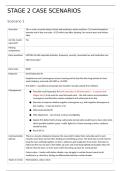
STAGE 2 CASE SCENARIOS
Scenario 1
Overview: 18-y-o male currently doing A levels and wanting to study medicine. C/o frontal headaches
towards end of day over past ~3/52 which stop after sleeping. No current specs and visions
okay.
Are the results Yes
expected?
Missing
components:
Extra questions: LOFTSEA of HAS especially duration, frequency, severity, associated sxs and medication use
VDU hours/day?
Extra tests: RAPD
Diagnosis: Small hyperopic Rx
Esophoria at near (convergence excess) causing end of day HAs after long periods of close
work/studying, removed with 2BO or +0.50DS
R/G defect – classified as protanope but shouldn’t actually classify from Ishihara
Management:
● Prescribe small hyperopic Rx (with extra plus +0.50 binocularly? – or eyezen/anti-
fatigue lens?) to be used for nead focussed work – this will reduce accommodative
convergence and therefore reduce esophoria and asthenopia from this
● Exercises to improve relative negative convergence e.g. with negative stereogram or
bar reading – 5 mins 2x day for 1/12
● VDU breaks 20/20/20
● VDU adjustment – size of task, contrast and lighting
● Explain R/G defect fairly strong, advise jobs (certain jobs would have to have extra tests
which possibly wouldn’t pass) + traffic lights for if starts learning to drive, medicine
should be okay
● Recall 24/12
Communication There is a muscle imbalance between the eyes which makes them naturally want to turn
with px: inwards more than normal when looking at something up close. The brain has to work hard to
keep the eyes working together so after a while you get headaches from strain. Exercises to
help train the eyes to stay in line better up close and small long-sighted prescription that will
help to relax the eyes, so to be worn when focussing up close for a long period.
Colour vision – harder with darker shades, may struggle in certain classes (wants to do
medicine) e.g. chemistry, biology to differentiate between certain shades.
Topics to revise: Heterophoria, colour vision
,Scenario 2
Overview: 5-y-o boy who has just started reception and Mum has noticed a turn in RE during near work or
at end of day. Also family history of amblyopia and was delivered with forceps so risk factors.
On examination high +ve Rx was found with anisometropia (higher +ve RE), with RE SOT bigger
at near unaided then only ortho(phoria) when fully corrected.
Are the results Yes as increase in near work with Rx producing strabismus, though Rx seems too high for a
expected? fully-accommodative esotropia
Missing Cyclopentolate expiry date and batch number and time
components:
Motility – smooth, pain, diplopia?
Near esophoria with Rx – size, recovery
Extra questions: C/o diplopia/HAs?
How long been noticing turn and which way?
Extra tests: Stereopsis – to judge improvement later tests
Hirschberg
10/20PD test
Dynamic retinoscopy and convergence next test as couldn’t do after cyclo
Diagnosis: Fully-accommodative esotropia due to convergence from accommodating through high Rx
High anisometropic Rx
RE amblyopia from RE SOT
Management:
● Prescribe full Rx to control RE SOT, needs adaptation, can expect to wear specs for life
● Referral to orthoptics for LE patching to bring vision RE up (needs to be done before
end of plastic period) and possible eye exercises – negative stereogram and fusional
reserves exercises with BI prism
● Recall 12/12 as referring to HES
Communication Child is very long-sighted but as young trying to compensate for this but this causes the eyes to
with px: overwork and stop working together and the RE is turning inwards, the system gives up easier
when looking close up or at the end of the day. Because the RE has been turning in it hasn’t
been used as much as LE so vision is weaker. When given full Rx it stops the eyes overworking
so the RE doesn’t turn. However to bring the vision in RE up will need to refer to orthoptics
who will likely put patch over LE to force the child to the use the RE to bring the vision up, may
also undertake some eye exercises. Important gets seen at hospital while still young.
Topics to revise: Childhood strabismus, anisometropia, high Rx dispense, child dispense + GOS entitlements
Scenario 3
,Overview: 48-y-o female c/o vision reduced dramatically, struggling to read travel books and read
train/airport board information when travelling. Currently using a speech synthesis and
enlargement software and CCTV at work. Diagnosed with diabetes T2 16 years ago which is
poorly controlled and has had extensive laser surgery for diabetic retinopathy
Are the results Unsure why central vision so poor
expected?
Peripheral vision down due to DR laser scarring.
Missing New WD with +4.00D should be 25cm not 20cm
components:
Extra questions: LOFTSEA for vision decrease – sudden/gradual, central peripheral, which eye?
Under HES/diabetic screening for DR? How often?
Been seen at a low vision service? Registered as sight impaired?
Burns? Falls? Okay taking medication - esp injections?
Extra tests: Fields – either confrontation or suprathreshold (increase stimulus size)
Amsler
OCT to check for DMO
Diagnosis: Diabetic retinopathy and scarring from laser surgery causing reduced peripheral and central
vision
Management:
● Rx update for near add – suggest sep pairs rather than varis due to mobility problems
as higher near add
● Referral to low vision service if not already on it. Discuss SSI registration (depending on
fields).
● Hand mag for travel books, stand mag for correspondence/classes – mag: say aiming
for N8 and include acuity reserve as needs to be sustained, 18/(8/3) = x6-7, telescope
for travel boards (glalilean as lighter and more portable)
● Other non-optical aids e.g. talking books, contrast, bumpons, large print
correspondence,
● Adv lighting and contrast
● Recall 12/12 + Amsler to monitor central vision
Communication Check understanding of diabetic changes in eye and treatment.
with px:
Need to explain how to use LVAs, especially WD and mag: hand mag – find focal length from
page, se with DV specs, stand mag – hold against page, use with NV specs, telescope – can’t use
when mobile
Topics to revise: Diabetic retinopathy + maculopathy, anterior diabetic problems, low vision aids, low vision
registration
Scenario 4
Overview: 69-y-o male c/o poor reading vision and haloes around lights at night. Does not like the line in
, current bifocals. Previous foreign body injury last year went to HES, does metalwork as a
hobby. Takes amiodarone along with other medication for a heart condition (amiodarone is an
anti-arrhythmic medication for tachycardia or ventricular fibrillation). Advised by GP to have
annual eye tests.
Are the results Yes, vortex keratopathy from amiodarone toxicity causing haloes around lights noticed more at
expected? night.
Finding more long-sighted which brings DV and NV up
No mention/picture of scarring from FB
Missing Bendroflumethiazide spelt wrong
components:
Binocular status – what test used? Also do not record as NMD
Motility – any diplopia?
Anaesthetic info for batch no/expiry
Extra questions: Near vision LOFTSEA
Haloes LOFTSEA, any associated sxs e.g. pain (DD from angle closure)
How long been on amiodarone for?
Do you wear any safety specs for metalwork?
Which eye had the FB injury?
Extra tests: Need to DD from subacute angle closure glaucoma – is hyperopic: angles with Van Herick
NaFl to check cornea for FB stain, check that whorling is not superficial. Check for rust ring.
Repeat fields as unreliable (FP over 15% and fixation losses over 20%) and few points missed on
PD
Diagnosis: Corneal whorling/ vortex keratopathy from amiodarone toxicity (whorl-like pattern of golden-
brown/grey opacity in the basal epithelia layer of the cornea from where the medication binds
to cellular lipids – often no sxs but can have haloes or blue/green rings in vision. Other eye
complications from it can be dry eye and optic neuropathy. No treatment and deposits not
usually visually significant, they normally resolve on cessation of medication.
Management:
● Rx update for DV and NV, varis rather than Bifs
● Safety specs for metalwork up close so SVN – safety specs/goggles over specs, plastic
● Explain vortex keratopathy as cause of haloes from amiodarone use and write to GP to
explain finding, can also report with the Yellow Card Scheme?
● Recall 12/12 again for amiodarone toxicity
Communication
with px:
Topics to revise: Ocular effects of systemic medication, Yellow Card Scheme, safety specs, ocular foreign bodies
Scenario 5
Scenario 1
Overview: 18-y-o male currently doing A levels and wanting to study medicine. C/o frontal headaches
towards end of day over past ~3/52 which stop after sleeping. No current specs and visions
okay.
Are the results Yes
expected?
Missing
components:
Extra questions: LOFTSEA of HAS especially duration, frequency, severity, associated sxs and medication use
VDU hours/day?
Extra tests: RAPD
Diagnosis: Small hyperopic Rx
Esophoria at near (convergence excess) causing end of day HAs after long periods of close
work/studying, removed with 2BO or +0.50DS
R/G defect – classified as protanope but shouldn’t actually classify from Ishihara
Management:
● Prescribe small hyperopic Rx (with extra plus +0.50 binocularly? – or eyezen/anti-
fatigue lens?) to be used for nead focussed work – this will reduce accommodative
convergence and therefore reduce esophoria and asthenopia from this
● Exercises to improve relative negative convergence e.g. with negative stereogram or
bar reading – 5 mins 2x day for 1/12
● VDU breaks 20/20/20
● VDU adjustment – size of task, contrast and lighting
● Explain R/G defect fairly strong, advise jobs (certain jobs would have to have extra tests
which possibly wouldn’t pass) + traffic lights for if starts learning to drive, medicine
should be okay
● Recall 24/12
Communication There is a muscle imbalance between the eyes which makes them naturally want to turn
with px: inwards more than normal when looking at something up close. The brain has to work hard to
keep the eyes working together so after a while you get headaches from strain. Exercises to
help train the eyes to stay in line better up close and small long-sighted prescription that will
help to relax the eyes, so to be worn when focussing up close for a long period.
Colour vision – harder with darker shades, may struggle in certain classes (wants to do
medicine) e.g. chemistry, biology to differentiate between certain shades.
Topics to revise: Heterophoria, colour vision
,Scenario 2
Overview: 5-y-o boy who has just started reception and Mum has noticed a turn in RE during near work or
at end of day. Also family history of amblyopia and was delivered with forceps so risk factors.
On examination high +ve Rx was found with anisometropia (higher +ve RE), with RE SOT bigger
at near unaided then only ortho(phoria) when fully corrected.
Are the results Yes as increase in near work with Rx producing strabismus, though Rx seems too high for a
expected? fully-accommodative esotropia
Missing Cyclopentolate expiry date and batch number and time
components:
Motility – smooth, pain, diplopia?
Near esophoria with Rx – size, recovery
Extra questions: C/o diplopia/HAs?
How long been noticing turn and which way?
Extra tests: Stereopsis – to judge improvement later tests
Hirschberg
10/20PD test
Dynamic retinoscopy and convergence next test as couldn’t do after cyclo
Diagnosis: Fully-accommodative esotropia due to convergence from accommodating through high Rx
High anisometropic Rx
RE amblyopia from RE SOT
Management:
● Prescribe full Rx to control RE SOT, needs adaptation, can expect to wear specs for life
● Referral to orthoptics for LE patching to bring vision RE up (needs to be done before
end of plastic period) and possible eye exercises – negative stereogram and fusional
reserves exercises with BI prism
● Recall 12/12 as referring to HES
Communication Child is very long-sighted but as young trying to compensate for this but this causes the eyes to
with px: overwork and stop working together and the RE is turning inwards, the system gives up easier
when looking close up or at the end of the day. Because the RE has been turning in it hasn’t
been used as much as LE so vision is weaker. When given full Rx it stops the eyes overworking
so the RE doesn’t turn. However to bring the vision in RE up will need to refer to orthoptics
who will likely put patch over LE to force the child to the use the RE to bring the vision up, may
also undertake some eye exercises. Important gets seen at hospital while still young.
Topics to revise: Childhood strabismus, anisometropia, high Rx dispense, child dispense + GOS entitlements
Scenario 3
,Overview: 48-y-o female c/o vision reduced dramatically, struggling to read travel books and read
train/airport board information when travelling. Currently using a speech synthesis and
enlargement software and CCTV at work. Diagnosed with diabetes T2 16 years ago which is
poorly controlled and has had extensive laser surgery for diabetic retinopathy
Are the results Unsure why central vision so poor
expected?
Peripheral vision down due to DR laser scarring.
Missing New WD with +4.00D should be 25cm not 20cm
components:
Extra questions: LOFTSEA for vision decrease – sudden/gradual, central peripheral, which eye?
Under HES/diabetic screening for DR? How often?
Been seen at a low vision service? Registered as sight impaired?
Burns? Falls? Okay taking medication - esp injections?
Extra tests: Fields – either confrontation or suprathreshold (increase stimulus size)
Amsler
OCT to check for DMO
Diagnosis: Diabetic retinopathy and scarring from laser surgery causing reduced peripheral and central
vision
Management:
● Rx update for near add – suggest sep pairs rather than varis due to mobility problems
as higher near add
● Referral to low vision service if not already on it. Discuss SSI registration (depending on
fields).
● Hand mag for travel books, stand mag for correspondence/classes – mag: say aiming
for N8 and include acuity reserve as needs to be sustained, 18/(8/3) = x6-7, telescope
for travel boards (glalilean as lighter and more portable)
● Other non-optical aids e.g. talking books, contrast, bumpons, large print
correspondence,
● Adv lighting and contrast
● Recall 12/12 + Amsler to monitor central vision
Communication Check understanding of diabetic changes in eye and treatment.
with px:
Need to explain how to use LVAs, especially WD and mag: hand mag – find focal length from
page, se with DV specs, stand mag – hold against page, use with NV specs, telescope – can’t use
when mobile
Topics to revise: Diabetic retinopathy + maculopathy, anterior diabetic problems, low vision aids, low vision
registration
Scenario 4
Overview: 69-y-o male c/o poor reading vision and haloes around lights at night. Does not like the line in
, current bifocals. Previous foreign body injury last year went to HES, does metalwork as a
hobby. Takes amiodarone along with other medication for a heart condition (amiodarone is an
anti-arrhythmic medication for tachycardia or ventricular fibrillation). Advised by GP to have
annual eye tests.
Are the results Yes, vortex keratopathy from amiodarone toxicity causing haloes around lights noticed more at
expected? night.
Finding more long-sighted which brings DV and NV up
No mention/picture of scarring from FB
Missing Bendroflumethiazide spelt wrong
components:
Binocular status – what test used? Also do not record as NMD
Motility – any diplopia?
Anaesthetic info for batch no/expiry
Extra questions: Near vision LOFTSEA
Haloes LOFTSEA, any associated sxs e.g. pain (DD from angle closure)
How long been on amiodarone for?
Do you wear any safety specs for metalwork?
Which eye had the FB injury?
Extra tests: Need to DD from subacute angle closure glaucoma – is hyperopic: angles with Van Herick
NaFl to check cornea for FB stain, check that whorling is not superficial. Check for rust ring.
Repeat fields as unreliable (FP over 15% and fixation losses over 20%) and few points missed on
PD
Diagnosis: Corneal whorling/ vortex keratopathy from amiodarone toxicity (whorl-like pattern of golden-
brown/grey opacity in the basal epithelia layer of the cornea from where the medication binds
to cellular lipids – often no sxs but can have haloes or blue/green rings in vision. Other eye
complications from it can be dry eye and optic neuropathy. No treatment and deposits not
usually visually significant, they normally resolve on cessation of medication.
Management:
● Rx update for DV and NV, varis rather than Bifs
● Safety specs for metalwork up close so SVN – safety specs/goggles over specs, plastic
● Explain vortex keratopathy as cause of haloes from amiodarone use and write to GP to
explain finding, can also report with the Yellow Card Scheme?
● Recall 12/12 again for amiodarone toxicity
Communication
with px:
Topics to revise: Ocular effects of systemic medication, Yellow Card Scheme, safety specs, ocular foreign bodies
Scenario 5


