

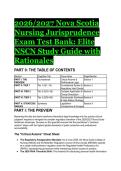
2026/2027 Nova Scotia
Nursing Jurisprudence
Exam Test Bank: Elite
NSCN Study Guide with
Rationales
PART 0: THE TABLE OF CONTENTS
Section Cognitive Tier Focus Area Page/Section
PART I: THE Foundational Critical Axioms & Section 1
PREVIEW Performance Logic
PART II: TIER 1 Tier 1 (Q1–15) Foundational Syntax & Section 2
Regulatory Hard Decks
PART III: TIER 2 Tier 2 (Q16–35) Complex Application & Section 3
Clinical Simulation
PART IV: TIER 3 Tier 3 (Q36–60) Grandmaster Synthesis Section 4
& High-Stakes Strategy
PART V: STRATEGIC Synthesis Legislative Section 5
TABLES Comparisons & Scopes
PART I: THE PREVIEW
Mastering this elite test bank transforms theoretical legal knowledge into the precise clinical
judgment required to navigate the complex regulatory transition of the 2026/2027 Nova Scotia
healthcare landscape. Success on this gauntlet ensures that the practitioner’s "practical
wisdom" aligns with the highest global standards of public protection and professional
accountability.
The "Critical Axioms" Cheat Sheet
● The Regulatory Amalgamation Mandate: As of June 2026, the Nova Scotia College of
Nursing (NSCN) and the Midwifery Regulatory Council of Nova Scotia (MRCNS) operate
as a single multi-profession regulator under the Regulated Health Professions Act
(RHPA), standardizing governance while maintaining distinct scopes of practice.
● The 2026 PHIA Threshold Shift: The threshold for disclosing personal health information
, without consent has transitioned from "significant and imminent danger" to a broader
"significant danger" standard, allowing for earlier intervention to avert harm.
● The Accountability Non-Transferability Rule: While a nurse may delegate a task to an
unregulated care provider (UCP), the accountability for the decision to delegate and the
ongoing supervision of that care remains solely with the nurse.
● The Statutory Consent Hierarchy: In the absence of a Personal Directive, the Personal
Directives Act (PDA) establishes a strict hierarchy for statutory decision-makers (SDMs),
beginning with the spouse and descending through children, parents, and siblings.
● The Mental Illness MAiD Moratorium: Medical Assistance in Dying (MAiD) for patients
whose sole underlying medical condition is a mental illness remains legally prohibited in
Canada until March 17, 2027.
PART II: THE ELITE TEST BANK (TIER 1)
Q1: A Registered Nurse (RN) is preparing to renew their license for the 2027 licensing year.
According to the Nova Scotia College of Nursing (NSCN) bylaws and the standard regulatory
cycle, on which date do all practicing nursing licenses in the province officially expire? A)
December 31st B) March 25th C) October 31st D) June 1st
● The Answer: C (October 31st)
● Distractor Analysis:
○ A is incorrect: December 31st is the standard calendar year end but does not align
with the NSCN’s established fiscal and regulatory licensing cycle.
○ B is incorrect: March 25, 2026, is the specific implementation date for the new
Jurisprudence requirement for all new applicants and returning registrants.
○ D is incorrect: June 1st is the date typically associated with the commencement of
terms for Board members, but it is not the deadline for individual license renewals.
The Mentor's Analysis: Professional self-regulation begins with an absolute commitment to
administrative compliance. Practicing for a single shift after October 31st without an active
renewal constitutes professional misconduct and exposes the practitioner to immediate
licensing sanctions. Professional/Academic Intuition: Licensure is the fundamental legal
"Hard Deck"; never allow your practice authority to expire through administrative
oversight.
Q2: Under the Regulated Health Professions Act (RHPA) and the current Nursing Act, how is
"Jurisprudence" formally defined within the Nova Scotia regulatory framework? A) The
adherence to specific employer-based clinical pathways and protocols. B) The application and
interpretation of legal rules as they relate to nursing practice and client obligations. C) The
ethical principles derived from the Canadian Nurses Association Code of Ethics. D) The clinical
assessment skills required to obtain a conditional license.
● The Answer: B (The application and interpretation of legal rules as they relate to nursing
practice and client obligations)
● Distractor Analysis:
○ A is incorrect: Clinical pathways are internal employer tools, whereas jurisprudence
refers to the broader provincial and federal legal architecture.
○ C is incorrect: Ethics and jurisprudence are related but distinct; jurisprudence
specifically focuses on the "practical wisdom" of the law.
○ D is incorrect: Clinical assessment is a competency requirement for registration, but
it does not define the legal field of jurisprudence itself.
,The Mentor's Analysis: Jurisprudence is the mechanism through which the law is
operationalized at the bedside. It provides the boundary markers for what is legally permissible,
ensuring that nursing care is safe, ethical, and defensible in a court of law.
Professional/Academic Intuition: Jurisprudence is "Practical Wisdom"; it is the bridge
between the statutes on the page and the nurse in the clinical environment.
Q3: As of April 1, 2026, the Nova Scotia Personal Health Information Act (PHIA) was amended
regarding the disclosure of personal health information (PHI) without consent. What was the
MOST SIGNIFICANT change to the legal threshold for disclosure? A) Disclosure is now
mandatory for all cases of suspected adult self-neglect. B) The requirement that the significant
danger be "imminent" was removed from the legislation. C) Nurses are now legally required to
obtain a court order before disclosing danger-related PHI. D) The "significant danger" standard
was replaced by a "potential risk" standard.
● The Answer: B (The requirement that the significant danger be "imminent" was removed
from the legislation)
● Distractor Analysis:
○ A is incorrect: The amendment facilitates disclosure but maintains the custodian’s
discretion; it does not mandate reporting for all adults who are not "in need of
protection".
○ C is incorrect: The purpose of the amendment is to reduce barriers to proactive
safety measures, not to add the delay of a court order.
○ D is incorrect: The "significant danger" threshold remains the operative legal
standard; only the temporal requirement of "immediacy" (imminence) was repealed.
The Mentor's Analysis: This legislative shift empowers health professionals to act on
"reasonable grounds" before a threat escalates into an immediate crisis. By removing the
"imminent" qualifier, the law allows for a more preventative and protective posture in mental
health and domestic violence scenarios. Professional/Academic Intuition: The 2026 PHIA
amendment prioritizes "Risk Prevention" over "Temporal Immediacy"; act when the
danger is significant, even if not immediate.
Q4: A Registered Nurse (RN) is asked to witness a client’s signature on a formal written request
for Medical Assistance in Dying (MAiD). According to Nova Scotia’s MAiD Practice Guidelines,
the nurse may act as a witness ONLY IF which condition is satisfied? A) The nurse is the
primary care provider for the client. B) The nurse is not a beneficiary under the client's will or a
recipient of any financial benefit from the death. C) The nurse has at least five licensing years of
experience in palliative care. D) The nurse is the administrator of the facility where the client is
being treated.
● The Answer: B (The nurse is not a beneficiary under the client's will or a recipient of any
financial benefit from the death)
● Distractor Analysis:
○ A is incorrect: While the primary nurse may be involved in care, the role of a
witness is focused on the voluntariness of the signature, not the clinical
management.
○ C is incorrect: There is no minimum years-of-practice requirement for witnessing a
MAiD request; the requirement is one of ethical independence.
○ D is incorrect: Owners or operators of health facilities are explicitly barred from
witnessing to prevent institutional coercion or conflicts of interest.
The Mentor's Analysis: The safeguards in the MAiD process are designed to ensure that the
patient’s request is entirely voluntary and free from external financial or institutional pressure.
Witnessing is a formal legal act of attesting to this autonomy. Professional/Academic
, Intuition: Independence is the mandatory prerequisite for witnessing a MAiD request; any
perceived or real conflict of interest invalidates the witness.
Q5: The Nova Scotia College of Nursing (NSCN) is currently transitioning to the Regulated
Health Professions Act (RHPA). What is the PRIMARY objective of this provincial legislative
overhaul? A) To eliminate the distinction between the scopes of practice for RNs and LPNs. B)
To create a standardized, consistent regulatory framework across all 21 health professions in
the province. C) To move the responsibility for nurse licensing from the College to the
Department of Health. D) To mandate that all nurses must also be licensed as midwives by
2027.
● The Answer: B (To create a standardized, consistent regulatory framework across all 21
health professions in the province)
● Distractor Analysis:
○ A is incorrect: The RHPA preserves the distinct identities and scopes of each
profession while standardizing the governance and disciplinary processes.
○ C is incorrect: The College remains the self-regulating body; the RHPA simply
provides the common rules the College must follow.
○ D is incorrect: Amalgamation refers to the regulatory bodies (NSCN and MRCNS),
not the merger of the nursing and midwifery professions themselves.
The Mentor's Analysis: The RHPA modernization efforts focus on consistency, transparency,
and public protection. It ensures that whether a complaint is against a nurse, a pharmacist, or
an optometrist, the investigative and adjudicative processes follow the same high standards of
fairness. Professional/Academic Intuition: Standardization under the RHPA is a move
toward regulatory maturity; the rules are common, but the professional scopes remain
unique.
Q6: A nurse in a surgical unit notices a colleague practicing while apparently impaired by an
unknown substance. According to the NSCN "Duty to Report" guideline and the Standards of
Practice, what is the nurse's FIRST legal accountability? A) To wait for a second occurrence to
confirm the impairment before reporting. B) To discuss the observation privately with the
colleague during a scheduled break. C) To report the suspected impairment immediately to the
employer and/or the NSCN. D) To document the behavior in a personal diary for future
reference in case of a lawsuit.
● The Answer: C (To report the suspected impairment immediately to the employer and/or
the NSCN)
● Distractor Analysis:
○ A is incorrect: Waiting for a second event unnecessarily risks public safety, which is
a breach of the fundamental mandate of nursing.
○ B is incorrect: While colleague-to-colleague support is valued, it does not fulfill the
legal requirement to ensure the public is protected from an impaired practitioner.
○ D is incorrect: Private documentation does not trigger the necessary regulatory
intervention required to prevent harm.
The Mentor's Analysis: The "Duty to Report" is a hallmark of a self-regulated profession.
Failing to report an incapacitated or dangerous colleague is itself an act of professional
misconduct, as it prioritizes professional loyalty over the legal mandate of public protection.
Professional/Academic Intuition: Public protection is the supreme professional mandate;
reporting impairment is a protective act, not a punitive one.
Q7: Effective December 1, 2025, which of the following nursing designations was officially
integrated into the NSCN regulatory fold in Nova Scotia? A) Nurse Practitioners (NPs) B)
Registered Psychiatric Nurses (RPNs) C) Licensed Practical Nurses (LPNs) D) Registered
Nursing Jurisprudence
Exam Test Bank: Elite
NSCN Study Guide with
Rationales
PART 0: THE TABLE OF CONTENTS
Section Cognitive Tier Focus Area Page/Section
PART I: THE Foundational Critical Axioms & Section 1
PREVIEW Performance Logic
PART II: TIER 1 Tier 1 (Q1–15) Foundational Syntax & Section 2
Regulatory Hard Decks
PART III: TIER 2 Tier 2 (Q16–35) Complex Application & Section 3
Clinical Simulation
PART IV: TIER 3 Tier 3 (Q36–60) Grandmaster Synthesis Section 4
& High-Stakes Strategy
PART V: STRATEGIC Synthesis Legislative Section 5
TABLES Comparisons & Scopes
PART I: THE PREVIEW
Mastering this elite test bank transforms theoretical legal knowledge into the precise clinical
judgment required to navigate the complex regulatory transition of the 2026/2027 Nova Scotia
healthcare landscape. Success on this gauntlet ensures that the practitioner’s "practical
wisdom" aligns with the highest global standards of public protection and professional
accountability.
The "Critical Axioms" Cheat Sheet
● The Regulatory Amalgamation Mandate: As of June 2026, the Nova Scotia College of
Nursing (NSCN) and the Midwifery Regulatory Council of Nova Scotia (MRCNS) operate
as a single multi-profession regulator under the Regulated Health Professions Act
(RHPA), standardizing governance while maintaining distinct scopes of practice.
● The 2026 PHIA Threshold Shift: The threshold for disclosing personal health information
, without consent has transitioned from "significant and imminent danger" to a broader
"significant danger" standard, allowing for earlier intervention to avert harm.
● The Accountability Non-Transferability Rule: While a nurse may delegate a task to an
unregulated care provider (UCP), the accountability for the decision to delegate and the
ongoing supervision of that care remains solely with the nurse.
● The Statutory Consent Hierarchy: In the absence of a Personal Directive, the Personal
Directives Act (PDA) establishes a strict hierarchy for statutory decision-makers (SDMs),
beginning with the spouse and descending through children, parents, and siblings.
● The Mental Illness MAiD Moratorium: Medical Assistance in Dying (MAiD) for patients
whose sole underlying medical condition is a mental illness remains legally prohibited in
Canada until March 17, 2027.
PART II: THE ELITE TEST BANK (TIER 1)
Q1: A Registered Nurse (RN) is preparing to renew their license for the 2027 licensing year.
According to the Nova Scotia College of Nursing (NSCN) bylaws and the standard regulatory
cycle, on which date do all practicing nursing licenses in the province officially expire? A)
December 31st B) March 25th C) October 31st D) June 1st
● The Answer: C (October 31st)
● Distractor Analysis:
○ A is incorrect: December 31st is the standard calendar year end but does not align
with the NSCN’s established fiscal and regulatory licensing cycle.
○ B is incorrect: March 25, 2026, is the specific implementation date for the new
Jurisprudence requirement for all new applicants and returning registrants.
○ D is incorrect: June 1st is the date typically associated with the commencement of
terms for Board members, but it is not the deadline for individual license renewals.
The Mentor's Analysis: Professional self-regulation begins with an absolute commitment to
administrative compliance. Practicing for a single shift after October 31st without an active
renewal constitutes professional misconduct and exposes the practitioner to immediate
licensing sanctions. Professional/Academic Intuition: Licensure is the fundamental legal
"Hard Deck"; never allow your practice authority to expire through administrative
oversight.
Q2: Under the Regulated Health Professions Act (RHPA) and the current Nursing Act, how is
"Jurisprudence" formally defined within the Nova Scotia regulatory framework? A) The
adherence to specific employer-based clinical pathways and protocols. B) The application and
interpretation of legal rules as they relate to nursing practice and client obligations. C) The
ethical principles derived from the Canadian Nurses Association Code of Ethics. D) The clinical
assessment skills required to obtain a conditional license.
● The Answer: B (The application and interpretation of legal rules as they relate to nursing
practice and client obligations)
● Distractor Analysis:
○ A is incorrect: Clinical pathways are internal employer tools, whereas jurisprudence
refers to the broader provincial and federal legal architecture.
○ C is incorrect: Ethics and jurisprudence are related but distinct; jurisprudence
specifically focuses on the "practical wisdom" of the law.
○ D is incorrect: Clinical assessment is a competency requirement for registration, but
it does not define the legal field of jurisprudence itself.
,The Mentor's Analysis: Jurisprudence is the mechanism through which the law is
operationalized at the bedside. It provides the boundary markers for what is legally permissible,
ensuring that nursing care is safe, ethical, and defensible in a court of law.
Professional/Academic Intuition: Jurisprudence is "Practical Wisdom"; it is the bridge
between the statutes on the page and the nurse in the clinical environment.
Q3: As of April 1, 2026, the Nova Scotia Personal Health Information Act (PHIA) was amended
regarding the disclosure of personal health information (PHI) without consent. What was the
MOST SIGNIFICANT change to the legal threshold for disclosure? A) Disclosure is now
mandatory for all cases of suspected adult self-neglect. B) The requirement that the significant
danger be "imminent" was removed from the legislation. C) Nurses are now legally required to
obtain a court order before disclosing danger-related PHI. D) The "significant danger" standard
was replaced by a "potential risk" standard.
● The Answer: B (The requirement that the significant danger be "imminent" was removed
from the legislation)
● Distractor Analysis:
○ A is incorrect: The amendment facilitates disclosure but maintains the custodian’s
discretion; it does not mandate reporting for all adults who are not "in need of
protection".
○ C is incorrect: The purpose of the amendment is to reduce barriers to proactive
safety measures, not to add the delay of a court order.
○ D is incorrect: The "significant danger" threshold remains the operative legal
standard; only the temporal requirement of "immediacy" (imminence) was repealed.
The Mentor's Analysis: This legislative shift empowers health professionals to act on
"reasonable grounds" before a threat escalates into an immediate crisis. By removing the
"imminent" qualifier, the law allows for a more preventative and protective posture in mental
health and domestic violence scenarios. Professional/Academic Intuition: The 2026 PHIA
amendment prioritizes "Risk Prevention" over "Temporal Immediacy"; act when the
danger is significant, even if not immediate.
Q4: A Registered Nurse (RN) is asked to witness a client’s signature on a formal written request
for Medical Assistance in Dying (MAiD). According to Nova Scotia’s MAiD Practice Guidelines,
the nurse may act as a witness ONLY IF which condition is satisfied? A) The nurse is the
primary care provider for the client. B) The nurse is not a beneficiary under the client's will or a
recipient of any financial benefit from the death. C) The nurse has at least five licensing years of
experience in palliative care. D) The nurse is the administrator of the facility where the client is
being treated.
● The Answer: B (The nurse is not a beneficiary under the client's will or a recipient of any
financial benefit from the death)
● Distractor Analysis:
○ A is incorrect: While the primary nurse may be involved in care, the role of a
witness is focused on the voluntariness of the signature, not the clinical
management.
○ C is incorrect: There is no minimum years-of-practice requirement for witnessing a
MAiD request; the requirement is one of ethical independence.
○ D is incorrect: Owners or operators of health facilities are explicitly barred from
witnessing to prevent institutional coercion or conflicts of interest.
The Mentor's Analysis: The safeguards in the MAiD process are designed to ensure that the
patient’s request is entirely voluntary and free from external financial or institutional pressure.
Witnessing is a formal legal act of attesting to this autonomy. Professional/Academic
, Intuition: Independence is the mandatory prerequisite for witnessing a MAiD request; any
perceived or real conflict of interest invalidates the witness.
Q5: The Nova Scotia College of Nursing (NSCN) is currently transitioning to the Regulated
Health Professions Act (RHPA). What is the PRIMARY objective of this provincial legislative
overhaul? A) To eliminate the distinction between the scopes of practice for RNs and LPNs. B)
To create a standardized, consistent regulatory framework across all 21 health professions in
the province. C) To move the responsibility for nurse licensing from the College to the
Department of Health. D) To mandate that all nurses must also be licensed as midwives by
2027.
● The Answer: B (To create a standardized, consistent regulatory framework across all 21
health professions in the province)
● Distractor Analysis:
○ A is incorrect: The RHPA preserves the distinct identities and scopes of each
profession while standardizing the governance and disciplinary processes.
○ C is incorrect: The College remains the self-regulating body; the RHPA simply
provides the common rules the College must follow.
○ D is incorrect: Amalgamation refers to the regulatory bodies (NSCN and MRCNS),
not the merger of the nursing and midwifery professions themselves.
The Mentor's Analysis: The RHPA modernization efforts focus on consistency, transparency,
and public protection. It ensures that whether a complaint is against a nurse, a pharmacist, or
an optometrist, the investigative and adjudicative processes follow the same high standards of
fairness. Professional/Academic Intuition: Standardization under the RHPA is a move
toward regulatory maturity; the rules are common, but the professional scopes remain
unique.
Q6: A nurse in a surgical unit notices a colleague practicing while apparently impaired by an
unknown substance. According to the NSCN "Duty to Report" guideline and the Standards of
Practice, what is the nurse's FIRST legal accountability? A) To wait for a second occurrence to
confirm the impairment before reporting. B) To discuss the observation privately with the
colleague during a scheduled break. C) To report the suspected impairment immediately to the
employer and/or the NSCN. D) To document the behavior in a personal diary for future
reference in case of a lawsuit.
● The Answer: C (To report the suspected impairment immediately to the employer and/or
the NSCN)
● Distractor Analysis:
○ A is incorrect: Waiting for a second event unnecessarily risks public safety, which is
a breach of the fundamental mandate of nursing.
○ B is incorrect: While colleague-to-colleague support is valued, it does not fulfill the
legal requirement to ensure the public is protected from an impaired practitioner.
○ D is incorrect: Private documentation does not trigger the necessary regulatory
intervention required to prevent harm.
The Mentor's Analysis: The "Duty to Report" is a hallmark of a self-regulated profession.
Failing to report an incapacitated or dangerous colleague is itself an act of professional
misconduct, as it prioritizes professional loyalty over the legal mandate of public protection.
Professional/Academic Intuition: Public protection is the supreme professional mandate;
reporting impairment is a protective act, not a punitive one.
Q7: Effective December 1, 2025, which of the following nursing designations was officially
integrated into the NSCN regulatory fold in Nova Scotia? A) Nurse Practitioners (NPs) B)
Registered Psychiatric Nurses (RPNs) C) Licensed Practical Nurses (LPNs) D) Registered


