
Second World War
Importance of the topics (In ascending order):
1. Paris peace conference
2. Failure of collective security (disarmament conferences, League of Nations,
international peace treaties / conferences)
3. Other factors
Great Depression
Appeasement policy
Invasion by totalitarian states
USA isolationist policy
4. Impact of World War II
5. Rise of totalitarianism
Background cause: Paris Peace Settlement and the rise of totalitarianism
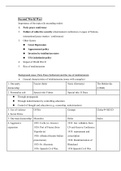
General characteristics of totalitarianism (some with examples)
1. One-party Fascist (Italy) Nazis (Germany) The Bolsheviks
dictatorship (USSR)
2. Personality cult Special title: Fuhrer Special title: II Duce
Through propaganda
Through indoctrination by controlling education
Control of thought and education (e.g. censorship, indoctrination)
3. Use of violence OVRA Gestapo Cheka NKVD
4. Secret Police
5. One-man dictatorship Mussolini Hitler Stalin
6. Aggressive 1923: Corfu (vs. Greece) 1933: Ger. withdrew from
expansion 1924: Port of Fiume (from LN and Geneva Conference
Yugoslavia) 1935: rearmament and
1926: Albania (became Italian conscription
protectorate) 1936: Remilitarization of
1935-36: Abyssinia Rhineland
1936: Spanish Civil War, 1936 Spanish Civil War
, Rome-Berlin Axis 1936 Anti-Comintern Pact
1937: Anti-Comintern Pact 1938: Anschluss
(with Germany and Japan), 1938 Munich Conference
withdrawal from the LN and Sudetenland
1939: Pact of Steel (with 1939: the rest of Czech
Germany) 1939 Nazi-Soviet Non-
Aggression Pact
1939 Poland
7. State-controlled Self-sufficiency Self-sufficiency Five Year Plans
economy Productivity campaigns: Productivity Collectivization
Battle for wheat campaigns of agriculture:
Battle for land Banned trade unions cooperatives
Banned trade unions Public ownership Rapid
Public ownership Four-year plan Industrialization
Public ownership Public
ownership
7. Anti-democracy: Supremacy of the state and absolute obedience
The people are subordinate to the state and submissive to the ruler
1. Anti-Communism 1. Anti-Communism
2. Superiority of the Aryan
Race and racial purity
Factor 1: Rise of Italian Fascism
Causes
1. Discontent with the Paris Peace Conference
60000 died and Italians thought they had made great sacrifices
However, Italy only received Istria and Tyrol, but not Dalmatia
and port of Fiume
Mussolini promised to revive national glory by territorial
expansion, thereby gaining the "deserved land"
2. Post-war economic problems
, War damages and casualties: 60000 soldiers died
Shortage of resources
Serious inflation: Prices risen by 5 times since 1915
Serious unemployment due to returning soldiers
Factory closed down by 13%
Mussolini promised to provide jobs, making changes in socio-
economic aspect. Foreign expansion was believed to be useful in
recovering economy too.
3. Weaknesses of Italian government
A. Ineffective governance
Italy had a parliamentary government since 1871.
No political party could win a majority in the parliament, and 5
Coalition Government involving different parties were formed
between 1918-22. Decision-making was hard in coalition
government (due to different parties). They were also corrupted.
No effective and consistent socio-economic policies could be
implemented.
B. Diplomatic failure
The democratic government that signed the Treaty of Versailles
was not popular, as they failed to get the port of Fiume and
Dalmatia.
Moreover, in the Paris Peace Conference, Italy government was
forced to accept the arrangement which made Dalmatia a free
city
This enraged the Italians as the government damaged their honour
and prestige. ("Disappointed victor")
C. Inability to supress the spread of Communism
Poor economy in Italy became a hotbed for communism. Thus,
Communism spread rapidly after WWII. For example, the
socialist / leftist became the biggest party in 1919.
Landowners, industrialist and capitalists were scared that their


