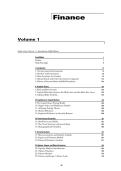
Finance
Volume 1
Bodie−Kane−Marcus • Investments, Fifth Edition
Front Matter 1
Preface 1
Walk Through 9
I. Introduction 13
1. The Investment Environment 13
2. Markets and Instruments 38
3. How Securities Are Traded 75
4. Mutual Funds and Other Investment Companies 114
5. History of Interest Rates and Risk Premiums 142
II. Portfolio Theory 163
6. Risk and Risk Aversion 163
7. Capital Allocation between the Risky Asset and the Risk−Free Asset 192
8. Optimal Risky Portfolio 216
III. Equilibrium In Capital Markets 266
9. The Capital Asset Pricing Model 266
10. Single−Index and Multifactor Models 300
11. Arbitrage Pricing Theory 328
12. Market Efficiency 348
13. Empirical Evidence on Security Returns 390
IV. Fixed−Income Securities 421
14. Bond Prices and Yields 421
15. The Term Structure of Interest Rates 459
16. Managing Bond Portfolios 489
V. Security Analysis 537
17. Macroeconomics and Industry Analysis 537
18. Equity and Valuation Models 567
19. Financial Statement Analysis 611
VI. Options, Futures, and Other Derivatives 652
20. Options Markets: Introduction 652
21. Option Valuation 700
22. Futures Markets 743
23. Futures and Swaps: A Closer Look 770
iii
,VII. Active Portfolio Management 808
24. Portfolio Performance Evaluation 808
25. International Diversification 850
26. The Process of Portfolio Management 875
iv
, Bodie−Kane−Marcus: Front Matter Preface © The McGraw−Hill 1
Investments, Fifth Edition Companies, 2001
P R E F A C E
We wrote the first edition of this textbook more than ten years ago. The intervening years
have been a period of rapid and profound change in the investments industry. This is due in
part to an abundance of newly designed securities, in part to the creation of new trading
strategies that would have been impossible without concurrent advances in computer tech-
nology, and in part to rapid advances in the theory of investments that have come out of the
academic community. In no other field, perhaps, is the transmission of theory to real-world
practice as rapid as is now commonplace in the financial industry. These developments
place new burdens on practitioners and teachers of investments far beyond what was re-
quired only a short while ago.
Investments, Fifth Edition, is intended primarily as a textbook for courses in investment
analysis. Our guiding principle has been to present the material in a framework that is or-
ganized by a central core of consistent fundamental principles. We make every attempt to
strip away unnecessary mathematical and technical detail, and we have concentrated on
providing the intuition that may guide students and practitioners as they confront new ideas
and challenges in their professional lives.
This text will introduce you to major issues currently of concern to all investors. It can
give you the skills to conduct a sophisticated assessment of current issues and debates cov-
ered by both the popular media as well as more specialized finance journals. Whether you
plan to become an investment professional, or simply a sophisticated individual investor,
you will find these skills essential.
Our primary goal is to present material of practical value, but all three of us are active
researchers in the science of financial economics and find virtually all of the material in
this book to be of great intellectual interest. Fortunately, we think, there is no contradiction
in the field of investments between the pursuit of truth and the pursuit of money. Quite the
opposite. The capital asset pricing model, the arbitrage pricing model, the efficient markets
hypothesis, the option-pricing model, and the other centerpieces of modern financial
research are as much intellectually satisfying subjects of scientific inquiry as they are of
immense practical importance for the sophisticated investor.
In our effort to link theory to practice, we also have attempted to make our approach
consistent with that of the Institute of Chartered Financial Analysts (ICFA), a subsidiary of
the Association of Investment Management and Research (AIMR). In addition to fostering
research in finance, the AIMR and ICFA administer an education and certification program
to candidates seeking the title of Chartered Financial Analyst (CFA). The CFA curriculum
represents the consensus of a committee of distinguished scholars and practitioners re-
garding the core of knowledge required by the investment professional.
There are many features of this text that make it consistent with and relevant to the CFA
curriculum. The end-of-chapter problem sets contain questions from past CFA exams, and,
for students who will be taking the exam, Appendix B is a useful tool that lists each CFA
question in the text and the exam from which it has been taken. Chapter 3 includes excerpts
from the “Code of Ethics and Standards of Professional Conduct” of the ICFA. Chapter 26,
which discusses investors and the investment process, is modeled after the ICFA outline.
In the Fifth Edition, we have introduced a systematic collection of Excel spreadsheets that
give students tools to explore concepts more deeply than was previously possible. These
vi
, 2 Bodie−Kane−Marcus: Front Matter Preface © The McGraw−Hill
Investments, Fifth Edition Companies, 2001
PREFACE vii
spreadsheets are available through the World Wide Web, and provide a taste of the sophisti-
cated analytic tools available to professional investors.
UNDERLYING PHILOSOPHY
Of necessity, our text has evolved along with the financial markets. In the Fifth Edition, we
address many of the changes in the investment environment.
At the same time, many basic principles remain important. We believe that attention to
these few important principles can simplify the study of otherwise difficult material and
that fundamental principles should organize and motivate all study. These principles are
crucial to understanding the securities already traded in financial markets and in under-
standing new securities that will be introduced in the future. For this reason, we have made
this book thematic, meaning we never offer rules of thumb without reference to the central
tenets of the modern approach to finance.
The common theme unifying this book is that security markets are nearly efficient,
meaning most securities are usually priced appropriately given their risk and return attri-
butes. There are few free lunches found in markets as competitive as the financial market.
This simple observation is, nevertheless, remarkably powerful in its implications for the
design of investment strategies; as a result, our discussions of strategy are always guided
by the implications of the efficient markets hypothesis. While the degree of market effi-
ciency is, and always will be, a matter of debate, we hope our discussions throughout the
book convey a good dose of healthy criticism concerning much conventional wisdom.
Distinctive Themes
Investments is organized around several important themes:
1. The central theme is the near-informational-efficiency of well-developed security
markets, such as those in the United States, and the general awareness that
competitive markets do not offer “free lunches” to participants.
A second theme is the risk–return trade-off. This too is a no-free-lunch notion,
holding that in competitive security markets, higher expected returns come only at
a price: the need to bear greater investment risk. However, this notion leaves
several questions unanswered. How should one measure the risk of an asset? What
should be the quantitative trade-off between risk (properly measured) and expected
return? The approach we present to these issues is known as modern portfolio
theory, which is another organizing principle of this book. Modern portfolio theory
focuses on the techniques and implications of efficient diversification, and we
devote considerable attention to the effect of diversification on portfolio risk as
well as the implications of efficient diversification for the proper measurement of
risk and the risk–return relationship.
2. This text places greater emphasis on asset allocation than most of its competitors.
We prefer this emphasis for two important reasons. First, it corresponds to the
procedure that most individuals actually follow. Typically, you start with all of your
money in a bank account, only then considering how much to invest in something
riskier that might offer a higher expected return. The logical step at this point is to
consider other risky asset classes, such as stock, bonds, or real estate. This is an
asset allocation decision. Second, in most cases, the asset allocation choice is far
more important in determining overall investment performance than is the set of
Volume 1
Bodie−Kane−Marcus • Investments, Fifth Edition
Front Matter 1
Preface 1
Walk Through 9
I. Introduction 13
1. The Investment Environment 13
2. Markets and Instruments 38
3. How Securities Are Traded 75
4. Mutual Funds and Other Investment Companies 114
5. History of Interest Rates and Risk Premiums 142
II. Portfolio Theory 163
6. Risk and Risk Aversion 163
7. Capital Allocation between the Risky Asset and the Risk−Free Asset 192
8. Optimal Risky Portfolio 216
III. Equilibrium In Capital Markets 266
9. The Capital Asset Pricing Model 266
10. Single−Index and Multifactor Models 300
11. Arbitrage Pricing Theory 328
12. Market Efficiency 348
13. Empirical Evidence on Security Returns 390
IV. Fixed−Income Securities 421
14. Bond Prices and Yields 421
15. The Term Structure of Interest Rates 459
16. Managing Bond Portfolios 489
V. Security Analysis 537
17. Macroeconomics and Industry Analysis 537
18. Equity and Valuation Models 567
19. Financial Statement Analysis 611
VI. Options, Futures, and Other Derivatives 652
20. Options Markets: Introduction 652
21. Option Valuation 700
22. Futures Markets 743
23. Futures and Swaps: A Closer Look 770
iii
,VII. Active Portfolio Management 808
24. Portfolio Performance Evaluation 808
25. International Diversification 850
26. The Process of Portfolio Management 875
iv
, Bodie−Kane−Marcus: Front Matter Preface © The McGraw−Hill 1
Investments, Fifth Edition Companies, 2001
P R E F A C E
We wrote the first edition of this textbook more than ten years ago. The intervening years
have been a period of rapid and profound change in the investments industry. This is due in
part to an abundance of newly designed securities, in part to the creation of new trading
strategies that would have been impossible without concurrent advances in computer tech-
nology, and in part to rapid advances in the theory of investments that have come out of the
academic community. In no other field, perhaps, is the transmission of theory to real-world
practice as rapid as is now commonplace in the financial industry. These developments
place new burdens on practitioners and teachers of investments far beyond what was re-
quired only a short while ago.
Investments, Fifth Edition, is intended primarily as a textbook for courses in investment
analysis. Our guiding principle has been to present the material in a framework that is or-
ganized by a central core of consistent fundamental principles. We make every attempt to
strip away unnecessary mathematical and technical detail, and we have concentrated on
providing the intuition that may guide students and practitioners as they confront new ideas
and challenges in their professional lives.
This text will introduce you to major issues currently of concern to all investors. It can
give you the skills to conduct a sophisticated assessment of current issues and debates cov-
ered by both the popular media as well as more specialized finance journals. Whether you
plan to become an investment professional, or simply a sophisticated individual investor,
you will find these skills essential.
Our primary goal is to present material of practical value, but all three of us are active
researchers in the science of financial economics and find virtually all of the material in
this book to be of great intellectual interest. Fortunately, we think, there is no contradiction
in the field of investments between the pursuit of truth and the pursuit of money. Quite the
opposite. The capital asset pricing model, the arbitrage pricing model, the efficient markets
hypothesis, the option-pricing model, and the other centerpieces of modern financial
research are as much intellectually satisfying subjects of scientific inquiry as they are of
immense practical importance for the sophisticated investor.
In our effort to link theory to practice, we also have attempted to make our approach
consistent with that of the Institute of Chartered Financial Analysts (ICFA), a subsidiary of
the Association of Investment Management and Research (AIMR). In addition to fostering
research in finance, the AIMR and ICFA administer an education and certification program
to candidates seeking the title of Chartered Financial Analyst (CFA). The CFA curriculum
represents the consensus of a committee of distinguished scholars and practitioners re-
garding the core of knowledge required by the investment professional.
There are many features of this text that make it consistent with and relevant to the CFA
curriculum. The end-of-chapter problem sets contain questions from past CFA exams, and,
for students who will be taking the exam, Appendix B is a useful tool that lists each CFA
question in the text and the exam from which it has been taken. Chapter 3 includes excerpts
from the “Code of Ethics and Standards of Professional Conduct” of the ICFA. Chapter 26,
which discusses investors and the investment process, is modeled after the ICFA outline.
In the Fifth Edition, we have introduced a systematic collection of Excel spreadsheets that
give students tools to explore concepts more deeply than was previously possible. These
vi
, 2 Bodie−Kane−Marcus: Front Matter Preface © The McGraw−Hill
Investments, Fifth Edition Companies, 2001
PREFACE vii
spreadsheets are available through the World Wide Web, and provide a taste of the sophisti-
cated analytic tools available to professional investors.
UNDERLYING PHILOSOPHY
Of necessity, our text has evolved along with the financial markets. In the Fifth Edition, we
address many of the changes in the investment environment.
At the same time, many basic principles remain important. We believe that attention to
these few important principles can simplify the study of otherwise difficult material and
that fundamental principles should organize and motivate all study. These principles are
crucial to understanding the securities already traded in financial markets and in under-
standing new securities that will be introduced in the future. For this reason, we have made
this book thematic, meaning we never offer rules of thumb without reference to the central
tenets of the modern approach to finance.
The common theme unifying this book is that security markets are nearly efficient,
meaning most securities are usually priced appropriately given their risk and return attri-
butes. There are few free lunches found in markets as competitive as the financial market.
This simple observation is, nevertheless, remarkably powerful in its implications for the
design of investment strategies; as a result, our discussions of strategy are always guided
by the implications of the efficient markets hypothesis. While the degree of market effi-
ciency is, and always will be, a matter of debate, we hope our discussions throughout the
book convey a good dose of healthy criticism concerning much conventional wisdom.
Distinctive Themes
Investments is organized around several important themes:
1. The central theme is the near-informational-efficiency of well-developed security
markets, such as those in the United States, and the general awareness that
competitive markets do not offer “free lunches” to participants.
A second theme is the risk–return trade-off. This too is a no-free-lunch notion,
holding that in competitive security markets, higher expected returns come only at
a price: the need to bear greater investment risk. However, this notion leaves
several questions unanswered. How should one measure the risk of an asset? What
should be the quantitative trade-off between risk (properly measured) and expected
return? The approach we present to these issues is known as modern portfolio
theory, which is another organizing principle of this book. Modern portfolio theory
focuses on the techniques and implications of efficient diversification, and we
devote considerable attention to the effect of diversification on portfolio risk as
well as the implications of efficient diversification for the proper measurement of
risk and the risk–return relationship.
2. This text places greater emphasis on asset allocation than most of its competitors.
We prefer this emphasis for two important reasons. First, it corresponds to the
procedure that most individuals actually follow. Typically, you start with all of your
money in a bank account, only then considering how much to invest in something
riskier that might offer a higher expected return. The logical step at this point is to
consider other risky asset classes, such as stock, bonds, or real estate. This is an
asset allocation decision. Second, in most cases, the asset allocation choice is far
more important in determining overall investment performance than is the set of