
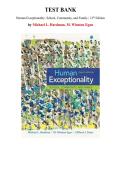
TEST BANK
Human Exceptionality: School, Community, and Family | 12th Edition
by Michael L. Hardman, M. Winston Egan
LU
XE
LI
BR
AR
Y
, Table of content
Part 1. Through the Lifespan
Chapter 1. Understanding Exceptionalities in the 21st Century
Chapter 2. Education for All
Chapter 3. Inclusion and Multidisciplinary Collaboration in the Early Childhood and
Elementary School Years
Chapter 4. Secondary Education and Transition Planning
Part 2. Perspectives on Diversity and the Family
LU
Chapter 5. Cultural and Linguistic Diversity
Chapter 6. Exceptionalities and Families
Part 3. People who Are Exceptional
XE
Chapter 7. Learning Disabilities
Chapter 8. Emotional/Behavioral Disorders
Chapter 9. Intellectual and Developmental Disabilities
Chapter 10. Communication Disorders
LI
Chapter 11. Autism Spectrum Disorders
Chapter 12. Severe and Multiple Disabilities
Chapter 13. Sensory Disabilities: Hearing and Vision Loss
BR
Chapter 14. Physical Disabilities and Other Health Disorders
Part 4. Exceptional Gifts and Talents
Chapter 15. Gifted, Creative, and Talented
AR
Y
, KJHGFDS
1. Which of the following statements is accurate?
a. Labels affect individuals in a similar manner.
b. Labels attempt to describe, identify, and distinguish individuals who differ from the norm.
c. Labels tend to be stable across cultures.
d. Labels are given only to people who differ significantly from the average.
ANSWER: b
REFERENCES: Bloom's: Remembering
LEARNING OBJECTIVES: HESC.HARD.17.01.01 - Describe why do we continue to label people even when we
know it may have a negative effect on an individual.
NATIONAL STANDARDS: United States - CEC.6.0 - Beginning special education professionals use foundational
LU
knowledge of the field and their professional Ethical Principles and Practice Standards
to inform special education practice, to engage in lifelong learning, and to advance their
profession.
NOTES: The purpose of a label is to communicate specific differences in people who vary
significantly from what is considered “typical or normal.”
2. Sabah is a person with a physical disability who uses a wheelchair. Sabah must bank by mail because the only bank in
XE
her town is not accessible by wheelchair. The term that most accurately describes the relationship between Sabah 's
condition and her lack of access to the bank is a
a. disability. b. handicap.
c. disturbance. d. disorder.
ANSWER: b
LI
REFERENCES: Bloom's: Applying
LEARNING OBJECTIVES: HESC.HARD.17.01.01 - Describe why do we continue to label people even when we
know it may have a negative effect on an individual.
BR
NATIONAL STANDARDS: United States - CEC.6.0 - Beginning special education professionals use foundational
knowledge of the field and their professional Ethical Principles and Practice Standards
to inform special education practice, to engage in lifelong learning, and to advance their
profession.
NOTES: A handicap is a limitation imposed on the individual by environmental demands and is
related to the individual's ability to adapt or adjust to these demands.
AR
Y
JHGFDS
, KJHGFDS
3. The term "exceptional" describes individuals who
a. are limited because of environmental demands.
b. have higher than average general ability.
c. deviate either higher or lower from the norm and may require specialized services.
d. have a general malfunction of mental processing.
ANSWER: c
REFERENCES: Bloom's: Remembering
LEARNING OBJECTIVES: HESC.HARD.17.01.01 - Describe why do we continue to label people even when we
know it may have a negative effect on an individual.
NATIONAL STANDARDS: United States - CEC.6.0 - Beginning special education professionals use foundational
LU
knowledge of the field and their professional Ethical Principles and Practice Standards
to inform special education practice, to engage in lifelong learning, and to advance their
profession.
NOTES: Exceptional is a comprehensive label. It describes an individual whose physical,
intellectual, or behavioral performance differs substantially from what is typical (or
normal), either higher or lower.
XE
4. All labels are
a. positive. b. negative.
c. based on perceptions d. factual.
ANSWER: c
LI
REFERENCES: Bloom's: Applying
LEARNING OBJECTIVES: HESC.HARD.17.01.01 - Describe why do we continue to label people even when we
know it may have a negative effect on an individual.
NATIONAL STANDARDS: United States - CEC.6.0 - Beginning special education professionals use foundational
BR
knowledge of the field and their professional Ethical Principles and Practice Standards
to inform special education practice, to engage in lifelong learning, and to advance their
profession.
5. Labels are used to
a. distinguish who is eligible for services and who is not and to help professionals communicate effectively with
one another.
AR
b. ensure that characteristics within a culture have the same meaning.
c. prohibit discrimination.
d. confirm environmental bias.
ANSWER: a
REFERENCES: Bloom's: Understanding
Y
LEARNING OBJECTIVES: HESC.HARD.17.01.01 - Describe why do we continue to label people even when we
know it may have a negative effect on an individual.
NATIONAL STANDARDS: United States - CEC.6.0 - Beginning special education professionals use foundational
knowledge of the field and their professional Ethical Principles and Practice Standards
to inform special education practice, to engage in lifelong learning, and to advance their
profession.
JHGFDS
Human Exceptionality: School, Community, and Family | 12th Edition
by Michael L. Hardman, M. Winston Egan
LU
XE
LI
BR
AR
Y
, Table of content
Part 1. Through the Lifespan
Chapter 1. Understanding Exceptionalities in the 21st Century
Chapter 2. Education for All
Chapter 3. Inclusion and Multidisciplinary Collaboration in the Early Childhood and
Elementary School Years
Chapter 4. Secondary Education and Transition Planning
Part 2. Perspectives on Diversity and the Family
LU
Chapter 5. Cultural and Linguistic Diversity
Chapter 6. Exceptionalities and Families
Part 3. People who Are Exceptional
XE
Chapter 7. Learning Disabilities
Chapter 8. Emotional/Behavioral Disorders
Chapter 9. Intellectual and Developmental Disabilities
Chapter 10. Communication Disorders
LI
Chapter 11. Autism Spectrum Disorders
Chapter 12. Severe and Multiple Disabilities
Chapter 13. Sensory Disabilities: Hearing and Vision Loss
BR
Chapter 14. Physical Disabilities and Other Health Disorders
Part 4. Exceptional Gifts and Talents
Chapter 15. Gifted, Creative, and Talented
AR
Y
, KJHGFDS
1. Which of the following statements is accurate?
a. Labels affect individuals in a similar manner.
b. Labels attempt to describe, identify, and distinguish individuals who differ from the norm.
c. Labels tend to be stable across cultures.
d. Labels are given only to people who differ significantly from the average.
ANSWER: b
REFERENCES: Bloom's: Remembering
LEARNING OBJECTIVES: HESC.HARD.17.01.01 - Describe why do we continue to label people even when we
know it may have a negative effect on an individual.
NATIONAL STANDARDS: United States - CEC.6.0 - Beginning special education professionals use foundational
LU
knowledge of the field and their professional Ethical Principles and Practice Standards
to inform special education practice, to engage in lifelong learning, and to advance their
profession.
NOTES: The purpose of a label is to communicate specific differences in people who vary
significantly from what is considered “typical or normal.”
2. Sabah is a person with a physical disability who uses a wheelchair. Sabah must bank by mail because the only bank in
XE
her town is not accessible by wheelchair. The term that most accurately describes the relationship between Sabah 's
condition and her lack of access to the bank is a
a. disability. b. handicap.
c. disturbance. d. disorder.
ANSWER: b
LI
REFERENCES: Bloom's: Applying
LEARNING OBJECTIVES: HESC.HARD.17.01.01 - Describe why do we continue to label people even when we
know it may have a negative effect on an individual.
BR
NATIONAL STANDARDS: United States - CEC.6.0 - Beginning special education professionals use foundational
knowledge of the field and their professional Ethical Principles and Practice Standards
to inform special education practice, to engage in lifelong learning, and to advance their
profession.
NOTES: A handicap is a limitation imposed on the individual by environmental demands and is
related to the individual's ability to adapt or adjust to these demands.
AR
Y
JHGFDS
, KJHGFDS
3. The term "exceptional" describes individuals who
a. are limited because of environmental demands.
b. have higher than average general ability.
c. deviate either higher or lower from the norm and may require specialized services.
d. have a general malfunction of mental processing.
ANSWER: c
REFERENCES: Bloom's: Remembering
LEARNING OBJECTIVES: HESC.HARD.17.01.01 - Describe why do we continue to label people even when we
know it may have a negative effect on an individual.
NATIONAL STANDARDS: United States - CEC.6.0 - Beginning special education professionals use foundational
LU
knowledge of the field and their professional Ethical Principles and Practice Standards
to inform special education practice, to engage in lifelong learning, and to advance their
profession.
NOTES: Exceptional is a comprehensive label. It describes an individual whose physical,
intellectual, or behavioral performance differs substantially from what is typical (or
normal), either higher or lower.
XE
4. All labels are
a. positive. b. negative.
c. based on perceptions d. factual.
ANSWER: c
LI
REFERENCES: Bloom's: Applying
LEARNING OBJECTIVES: HESC.HARD.17.01.01 - Describe why do we continue to label people even when we
know it may have a negative effect on an individual.
NATIONAL STANDARDS: United States - CEC.6.0 - Beginning special education professionals use foundational
BR
knowledge of the field and their professional Ethical Principles and Practice Standards
to inform special education practice, to engage in lifelong learning, and to advance their
profession.
5. Labels are used to
a. distinguish who is eligible for services and who is not and to help professionals communicate effectively with
one another.
AR
b. ensure that characteristics within a culture have the same meaning.
c. prohibit discrimination.
d. confirm environmental bias.
ANSWER: a
REFERENCES: Bloom's: Understanding
Y
LEARNING OBJECTIVES: HESC.HARD.17.01.01 - Describe why do we continue to label people even when we
know it may have a negative effect on an individual.
NATIONAL STANDARDS: United States - CEC.6.0 - Beginning special education professionals use foundational
knowledge of the field and their professional Ethical Principles and Practice Standards
to inform special education practice, to engage in lifelong learning, and to advance their
profession.
JHGFDS


