

Solution Manual For
Introduction to Aeroelasticity, 1E James DeLaurier
Chapters 1-3
Chapter 1
Problem 1:
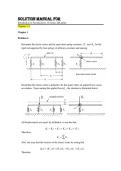
Determine the elastic centre and the equivalent spring constants, K z and K for the
rigid rod supported by four springs of arbitrary constants and spacing:
Recall that the elastic centre is defined to be that point where an applied force causes
no rotation. Upon naming the applied force Q z , the situation is illustrated below:
All displacements are equal, by definition, so one has that
Q z K1 z K 2 z K 3 z K 4 z K z z
Therefore,
4
K z Ki
1
Also, one may find the location of the elastic centre by noting that
Q z d ( K z z ) d ( K1 z ) d1 ( K 2 z ) d 2 ( K 3 z ) d 3
Therefore
, 3
Kzd K jd j
1
One may then calculate that
3
1 3 K j dj
d K j dj 1
4
K
Kz 1
i
1
Now, apply a moment Q to find the equivalent torsion spring constant K :
Q K1 (d1 d ) 2 K 2 (d 2 d ) 2 K 3 (d 3 d ) 2 K 4 (d 4 d ) 2 z K
where sin and cos 1. Therefore, one has that
4
K K i (d i d ) 2
1
Problem 2:
Three thin “disks” are connected by torsion springs of constants k 1 , k 2 , and k 3 . With
the displacement variables being the rotations of the disks: 1 , 2 , and 3 , find the
stiffness and flexibility matrices of this system. Note that the disks are seen
edgewise:
,(a) In order to find the flexibility influence-coefficient matrix, one sequentially
applies a unit torque at each station:
Step 1: A unit torque applied at station 1 gives the following deformations:
1 1 1 1 1 1
C3,1 3 , C 2,1 2 , C1,1 1
k3 k 2 k3 k1 k 2 k 3
Step 2: A unit torque applied at station 2 gives the following deformations:
1 1 1 1 1
C 3, 2 3 , C 2, 2 2 , C1, 2 1
k3 k 2 k3 k 2 k3
Step 3: A unit torque applied at station 3 gives the following deformations:
1 1 1
C 3, 3 3 , C 2,3 2 , C1,3 1
k3 k3 k3
Therefore, the flexibility influence-coefficient matrix is:
1 1 1 1 1 1
k1 k 2 k 3 k 2 k3 k3
C 1 1 1
1 1
k 2 k3 k 2 k3 k3
1 1 1
k3 k3 k 3
Next, the stiffness influence-coefficient matrix is found by determining the torques
required to give unit displacements at each station:
, Step 1: The torques necessary to make 1 1 and 2 3 0 are:
k1,1 T1 k1 , k 2,1 T2 k1 , k3,1 T3 0
Step 2: The torques necessary to make 1 0 , 2 1 , and 3 0 are:
k1, 2 T1 k1 , k 2, 2 T2 k1 k 2 , k3, 2 T3 k 2
Step 3: The torques necessary to make 1 2 0 and 3 1 are:
k1,3 T1 0 , k 2,3 T2 k 2 , k3,3 T3 k 2 k3
Therefore, the stiffness influence-coefficient matrix is:
k1 k1 0
K k1 k1 k 2 k 2
0 k2 k 2 k 3
One may check on the correctness of the solutions by
C K I ?
1 1 1 1 1 1
k1 k 2 k3 k 2 k3 k3 k1 k1 0 1 0 0
C K 1 1 1 1 1 k k k k 2 = 0 1 0 , O.K.
1 1 2
k k k 2 k3 k3
21 3 0 k2 k 2 k3 0 0 1
1 1
k3 k3 k3
(b) Because C K I , then one has that det C det K det I 1 . Thus:
.
Introduction to Aeroelasticity, 1E James DeLaurier
Chapters 1-3
Chapter 1
Problem 1:
Determine the elastic centre and the equivalent spring constants, K z and K for the
rigid rod supported by four springs of arbitrary constants and spacing:
Recall that the elastic centre is defined to be that point where an applied force causes
no rotation. Upon naming the applied force Q z , the situation is illustrated below:
All displacements are equal, by definition, so one has that
Q z K1 z K 2 z K 3 z K 4 z K z z
Therefore,
4
K z Ki
1
Also, one may find the location of the elastic centre by noting that
Q z d ( K z z ) d ( K1 z ) d1 ( K 2 z ) d 2 ( K 3 z ) d 3
Therefore
, 3
Kzd K jd j
1
One may then calculate that
3
1 3 K j dj
d K j dj 1
4
K
Kz 1
i
1
Now, apply a moment Q to find the equivalent torsion spring constant K :
Q K1 (d1 d ) 2 K 2 (d 2 d ) 2 K 3 (d 3 d ) 2 K 4 (d 4 d ) 2 z K
where sin and cos 1. Therefore, one has that
4
K K i (d i d ) 2
1
Problem 2:
Three thin “disks” are connected by torsion springs of constants k 1 , k 2 , and k 3 . With
the displacement variables being the rotations of the disks: 1 , 2 , and 3 , find the
stiffness and flexibility matrices of this system. Note that the disks are seen
edgewise:
,(a) In order to find the flexibility influence-coefficient matrix, one sequentially
applies a unit torque at each station:
Step 1: A unit torque applied at station 1 gives the following deformations:
1 1 1 1 1 1
C3,1 3 , C 2,1 2 , C1,1 1
k3 k 2 k3 k1 k 2 k 3
Step 2: A unit torque applied at station 2 gives the following deformations:
1 1 1 1 1
C 3, 2 3 , C 2, 2 2 , C1, 2 1
k3 k 2 k3 k 2 k3
Step 3: A unit torque applied at station 3 gives the following deformations:
1 1 1
C 3, 3 3 , C 2,3 2 , C1,3 1
k3 k3 k3
Therefore, the flexibility influence-coefficient matrix is:
1 1 1 1 1 1
k1 k 2 k 3 k 2 k3 k3
C 1 1 1
1 1
k 2 k3 k 2 k3 k3
1 1 1
k3 k3 k 3
Next, the stiffness influence-coefficient matrix is found by determining the torques
required to give unit displacements at each station:
, Step 1: The torques necessary to make 1 1 and 2 3 0 are:
k1,1 T1 k1 , k 2,1 T2 k1 , k3,1 T3 0
Step 2: The torques necessary to make 1 0 , 2 1 , and 3 0 are:
k1, 2 T1 k1 , k 2, 2 T2 k1 k 2 , k3, 2 T3 k 2
Step 3: The torques necessary to make 1 2 0 and 3 1 are:
k1,3 T1 0 , k 2,3 T2 k 2 , k3,3 T3 k 2 k3
Therefore, the stiffness influence-coefficient matrix is:
k1 k1 0
K k1 k1 k 2 k 2
0 k2 k 2 k 3
One may check on the correctness of the solutions by
C K I ?
1 1 1 1 1 1
k1 k 2 k3 k 2 k3 k3 k1 k1 0 1 0 0
C K 1 1 1 1 1 k k k k 2 = 0 1 0 , O.K.
1 1 2
k k k 2 k3 k3
21 3 0 k2 k 2 k3 0 0 1
1 1
k3 k3 k3
(b) Because C K I , then one has that det C det K det I 1 . Thus:
.


