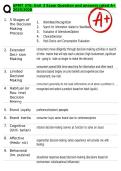
SPMT 370: Unit 3 Exam Question and answers rated A+
2025/2026
1. 5 Stages of
1. Want/Need Recognition
the Decision
2. Search for Information related to Want/Need
Making
Process 3. Evaluation of Alternatives/Options
4. Choice/Decision
5. Post-Choice and Consumption Evaluation
2. Extended consumers move diligently through decision-making activities in search
Deci- sion of infor- mation that will help reach a decision (high involvement, significant
Making risk - going to take us longer to make the decision)
consumers spend little time searching for information and often reach
3. Limited decisions based largely on prior beliefs and experiences (low
Decision involvement, low risk)
Making
consumers generally do not seek information at all when a problem is
4. Habitual (or recognized and select a product based on habit (quick)
Rou- tine)
Decision
Making
5. Brand Loyalty preference/insistent people
6. Brand Inertia consumer buys same brand due to continence/price
7. Cognitive rational decision-making (serves as function to solve an issue)
(Utili- tarian)
8. Affective
experiential decision-making (what experience will provide me with
(Hedo- nic) feeling)
9. Behavioral
(Im- pulsive)
situational response-based decision-making (decisions based on
environmen- tal/situational influences)
1/
3
2025/2026
1. 5 Stages of
1. Want/Need Recognition
the Decision
2. Search for Information related to Want/Need
Making
Process 3. Evaluation of Alternatives/Options
4. Choice/Decision
5. Post-Choice and Consumption Evaluation
2. Extended consumers move diligently through decision-making activities in search
Deci- sion of infor- mation that will help reach a decision (high involvement, significant
Making risk - going to take us longer to make the decision)
consumers spend little time searching for information and often reach
3. Limited decisions based largely on prior beliefs and experiences (low
Decision involvement, low risk)
Making
consumers generally do not seek information at all when a problem is
4. Habitual (or recognized and select a product based on habit (quick)
Rou- tine)
Decision
Making
5. Brand Loyalty preference/insistent people
6. Brand Inertia consumer buys same brand due to continence/price
7. Cognitive rational decision-making (serves as function to solve an issue)
(Utili- tarian)
8. Affective
experiential decision-making (what experience will provide me with
(Hedo- nic) feeling)
9. Behavioral
(Im- pulsive)
situational response-based decision-making (decisions based on
environmen- tal/situational influences)
1/
3