
AQA A level Chemistry PPE Dec
Paper 2 - Physical, Organic and Inorganic
Q1.
This question is about the analysis of organic compounds.
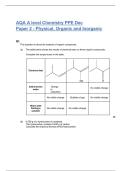
(a) The table below shows the results of chemical tests on three organic compounds.
Complete the empty boxes in the table.
Chemical test
Add bromine Orange
No visible change
water to
colourless
No visible change Bubbles of gas No visible change
Warm with
Fehling’s No visible change No visible change
solution
(3)
(b) 0.500 g of a hydrocarbon is analysed.
The hydrocarbon contains 0.450 g of carbon.
Calculate the empirical formula of this hydrocarbon.
,Empirical formula
(3)
(Total 6 marks)
,Q2.
This question is about compounds that contain fluorine.
(a) Sodium fluoride contains sodium ions (Na+) and fluoride ions (F–).
Na+ and F– have the same electron configuration.
Explain why a fluoride ion is larger than a sodium ion.
(2)
(b) Explain, in terms of structure and bonding, why the melting point of sodium fluoride
is high.
(2)
, (c) The ion H2F+ is formed when hydrogen fluoride gains a proton as shown in the
equation
HF + H+ → H2F+
Name the type of bond formed when HF reacts with H+
Explain how this bond is formed.
Type of bond
Explanation
(2)
(d) Fluoroantimonic acid contains two ions, sbf6– and H2F+
Draw the shape of the sbf6– ion and the shape of the H2F+ ion. Include any lone pairs
that influence the shape.
Name the shape of each ion.
Sbf6– H2F+
Shape
Name
of
shape
(4)
Paper 2 - Physical, Organic and Inorganic
Q1.
This question is about the analysis of organic compounds.
(a) The table below shows the results of chemical tests on three organic compounds.
Complete the empty boxes in the table.
Chemical test
Add bromine Orange
No visible change
water to
colourless
No visible change Bubbles of gas No visible change
Warm with
Fehling’s No visible change No visible change
solution
(3)
(b) 0.500 g of a hydrocarbon is analysed.
The hydrocarbon contains 0.450 g of carbon.
Calculate the empirical formula of this hydrocarbon.
,Empirical formula
(3)
(Total 6 marks)
,Q2.
This question is about compounds that contain fluorine.
(a) Sodium fluoride contains sodium ions (Na+) and fluoride ions (F–).
Na+ and F– have the same electron configuration.
Explain why a fluoride ion is larger than a sodium ion.
(2)
(b) Explain, in terms of structure and bonding, why the melting point of sodium fluoride
is high.
(2)
, (c) The ion H2F+ is formed when hydrogen fluoride gains a proton as shown in the
equation
HF + H+ → H2F+
Name the type of bond formed when HF reacts with H+
Explain how this bond is formed.
Type of bond
Explanation
(2)
(d) Fluoroantimonic acid contains two ions, sbf6– and H2F+
Draw the shape of the sbf6– ion and the shape of the H2F+ ion. Include any lone pairs
that influence the shape.
Name the shape of each ion.
Sbf6– H2F+
Shape
Name
of
shape
(4)


