

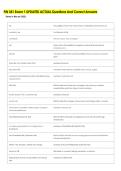
FIN 341 Exam 1 UPDATED ACTUAL Questions And Correct Answers
Terms in this set (103)
risk the possibility of loss or the chance that an undesirable outcome will occur.
uncertainty, loss Two Elements of Risk
uncertainty The event may or may not happen.
loss There must be the possibility of a negative outcome (financial, physical,
emotional, etc.).
pure risk A situation where there is only the possibility of loss or no loss (no chance of
gain).
House fire, Car accident, Illness, Theft examples of pure risk
Speculative Risk A situation where there is a possibility of loss, no loss, or gain.
Investing in stocks, Starting a business, Gambling, Buying examples of speculative risk
cryptocurrency
Static Risk Risk that exists even if there are no changes in the economy; caused by
unpredictable events like nature or human behavior.
Natural disasters, Theft, Accidental injury examples of static risk
dynamic risk Risk that arises from changes in the economy, technology, politics, or society.
Job loss due to automation, Market crashes, Changes in examples of dynamic risk
consumer preferences
Diversifiable Risk (Specific Risk) Risk that affects individuals or small groups and can be reduced through
diversification.
A company going bankrupt, A car being stolen, A examples of Diversifiable Risk (Specific Risk)
building fire
Non-Diversifiable Risk (Systematic Risk) Risk that affects the entire economy or large groups and cannot be eliminated
through diversification.
Inflation, War, Recession, Interest rate changes examples of Non-Diversifiable Risk (Systematic Risk)
Subjective Risk Risk based on a person's feelings, perceptions, or opinions
Being afraid to fly even though statistics show flying is examples of subjective risk
safe.
, Objective Risk Risk that can be measured with statistics and data.
The statistical probability of getting into a car accident. examples of Objective Risk
pure what type of risk is this? Your house is damaged in a tornado. Speculative or Pure?
speculative You buy a lottery ticket. speculative or pure?
pure A person develops cancer. speculative or pure?
static A hurricane destroys homes in Florida. static or dynamic?
dynamic A company loses money because new technology made its product outdated.
static or dynamic?
static A person slips and breaks their arm. static or dynamic?
diversifiable One company's stock price drops due to a scandal. diversifiable or non
diversifiable?
non diversifiable Interest rates rise nationwide. diversifiable or non diversifiable?
subjective Someone feels that driving at night is extremely dangerous. subjective or
objective?
objective Actuarial tables calculate life expectancy. subjective or objective?
frequency The number of times a specific loss occurs within a given period (Howoften).
severity Given that a loss occurs (frequency > 0), the financial impact of that loss(How bad
is it?).
High Frequency, Low Severity Losses happen often but cost little each time. EX: Minor car scratches
Low Frequency, High Severity Losses happen rarely but are very costly. EX: house fire
High frequency Which is more predictable: High frequency or low frequency losses?
peril A random event that is theimmediate cause of a loss.
Fire, theft, flood, tornado, collision. Examples of Perils
hazard A condition that increases the chance of a loss or increases the severity of a loss.
physical hazard A physical condition that increases the chance of loss.
Icy roads, Broken stair railing, Faulty wiring, Wet floors examples of physical hazards
Terms in this set (103)
risk the possibility of loss or the chance that an undesirable outcome will occur.
uncertainty, loss Two Elements of Risk
uncertainty The event may or may not happen.
loss There must be the possibility of a negative outcome (financial, physical,
emotional, etc.).
pure risk A situation where there is only the possibility of loss or no loss (no chance of
gain).
House fire, Car accident, Illness, Theft examples of pure risk
Speculative Risk A situation where there is a possibility of loss, no loss, or gain.
Investing in stocks, Starting a business, Gambling, Buying examples of speculative risk
cryptocurrency
Static Risk Risk that exists even if there are no changes in the economy; caused by
unpredictable events like nature or human behavior.
Natural disasters, Theft, Accidental injury examples of static risk
dynamic risk Risk that arises from changes in the economy, technology, politics, or society.
Job loss due to automation, Market crashes, Changes in examples of dynamic risk
consumer preferences
Diversifiable Risk (Specific Risk) Risk that affects individuals or small groups and can be reduced through
diversification.
A company going bankrupt, A car being stolen, A examples of Diversifiable Risk (Specific Risk)
building fire
Non-Diversifiable Risk (Systematic Risk) Risk that affects the entire economy or large groups and cannot be eliminated
through diversification.
Inflation, War, Recession, Interest rate changes examples of Non-Diversifiable Risk (Systematic Risk)
Subjective Risk Risk based on a person's feelings, perceptions, or opinions
Being afraid to fly even though statistics show flying is examples of subjective risk
safe.
, Objective Risk Risk that can be measured with statistics and data.
The statistical probability of getting into a car accident. examples of Objective Risk
pure what type of risk is this? Your house is damaged in a tornado. Speculative or Pure?
speculative You buy a lottery ticket. speculative or pure?
pure A person develops cancer. speculative or pure?
static A hurricane destroys homes in Florida. static or dynamic?
dynamic A company loses money because new technology made its product outdated.
static or dynamic?
static A person slips and breaks their arm. static or dynamic?
diversifiable One company's stock price drops due to a scandal. diversifiable or non
diversifiable?
non diversifiable Interest rates rise nationwide. diversifiable or non diversifiable?
subjective Someone feels that driving at night is extremely dangerous. subjective or
objective?
objective Actuarial tables calculate life expectancy. subjective or objective?
frequency The number of times a specific loss occurs within a given period (Howoften).
severity Given that a loss occurs (frequency > 0), the financial impact of that loss(How bad
is it?).
High Frequency, Low Severity Losses happen often but cost little each time. EX: Minor car scratches
Low Frequency, High Severity Losses happen rarely but are very costly. EX: house fire
High frequency Which is more predictable: High frequency or low frequency losses?
peril A random event that is theimmediate cause of a loss.
Fire, theft, flood, tornado, collision. Examples of Perils
hazard A condition that increases the chance of a loss or increases the severity of a loss.
physical hazard A physical condition that increases the chance of loss.
Icy roads, Broken stair railing, Faulty wiring, Wet floors examples of physical hazards


