

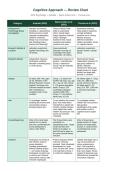
Cognitive Approach — Review Chart
AICE Psychology | Andrade • Baron-Cohen et al. • Pozzulo et al.
Baron-Cohen et al.
Category Andrade (2010) Pozzulo et al. (2012)
(2001)
Background / Attention and memory. Theory of Mind (ToM): Eyewitness testimony.
Psychology Being Doodling vs. daydreaming. ability to understand False positive responses:
Investigated Working memory model others' mental states. wrongly identifying
(separate visual/auditory Autism Spectrum Disorder someone not in a lineup.
systems). Dual-task (ASD) / Asperger Memory accuracy
design: can a secondary Syndrome (AS). Social differences between
task (doodling) help a sensitivity and reading children and adults. Social
primary task (listening)? emotions from eyes. vs. cognitive factors.
Research Method & Laboratory experiment. Quasi-experiment Laboratory experiment.
Location Applied Psychology Unit, (naturally occurring IV). Eastern Ontario, Canada
UK (2010). Cambridge and Exeter (2012).
Universities, UK (2001).
Research Design Independent measures. Independent measures (4 Mixed factorial design.
Participants randomly groups) + matched pairs Independent measures for
allocated to doodling group (Group 1 matched to age group (children vs.
or control group. Group 4 by IQ). Naturally adults); repeated
occurring IV. measures for lineup type
(target-present vs. target-
absent) and target type
(human vs. cartoon).
Sample 40 adults (35F, 5M), ages Group 1: 15 adults with 59 children aged 4–7 (avg.
18–55. Members of the AS/HFA (all male, avg. age 4.98; 21F, 38M) from
Medical Research Council 29.7, avg. IQ 115). Group private schools in Ontario.
Applied Psychology Unit. 2: 122 general population 53 adults aged 17–30
Volunteer sample recruited adults. Group 3: 103 (avg. 20.5; 36F, 17M) from
after completing an Cambridge undergrad a university psychology
unrelated study. 20 per students (53M, 50F). pool.
condition. Group 4: 14 IQ-matched
adults (avg. IQ 116).
Aim To investigate whether To test whether the revised To investigate whether
doodling aids memory and Eyes Test would detect children are more prone to
concentration during a ToM deficits in adults with false positive
boring/mundane task. AS/HFA; whether females identifications than adults
score higher than males; and whether social or
whether AQ and Eyes Test cognitive factors explain
scores are inversely this.
correlated.
Counterbalancing Order of the recall tasks The 36 eye photos were Order of lineup types
(names first vs. places presented in a (target-present vs. target-
first) was counterbalanced standardised order. Target absent) and target types
across participants to words and foils were (human vs. cartoon) were
reduce order effects. piloted on 8 judges; at counterbalanced across
least 5/8 had to agree on participants.
the correct answer before
inclusion.
Controls Participants recruited just Practice trial given before Children told target may or
after another study (to main test. Glossary may not be present (to
ensure boredom). provided. Tests individually reduce acquiescence
Doodling operationally administered in a quiet bias). Foils matched to
defined (shading shapes room. No time limit. Group target on facial features
— not creative drawing). 4 IQ-matched to Group 1 (hair, face shape). Photos
Participants not told it was to control for intelligence. cropped to face/neck only.
a memory test. Demand Silhouette box provided for
characteristic checks: data 'not present' response.
removed if participant
, Baron-Cohen et al.
Category Andrade (2010) Pozzulo et al. (2012)
(2001)
suspected a memory test.
Hypotheses H1: The doodling group H1: Adults with AS/HFA H1: Children will make
will recall significantly more will score lower on the more false positive
information than the Eyes Test than identifications than adults.
control group. H2: neurotypical controls. H2: H2: Both groups will be
Doodling will not impair Females will score higher more accurate with cartoon
monitoring task than males on the Eyes faces than human faces.
performance. Test. H3: AQ scores will be H3: Children will be less
inversely correlated with accurate at correctly
Eyes Test scores. rejecting target-absent
lineups.
Results Doodling group recalled AS/HFA group scored Children had much lower
29% more information significantly lower on Eyes correct identification rates
overall (mean 7.5 vs. Test than all control for human faces (0.23) vs.
5.81). Monitoring scores: groups. Female controls adults (0.66). Both groups
doodling 7.71 vs. control scored higher than male near-perfect for cartoons
6.91. Doodling group had controls. Significant (children 0.99, adults
fewer false alarms (1 vs. negative correlation 0.95). Children had lower
5). Doodling group shaded between AQ scores and correct rejection rates for
avg. of 36.3 shapes. Eyes Test scores (higher human faces (0.45 vs.
AQ = lower ToM). adults' higher rate), making
more false positives.
Conclusion Doodling aids memory Adults with AS/HFA have a Children are more prone to
recall and concentration deficit in theory of mind false positive
during boring tasks — it (reading mental states identifications than adults,
prevents daydreaming by from eyes). The Eyes Test particularly with human
maintaining arousal is a valid and reliable tool faces. Both cognitive
without overloading for detecting social (developing memory) and
working memory. cognitive differences. social (pressure from
Females have slightly authority) factors
better social sensitivity contribute. Children are as
than males. accurate as adults with
familiar (cartoon) faces.
Ethics Participants not told it was Informed consent Children's parents gave
a memory test (mild obtained. Right to informed consent. Children
deception). Debriefed withdraw. Participants with assented. Right to
afterwards. Volunteer AS/HFA recruited withdraw. No deception
sample — right to withdraw sensitively via support (told target may or may not
implied. No harm caused. groups. No deception. be present). No distress
Data removed for those Glossary provided to caused. School-based
who suspected the ensure comprehension recruitment ensured
purpose. and reduce distress. familiar setting.
Nature / Nurture Both: cognitive architecture Both: ToM deficits in Both: children's developing
(working memory — AS/HFA suggest a cognitive abilities
nature) determines how neurological/biological (nature/maturation) limit
doodling helps, but basis (nature). However, memory accuracy. Social
doodling is a learned social experience and pressure from authority
behaviour (nurture). Task learning also shape how figures (nurture) also
boredom is environmental well people read emotions increases false positives.
(nurture). (nurture). Both interact.
AICE Psychology | Andrade • Baron-Cohen et al. • Pozzulo et al.
Baron-Cohen et al.
Category Andrade (2010) Pozzulo et al. (2012)
(2001)
Background / Attention and memory. Theory of Mind (ToM): Eyewitness testimony.
Psychology Being Doodling vs. daydreaming. ability to understand False positive responses:
Investigated Working memory model others' mental states. wrongly identifying
(separate visual/auditory Autism Spectrum Disorder someone not in a lineup.
systems). Dual-task (ASD) / Asperger Memory accuracy
design: can a secondary Syndrome (AS). Social differences between
task (doodling) help a sensitivity and reading children and adults. Social
primary task (listening)? emotions from eyes. vs. cognitive factors.
Research Method & Laboratory experiment. Quasi-experiment Laboratory experiment.
Location Applied Psychology Unit, (naturally occurring IV). Eastern Ontario, Canada
UK (2010). Cambridge and Exeter (2012).
Universities, UK (2001).
Research Design Independent measures. Independent measures (4 Mixed factorial design.
Participants randomly groups) + matched pairs Independent measures for
allocated to doodling group (Group 1 matched to age group (children vs.
or control group. Group 4 by IQ). Naturally adults); repeated
occurring IV. measures for lineup type
(target-present vs. target-
absent) and target type
(human vs. cartoon).
Sample 40 adults (35F, 5M), ages Group 1: 15 adults with 59 children aged 4–7 (avg.
18–55. Members of the AS/HFA (all male, avg. age 4.98; 21F, 38M) from
Medical Research Council 29.7, avg. IQ 115). Group private schools in Ontario.
Applied Psychology Unit. 2: 122 general population 53 adults aged 17–30
Volunteer sample recruited adults. Group 3: 103 (avg. 20.5; 36F, 17M) from
after completing an Cambridge undergrad a university psychology
unrelated study. 20 per students (53M, 50F). pool.
condition. Group 4: 14 IQ-matched
adults (avg. IQ 116).
Aim To investigate whether To test whether the revised To investigate whether
doodling aids memory and Eyes Test would detect children are more prone to
concentration during a ToM deficits in adults with false positive
boring/mundane task. AS/HFA; whether females identifications than adults
score higher than males; and whether social or
whether AQ and Eyes Test cognitive factors explain
scores are inversely this.
correlated.
Counterbalancing Order of the recall tasks The 36 eye photos were Order of lineup types
(names first vs. places presented in a (target-present vs. target-
first) was counterbalanced standardised order. Target absent) and target types
across participants to words and foils were (human vs. cartoon) were
reduce order effects. piloted on 8 judges; at counterbalanced across
least 5/8 had to agree on participants.
the correct answer before
inclusion.
Controls Participants recruited just Practice trial given before Children told target may or
after another study (to main test. Glossary may not be present (to
ensure boredom). provided. Tests individually reduce acquiescence
Doodling operationally administered in a quiet bias). Foils matched to
defined (shading shapes room. No time limit. Group target on facial features
— not creative drawing). 4 IQ-matched to Group 1 (hair, face shape). Photos
Participants not told it was to control for intelligence. cropped to face/neck only.
a memory test. Demand Silhouette box provided for
characteristic checks: data 'not present' response.
removed if participant
, Baron-Cohen et al.
Category Andrade (2010) Pozzulo et al. (2012)
(2001)
suspected a memory test.
Hypotheses H1: The doodling group H1: Adults with AS/HFA H1: Children will make
will recall significantly more will score lower on the more false positive
information than the Eyes Test than identifications than adults.
control group. H2: neurotypical controls. H2: H2: Both groups will be
Doodling will not impair Females will score higher more accurate with cartoon
monitoring task than males on the Eyes faces than human faces.
performance. Test. H3: AQ scores will be H3: Children will be less
inversely correlated with accurate at correctly
Eyes Test scores. rejecting target-absent
lineups.
Results Doodling group recalled AS/HFA group scored Children had much lower
29% more information significantly lower on Eyes correct identification rates
overall (mean 7.5 vs. Test than all control for human faces (0.23) vs.
5.81). Monitoring scores: groups. Female controls adults (0.66). Both groups
doodling 7.71 vs. control scored higher than male near-perfect for cartoons
6.91. Doodling group had controls. Significant (children 0.99, adults
fewer false alarms (1 vs. negative correlation 0.95). Children had lower
5). Doodling group shaded between AQ scores and correct rejection rates for
avg. of 36.3 shapes. Eyes Test scores (higher human faces (0.45 vs.
AQ = lower ToM). adults' higher rate), making
more false positives.
Conclusion Doodling aids memory Adults with AS/HFA have a Children are more prone to
recall and concentration deficit in theory of mind false positive
during boring tasks — it (reading mental states identifications than adults,
prevents daydreaming by from eyes). The Eyes Test particularly with human
maintaining arousal is a valid and reliable tool faces. Both cognitive
without overloading for detecting social (developing memory) and
working memory. cognitive differences. social (pressure from
Females have slightly authority) factors
better social sensitivity contribute. Children are as
than males. accurate as adults with
familiar (cartoon) faces.
Ethics Participants not told it was Informed consent Children's parents gave
a memory test (mild obtained. Right to informed consent. Children
deception). Debriefed withdraw. Participants with assented. Right to
afterwards. Volunteer AS/HFA recruited withdraw. No deception
sample — right to withdraw sensitively via support (told target may or may not
implied. No harm caused. groups. No deception. be present). No distress
Data removed for those Glossary provided to caused. School-based
who suspected the ensure comprehension recruitment ensured
purpose. and reduce distress. familiar setting.
Nature / Nurture Both: cognitive architecture Both: ToM deficits in Both: children's developing
(working memory — AS/HFA suggest a cognitive abilities
nature) determines how neurological/biological (nature/maturation) limit
doodling helps, but basis (nature). However, memory accuracy. Social
doodling is a learned social experience and pressure from authority
behaviour (nurture). Task learning also shape how figures (nurture) also
boredom is environmental well people read emotions increases false positives.
(nurture). (nurture). Both interact.


