

Written by students who passed Immediately available after payment Read online or as PDF Wrong document? Swap it for free 4.6 TrustPilot
logo-home
Document preview thumbnail
Preview 4 out of 126 pages
Exam (elaborations)

NURS 676 ADVANCED PHARMACOLOGY FINAL EXAM FIRST TRY | 300+ VERIFIED Q&A WITH RATIONALE & GRADED A+ (WEST COAST UNIVERSITY 2026/27)

Document preview thumbnail
Preview 4 out of 126 pages

Stop stressing over your NURS 676 Advanced Pharmacology Final Exam! This is the ULTIMATE exam prep guide for West Coast University – updated for the 2026/27 Spring Quarter – featuring over 300 real exam-style questions with 100% correct answers, detailed rationales, and graded A+ explanations. ACTUAL EXAM CONTENT – These are NOT generic textbook summaries. This file contains the exact question types, pharmacology concepts, and clinical scenarios you will see on the NURS 676 final exam. No surprises on test day. COMPREHENSIVE COVERAGE – Every major pharmacology topic you need to master: General Principles – pharmacokinetics (absorption, distribution, metabolism, excretion), half-life, steady state, bioavailability, volume of distribution, first-pass metabolism, protein binding, CYP450 enzymes (3A4, 2D6, 2C9), drug interactions, therapeutic index, loading dose, TDM Autonomic Nervous System Drugs – beta-blockers (cardioselective, non-selective, ISA), alpha-blockers, cholinergic agonists, anticholinergics, neuromuscular blockers, reversal agents, cholinesterase inhibitors (neostigmine, pyridostigmine, edrophonium), atropine, scopolamine, clonidine, methyldopa, dobutamine, dopamine, epinephrine Cardiovascular Pharmacology – digoxin (toxicity, hypokalemia, immune Fab), amiodarone (pulmonary fibrosis, corneal deposits, thyrotoxicosis), warfarin (INR, vitamin K, CYP2C9), DOACs (apixaban, rivaroxaban, dabigatran, reversal agents), heparin (HIT, aPTT, protamine), antiplatelets (aspirin, clopidogrel, ticagrelor, prasugrel), statins (rosuvastatin, atorvastatin, myopathy, rhabdomyolysis), ACE inhibitors (cough, angioedema), ARBs, CCBs (amlodipine, diltiazem, verapamil), diuretics (furosemide, HCTZ, spironolactone), antiarrhythmics (Class I-IV), fibrinolytics (tenecteplase) Antimicrobial Pharmacology – penicillins, cephalosporins (cross-reactivity), carbapenems, macrolides (QT prolongation), fluoroquinolones (Achilles rupture), aminoglycosides (nephrotoxicity, ototoxicity), tetracyclines (photosensitivity), vancomycin (red man syndrome, MRSA), daptomycin (CPK monitoring), linezolid (serotonin syndrome, thrombocytopenia), metronidazole (disulfiram-like reaction), TMP-SMX (hyperkalemia, G6PD), antifungals (amphotericin B, voriconazole, TDM), antivirals (acyclovir, oseltamivir, antiretrovirals), anti-TB drugs (rifampin, isoniazid, pyridoxine, ethambutol) Neurologic & Psychiatric Pharmacology – SSRIs (CYP2D6, interactions), MAOIs (tyramine crisis), lithium (nephrogenic DI, tremor, toxicity), anticonvulsants (phenytoin, valproate, carbamazepine, lamotrigine), antipsychotics (olanzapine, clozapine, weight gain, agranulocytosis), levodopa/carbidopa (dyskinesia, wearing off), COMT inhibitors, NMDA antagonists (memantine), cholinesterase inhibitors (donepezil, bradycardia), benzodiazepines, z-drugs, buspirone, pregabalin, gabapentin, duloxetine Endocrine & Rheumatologic Pharmacology – metformin (eGFR, lactic acidosis), SGLT2 inhibitors (empagliflozin, dapagliflozin), GLP-1 agonists (semaglutide, liraglutide), insulin (glargine, NPH, hypoglycemia), levothyroxine (overtreatment), PTU vs. methimazole in pregnancy, glucocorticoids (stress dosing, taper), bisphosphonates (alendronate, esophageal ulcer), allopurinol (HLA-B*5801, drug interactions), colchicine, JAK inhibitors (tofacitinib), biologics (infliximab, tocilizumab) Oncologic & Hematologic Pharmacology – methotrexate (leucovorin rescue, glucarpidase), cyclophosphamide (hemorrhagic cystitis, mesna), doxorubicin (cardiomyopathy), taxanes (peripheral neuropathy), CDK 4/6 inhibitors (QT prolongation), PARP inhibitors, immune checkpoint inhibitors (pneumonitis, steroids), TKIs (imatinib, dasatinib, nilotinib), proteasome inhibitors (bortezomib, neuropathy), rituximab (HBsAg screening), HIT (argatroban), TPO agonists (eltrombopag, romiplostim), sickle cell drugs (hydroxyurea), DOAC reversal (andexanet, idarucizumab) And much more – 300+ Q&As with detailed rationales! STUDENT-PROVEN FORMAT – Each question is followed by the correct answer AND rationale explaining the mechanism, clinical application, and why other options are wrong. Perfect for self-quizzing, rapid memorization, and last-minute review.

Content preview

Page 1 of 126


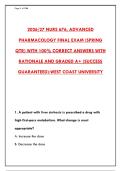
2026/27 NURS 676, ADVANCED

PHARMACOLOGY FINAL EXAM (SPRING

QTR) WITH 100% CORRECT ANSWERS WITH

RATIONALE AND GRADED A+ (SUCCESS

GUARANTEED):WEST COAST UNIVERSITY


1. A patient with liver cirrhosis is prescribed a drug with

high first-pass metabolism. What change is most

appropriate?

A. Increase the dose

B. Decrease the dose

,Page 2 of 126


C. Administer intravenously

D. No change needed

Correct Answer: B – Liver disease reduces first-pass

metabolism, leading to higher bioavailability; dose reduction

prevents toxicity.

2. Which statement best describes the blood-brain barrier

(BBB) effect on drug distribution?

A. Lipophilic drugs cross easily

B. Hydrophilic drugs cross easily

C. All drugs cross freely

D. Only ionized drugs cross

Correct Answer: A – The BBB is lipid-based; lipophilic drugs

passively diffuse through.

3. A patient takes a drug with a half-life of 12 hours. How

long to reach steady state?

A. 24 hours

B. 48 hours

,Page 3 of 126


C. 60 hours

D. 72 hours

Correct Answer: C – Steady state = 4–5 half-lives → 48–60

hours; closest is 60 hours.

4. Which cytochrome P450 enzyme is most commonly

involved in drug-drug interactions?

A. CYP1A2

B. CYP2D6

C. CYP3A4

D. CYP2E1

Correct Answer: C – CYP3A4 metabolizes >50% of all drugs.

5. A drug with zero-order kinetics:

A. Eliminates constant amount per time

B. Eliminates constant fraction per time

C. Has a constant half-life

D. Is always renally cleared

, Page 4 of 126


Correct Answer: A – Example: phenytoin; saturation of

metabolic pathways.

6. Which factor increases volume of distribution (Vd)?

A. High protein binding

B. Low lipophilicity

C. High tissue binding

D. Large molecular weight

Correct Answer: C – High tissue binding pulls drug out of

plasma.

7. A patient has a glomerular filtration rate (GFR) of 25

mL/min. Which antibiotic requires no dose adjustment?

A. Gentamicin

B. Amoxicillin

C. Ceftriaxone

D. Vancomycin

Correct Answer: C – Ceftriaxone is hepatically excreted.

Document information

Uploaded on
April 19, 2026
Number of pages
126
Written in
2025/2026
Type
Exam (elaborations)
Contains
Questions & answers
$28.49

Wrong document? Swap it for free Within 14 days of purchase and before downloading, you can choose a different document. You can simply spend the amount again.
Written by students who passed
Immediately available after payment
Read online or as PDF

Seller avatar
Reputation scores are based on the amount of documents a seller has sold for a fee and the reviews they have received for those documents. There are three levels: Bronze, Silver and Gold. The better the reputation, the more your can rely on the quality of the sellers work.
PREPPERFECT
4.7
(3475)
Sold
431
Followers
60
Items
12065
Last sold
15 hours ago


Why students choose Stuvia

Created by fellow students, verified by reviews

Quality you can trust: written by students who passed their tests and reviewed by others who've used these notes.

Didn't get what you expected? Choose another document

No worries! You can instantly pick a different document that better fits what you're looking for.

Pay as you like, start learning right away

No subscription, no commitments. Pay the way you're used to via credit card and download your PDF document instantly.

Student with book image

“Bought, downloaded, and aced it. It really can be that simple.”

Alisha Student

Working on your references?

Create accurate citations in APA, MLA and Harvard with our free citation generator.

Working on your references?

Frequently asked questions

