

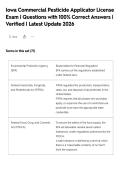
Iowa Commercial Pesticide Applicator License
Exam | Questions with 100% Correct Answers |
Verified | Latest Update 2026
Save
Terms in this set (71)
Enviromental Protection Agency Responsible for Pesticide Regulation
(EPA) EPA carries out the regulations established
under federal laws.
Federal Insecticide, Fungicide, FIFRA regulates the production, transportation,
and Rodenticide Act (FIFRA) sales, use, and disposal of all pesticides in the
United States.
FIFRA requires that all people who purchase,
apply, or supervise the use of a restricted-use
pesticide must have the appropriate state
credentials.
Federal Food, Drug, and Cosmetic To ensure the safety of the food supply, the
Act (FFDCA) EPA set allowable residue levels called
tolerances, under regulations authorized by the
FFDCA.
A safe tolerance is defined as a level at which
there is a "reasonable certainty of no harm"
from the exposure.
, Residue Residue is Pesticides that remain in small
amounts in or on fruits, vegetables, grains,
other foods, and animal feed.
Tolerance The amount of Residue levels allowed in
products that will cause no harm.
Food Quality Protection Act FQPA amended both FIFRA and FFSCA and set
(FQPA) a tougher standard for pesticide use on foods.
FQPA established a single, health-based
standard to be used when assessing the risk of
pesticide residues in food or feed.
FQPA also requires EPA to give special
consideration to the exposure of infants and
children to pesticide residues in food.
Worker Protection Standard WPS is a set of regulations from the EPA aimed
(WPS) at reducing the risk of pesticide poisonings,
injuries, and exposure to agricultural workers
and handlers.
Endangered Species Act (ESA) ESA is a program for the conservation of
threatened ad endangered plants and animals
and the habitats in which they are found.
Pesticide use may directly or indirectly ,
through drift and runoff, affect Endangered
and Threatened Species and their habitat.
Exam | Questions with 100% Correct Answers |
Verified | Latest Update 2026
Save
Terms in this set (71)
Enviromental Protection Agency Responsible for Pesticide Regulation
(EPA) EPA carries out the regulations established
under federal laws.
Federal Insecticide, Fungicide, FIFRA regulates the production, transportation,
and Rodenticide Act (FIFRA) sales, use, and disposal of all pesticides in the
United States.
FIFRA requires that all people who purchase,
apply, or supervise the use of a restricted-use
pesticide must have the appropriate state
credentials.
Federal Food, Drug, and Cosmetic To ensure the safety of the food supply, the
Act (FFDCA) EPA set allowable residue levels called
tolerances, under regulations authorized by the
FFDCA.
A safe tolerance is defined as a level at which
there is a "reasonable certainty of no harm"
from the exposure.
, Residue Residue is Pesticides that remain in small
amounts in or on fruits, vegetables, grains,
other foods, and animal feed.
Tolerance The amount of Residue levels allowed in
products that will cause no harm.
Food Quality Protection Act FQPA amended both FIFRA and FFSCA and set
(FQPA) a tougher standard for pesticide use on foods.
FQPA established a single, health-based
standard to be used when assessing the risk of
pesticide residues in food or feed.
FQPA also requires EPA to give special
consideration to the exposure of infants and
children to pesticide residues in food.
Worker Protection Standard WPS is a set of regulations from the EPA aimed
(WPS) at reducing the risk of pesticide poisonings,
injuries, and exposure to agricultural workers
and handlers.
Endangered Species Act (ESA) ESA is a program for the conservation of
threatened ad endangered plants and animals
and the habitats in which they are found.
Pesticide use may directly or indirectly ,
through drift and runoff, affect Endangered
and Threatened Species and their habitat.


