

=
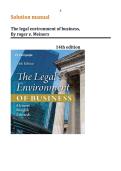
Solution manual
The legal environment of business,
By roger e. Meiners
14th edition
, =
Table of contents
➢ Chapter 1. Today’s business environment: law and ethics
➢ Chapter 2. The court systems
➢ Chapter 3. Trials and resolving disputes
➢ Chapter 4. The constitution: focus on application to business
➢ Chapter 5. Criminal law and business
➢ Chapter 6. Elements of torts
➢ Chapter 7. Business torts and product liability
➢ Chapter 8. Real and personal property
➢ Chapter 9. Intellectual property
➢ Chapter 10. Contracts
➢ Chapter 11. Domestic and international sales
➢ Chapter 12. Business organizations
➢ Chapter 13. Negotiable instruments, credit, and bankruptcy
➢ Chapter 14. Agency and the employment relationship
➢ Chapter 15. Employment and labor regulations
➢ Chapter 16. Employment discrimination
➢ Chapter 17. The regulatory process
➢ Chapter 18. Securities regulation
➢ Chapter 19. Consumer protection
➢ Chapter 20. Antitrust law
➢ Chapter 21. Environmental law
, =
➢ Chapter 22. The international legal environment of business
Chapter 1
Table of contents
Answer to discussion question................................................................................................................ 1
Answers to case questions ......................................................................................................................... 1
Answers to ethics and social questions .............................................................................................. 3
Answer to discussion question
Should the common law maxim “ignorance of the law is no excuse” apply to an
immigrant who speaks little english and was not educated in the united states? How
about for a tourist who does not speak english? Everyone knows criminal acts are
prohibited, but what about subtler rules that differ across countries and so may be
misunderstood by foreigners?
Answer: it is generally true that ignorance of the law is no excuse. Citizens are
deemed to have constructive knowledge of the law. Yet, as well known as this
rule is, it is surprising how often it is proffered as an excuse. (a westlaw
search cases finds hundreds of examples). Examples include: deluco v. Dezi
(conn. Super) (lack of knowledge regarding the state‘s usury laws is no excuse
for the inclusion of an illegal interest rate in a sales contract); and plumlee v.
Paddock (ignorance of the fact that the subject matter of the contract was
illegal was not excuse). The courts have provided a small exception to the rule
when it comes to people in lack of english language skills.
Consider flanery v. Kuska, (defendant did not speak english was advised by a
friend that an answer to a complaint was not required); ramon v. Dept. Of
transportation, (no english and an inability to understand the law required for
an excuse); yurechko v.
County of allegheny, (ignorance and with the fact that the municipality
suffered no hardship in late lawsuit filing was an excuse).
Answers to case questions
1. Facts from an english judge’s decision in 1884: “the crew of an english yacht
were
cast away in
A storm on the high seas . . . And were compelled to put into an open boat. They
had no supply
Of water and no supply of food. . . . That on the eighteenth day . . . They suggested
, =
that one
Should be sacrificed to save the rest. . . . That next day . . . They ..... went to the boy
......................................................................................................................................................... Put a knife
Into his throat and killed him . . . The three men fed upon the body of the boy
for four days; [then]
The boat was picked up by a passing vessel, and [they] were rescued and
committed
For trial. . . .
If the men had not fed upon the body of the boy they would probably not have
Survived to be so picked up and rescued, but wouldhave died of famine. The
boy, being in a much weaker
Condition, was likely to have died before them the real question in this case
[is] whether killing
Under the conditions set forth be or be not murder.” Do you consider the acts to
be immoral?
[regina v. Dudley and stephens, 14 queens bench division 273 (1884)]
Answer: this points out that the legal system has limits. Its acceptability is
dictated by legal culture--which determines whether law will be enforced,
obeyed, avoided, or abused. It is limited by the informal rules of the society--
its customs and values. One limit is the extent to which society will allow the
formal rules to be imposed when a crime is committed in odd circumstances.
Here there was an intentional murder. Does the motive for the murder, the
effort to save several lives by sacrificing one
Solution manual
The legal environment of business,
By roger e. Meiners
14th edition
, =
Table of contents
➢ Chapter 1. Today’s business environment: law and ethics
➢ Chapter 2. The court systems
➢ Chapter 3. Trials and resolving disputes
➢ Chapter 4. The constitution: focus on application to business
➢ Chapter 5. Criminal law and business
➢ Chapter 6. Elements of torts
➢ Chapter 7. Business torts and product liability
➢ Chapter 8. Real and personal property
➢ Chapter 9. Intellectual property
➢ Chapter 10. Contracts
➢ Chapter 11. Domestic and international sales
➢ Chapter 12. Business organizations
➢ Chapter 13. Negotiable instruments, credit, and bankruptcy
➢ Chapter 14. Agency and the employment relationship
➢ Chapter 15. Employment and labor regulations
➢ Chapter 16. Employment discrimination
➢ Chapter 17. The regulatory process
➢ Chapter 18. Securities regulation
➢ Chapter 19. Consumer protection
➢ Chapter 20. Antitrust law
➢ Chapter 21. Environmental law
, =
➢ Chapter 22. The international legal environment of business
Chapter 1
Table of contents
Answer to discussion question................................................................................................................ 1
Answers to case questions ......................................................................................................................... 1
Answers to ethics and social questions .............................................................................................. 3
Answer to discussion question
Should the common law maxim “ignorance of the law is no excuse” apply to an
immigrant who speaks little english and was not educated in the united states? How
about for a tourist who does not speak english? Everyone knows criminal acts are
prohibited, but what about subtler rules that differ across countries and so may be
misunderstood by foreigners?
Answer: it is generally true that ignorance of the law is no excuse. Citizens are
deemed to have constructive knowledge of the law. Yet, as well known as this
rule is, it is surprising how often it is proffered as an excuse. (a westlaw
search cases finds hundreds of examples). Examples include: deluco v. Dezi
(conn. Super) (lack of knowledge regarding the state‘s usury laws is no excuse
for the inclusion of an illegal interest rate in a sales contract); and plumlee v.
Paddock (ignorance of the fact that the subject matter of the contract was
illegal was not excuse). The courts have provided a small exception to the rule
when it comes to people in lack of english language skills.
Consider flanery v. Kuska, (defendant did not speak english was advised by a
friend that an answer to a complaint was not required); ramon v. Dept. Of
transportation, (no english and an inability to understand the law required for
an excuse); yurechko v.
County of allegheny, (ignorance and with the fact that the municipality
suffered no hardship in late lawsuit filing was an excuse).
Answers to case questions
1. Facts from an english judge’s decision in 1884: “the crew of an english yacht
were
cast away in
A storm on the high seas . . . And were compelled to put into an open boat. They
had no supply
Of water and no supply of food. . . . That on the eighteenth day . . . They suggested
, =
that one
Should be sacrificed to save the rest. . . . That next day . . . They ..... went to the boy
......................................................................................................................................................... Put a knife
Into his throat and killed him . . . The three men fed upon the body of the boy
for four days; [then]
The boat was picked up by a passing vessel, and [they] were rescued and
committed
For trial. . . .
If the men had not fed upon the body of the boy they would probably not have
Survived to be so picked up and rescued, but wouldhave died of famine. The
boy, being in a much weaker
Condition, was likely to have died before them the real question in this case
[is] whether killing
Under the conditions set forth be or be not murder.” Do you consider the acts to
be immoral?
[regina v. Dudley and stephens, 14 queens bench division 273 (1884)]
Answer: this points out that the legal system has limits. Its acceptability is
dictated by legal culture--which determines whether law will be enforced,
obeyed, avoided, or abused. It is limited by the informal rules of the society--
its customs and values. One limit is the extent to which society will allow the
formal rules to be imposed when a crime is committed in odd circumstances.
Here there was an intentional murder. Does the motive for the murder, the
effort to save several lives by sacrificing one


