WJEC AS Macroeconomics Revision Notes
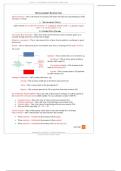
WJEC AS Macroeconomics Revision Notes 100% Pass Macroeconomics Revision Notes Macroeconomics = This is the branch of economics that studies the behaviour and performance of the economy as a whole. 1. Macroeconomic Theory Topics include: the circular flow of income - 1.1; aggregate demand (AD) - 1.2; aggregate supply (AS) -1.3; AD/AS Analysis – 1.4. 1.1. Circular Flow of Income The circular flow of income = This is how money moves between various economic agents in an economy through the process of trade and exchange. Domestic consumption = This is when money flows to firms from households in exchange for goods and services. Income = This is when money flows to households from firms in exchange for the supply of labour. The model: HOUSEHOLDS INJECTIONS Investment (I) Government Expenditure (6) Exports (X) Consumption (C) FIRMS LEAKAGES/ WITHDRAWALS Saving (S) Taxes (T Imports (M) Injection = This is money that enters the model, e.g: Investment = This is money spent on firms to increase their output (I). Government spending = This is money in the form of fiscal policy (G). Exports = This is money spent on UK products by other countries (X). Leakages/withdrawals = This is money that leaves, e.g: Savings = This is money people put in the bank to earn interest (S). Taxes = This is money taken by the government (T). Imports = This is money spent by the UK on products from other countries (M). Gross Domestic Product (GDP) = This is the value of the country's economy; it is all the aspects of the circular flow of income model added together. You can calculate a country's GDP by: National income = This is the value of what is earnt in an economy (NI). National expenditure = This is the value of all spending in an economy (NE). National output = This is the value of everything produced in an economy (NO). They are all the same thing: NI = NE = NO. Closed economy = This is when money cannot enter or leave the circular flow of income. Open economy = This is when money can enter and leave the economy. When injections withdrawals the economy will get bigger. When injections withdrawals the economy will get smaller. When injections = withdrawals the economy will stay the same size. Economy Growing More jobs are created, so there is more spending. Less need to spend on benefits. More government tax revenue for investment. Higher firm profits to expand, so they will become more internationally competitive. Economy Shrinking Fewerjobs, so there is less spending. More need to spend on benefits. Less government tax revenue for investment. Lower firm profits to expand, so they will become less internationally competitive. 1.1.1. The Multiplier Effect The multiplier effect = This is when a change in injections causes a larger final change in GDP. Fiscal multiplier = This is when the initial trigger is caused by government expenditure. Multiplier (K) = Change in real GDP (Y) / Change in Injections (J) K= Y/J Factors affecting the multiplier include: 1. Propensity to spend on domestic products = In the UK, we tend to favour imports over domestic, whereas in USA people are more passionate about buying domestic products. 2. Propensity to save = In Japan, people are very quick to save any extra income, whereas people in the UK are far more likely to spend. 3. Marginal rate of tax = The UK has a fairly high rate of tax meaning a lot of extra income will simply leave the economy, whereas in parts of Eastern Europe it is much lower. 4. Consumer confidence = Typically, during a time of economic growth the multiplier will be larger than in a recession. 1.2. Aggregate Demand Aggregate demand = This is the total amount of demand for goods and services in the economy. The five categories: Category Domestic Consumption (C) Investment (I) Government Spending (G) Imports (M) Exports (X) Explanation This is the domestic produce purchased by people within the UK. This is the money spent by firms on buildings, machinery and improving the skills of the labour force. This is money spent by the government on a product or service. These are the goods and services that are purchased from other countries. These are the goods and services sold to other countries.
Document information
- Uploaded on
- April 17, 2026
- Number of pages
- 48
- Written in
- 2025/2026
- Type
- Exam (elaborations)
- Contains
- Questions & answers