

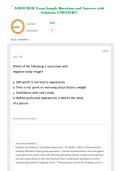
ASWB MSW Exam Sample Questions and Answers with
Solutions UPDATED!!!
Correct
Incorrect
The correct answer is C.
Kadushin and Harkness ("Social Work Supervision," 4th Edition, 2002, p. 454) provide the
following definition of peer group supervision: "A group of professionals in the same agency
meet regularly to review cases and treatment approaches without a leader, share expertise,
and take responsibility for their own and each other's professional development and for
maintaining standards of [agency] service." The peer group controls the meetings, and, if a
,supervisor attends the meetings, he or she is just another member of the group. Social
workers attending the meetings decide for themselves what to do with the suggestions and
advice offered by their peers.
Answer A: The question is asking about peer group supervision, not a one-on-one
consultation.
Answer B: Supervisors are not banned from the group - if a supervisor attends the meetings,
he or she is just another member of the group.
The correct answer is AAnswer D: The peer group controls the meetings.
Being asked on a date by a former client three months after treatment ends requires some
sort of response; explaining the concept of ethical boundaries to the client is the social
worker's BEST response.
Option D
If a client believes that his or her physical
appearance is linked to his or her value, negative
body image is likely to emerge. A client's self-
worth should not be defined by appearance.
The correct answer is C.
Single-subject designs (e.g., ABAB design, multiple baseline design) study the effects of
treatment on the behavior of one subject. They differ from group designs in two primary
ways: the number of subjects used and the use of repeated measures of the dependent
variable during baseline and treatment phases of the study. In a single subject research
design, the subject serves as his or her own control. In other words, the subject serves as his
or her own comparison group - i.e., the subject's performance during the baseline (no
treatment) phases is compared to his or her performance during the treatment phases.
Answer A: The dependent variable is the variable being tested and measured in an
experiment, and is 'dependent' on the independent variable.
Answer B: A variable is an independent variable when it is believed to affect or alter
,
, Answer C: There is no need to refer the client. The social worker should take this as an
opportunity to broaden her knowledge about the client's culture.
The correct answer is C.
Kadushin and Harkness ("Social Work Supervision," 4th Edition, 2002, p. 454) provide the
following definition of peer group supervision: "A group of professionals in the same agency
meet regularly to review cases and treatment approaches without a leader, share expertise,
and take responsibility for their own and each other's professional development and for
maintaining standards of [agency] service." The peer group controls the meetings, and, if a
supervisor attends the meetings, he or she is just another member of the group. Social
workers attending the meetings decide for themselves what to do with the suggestions and
advice offered by their peers.
Answer A: The question is asking about peer group supervision, not a one-on-one
consultation.
Answer B: Supervisors are not banned from the group - if a supervisor attends the meetings,
he or she is just another member of the group. Answer D: The peer group controls the
meetings.
The correct answer is C.
The risk for "copy-cat" suicide can be high for someone who has had proximity to another's
suicide, so this answer deals directly with the safety issue posed by this phenomenon.
Answer A: This is a good answer but does not deal with the potential of suicidal ideation.
Answer B: This is also a good answer but does not deal with the potential of suicidal ideation.
Answer D: While this answer does deal with the issue of copy-cat suicide, it is less targeted
on the clinical management of the difficulty she may have with the suicide of her brother - in
other words, assessing her for medical issues would have happened in the first session,
whereas this question is focusing more on the middle stage interventions.
Solutions UPDATED!!!
Correct
Incorrect
The correct answer is C.
Kadushin and Harkness ("Social Work Supervision," 4th Edition, 2002, p. 454) provide the
following definition of peer group supervision: "A group of professionals in the same agency
meet regularly to review cases and treatment approaches without a leader, share expertise,
and take responsibility for their own and each other's professional development and for
maintaining standards of [agency] service." The peer group controls the meetings, and, if a
,supervisor attends the meetings, he or she is just another member of the group. Social
workers attending the meetings decide for themselves what to do with the suggestions and
advice offered by their peers.
Answer A: The question is asking about peer group supervision, not a one-on-one
consultation.
Answer B: Supervisors are not banned from the group - if a supervisor attends the meetings,
he or she is just another member of the group.
The correct answer is AAnswer D: The peer group controls the meetings.
Being asked on a date by a former client three months after treatment ends requires some
sort of response; explaining the concept of ethical boundaries to the client is the social
worker's BEST response.
Option D
If a client believes that his or her physical
appearance is linked to his or her value, negative
body image is likely to emerge. A client's self-
worth should not be defined by appearance.
The correct answer is C.
Single-subject designs (e.g., ABAB design, multiple baseline design) study the effects of
treatment on the behavior of one subject. They differ from group designs in two primary
ways: the number of subjects used and the use of repeated measures of the dependent
variable during baseline and treatment phases of the study. In a single subject research
design, the subject serves as his or her own control. In other words, the subject serves as his
or her own comparison group - i.e., the subject's performance during the baseline (no
treatment) phases is compared to his or her performance during the treatment phases.
Answer A: The dependent variable is the variable being tested and measured in an
experiment, and is 'dependent' on the independent variable.
Answer B: A variable is an independent variable when it is believed to affect or alter
,
, Answer C: There is no need to refer the client. The social worker should take this as an
opportunity to broaden her knowledge about the client's culture.
The correct answer is C.
Kadushin and Harkness ("Social Work Supervision," 4th Edition, 2002, p. 454) provide the
following definition of peer group supervision: "A group of professionals in the same agency
meet regularly to review cases and treatment approaches without a leader, share expertise,
and take responsibility for their own and each other's professional development and for
maintaining standards of [agency] service." The peer group controls the meetings, and, if a
supervisor attends the meetings, he or she is just another member of the group. Social
workers attending the meetings decide for themselves what to do with the suggestions and
advice offered by their peers.
Answer A: The question is asking about peer group supervision, not a one-on-one
consultation.
Answer B: Supervisors are not banned from the group - if a supervisor attends the meetings,
he or she is just another member of the group. Answer D: The peer group controls the
meetings.
The correct answer is C.
The risk for "copy-cat" suicide can be high for someone who has had proximity to another's
suicide, so this answer deals directly with the safety issue posed by this phenomenon.
Answer A: This is a good answer but does not deal with the potential of suicidal ideation.
Answer B: This is also a good answer but does not deal with the potential of suicidal ideation.
Answer D: While this answer does deal with the issue of copy-cat suicide, it is less targeted
on the clinical management of the difficulty she may have with the suicide of her brother - in
other words, assessing her for medical issues would have happened in the first session,
whereas this question is focusing more on the middle stage interventions.


