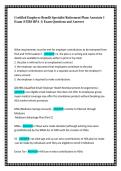
Certified Employee Benefit Specialist Retirement Plans Associate 1
Exam (CEBS RPA 1) Exam Questions and Answers
What requirements must be met for employer contributions to be exempted from
FICA and FUTA taxation? - ANSWER>>1. the plan is in writing and copies of the
details are available to employees either in print or by email
2. the plan is referred to in an employment contract
3. the employer can document that employees contribute to the plan
4. employer contributions are kept in a separate account from the employer's
salary account
5. the employer is required to make contributions
QSEHRA (Qualified Small Employer Health Reimbursement Arrangements) -
ANSWER>>an eligible small employer that does not offer its employees group
major medical coverage may offer this standalone product without breaking any
ACA market reform provisions
MSA (Medicare Savings Account) - ANSWER>>similar to HSA but through
Medicare
-Medicare Advantage Plan (Part C)
MSAs - ANSWER>>These were made obsolete (although existing ones were
grandfathered) by the MMA Act of 2003 with the creation of HSAs
55 - ANSWER>>at what age and up can extra contributions to HSA plan be made
-can be made by individuals until they are eligible to enroll in Medicare
Excise Tax - ANSWER>>6% tax on extra contributions to HSAs
,Cafeteria Plan - ANSWER>>a type of benefit plan permitted by IRS Section 125 in
which the employer offers employees a choice of benefits
-either taxable cash compensation or tax free (qualified benefits)
-plan must include one taxable and one qualified benefit
Type of plans offered under a cafeteria plan - ANSWER>>401k plan, health and
accident insurance plan coverage, HSA contributions, long term and short term
disability coverage, COBRA continuation coverage premiums
Benefits that are nonqualified and may be offered as part of a cafeteria plan -
ANSWER>>Scholarships/fellowships, nontaxable fringe benefits under section
132, educational assistance benefits, meals/lodging provided for the employer's
benefit, MSA contribution made by the employer, certain HSAs, certain long term
care insurance benefits, certain group term life insurance benefits, tax sheltered
annuity plan elective deferrals under section 403b
Roth IRA - ANSWER>>an individual retirement account allowing a person to set
aside after-tax income up to a specified amount each year.
-contributions are not deductible from employee income
-Both earnings on the account and withdrawals after age 59½ are tax-free.
SEP (Simplified Employee Pension) Plan - ANSWER>>an option for employers that
do no have the financial resources to administer more complicated deferred
compensation plans such as 401k plans
-employer contributions to these plans (up to the annual limit) are no FIT, FICA, or
FUTA taxable and any contributions over the limit are wages to employees
Windsor Effect - ANSWER>>The extension of benefit rights to couples in same-sex
marriage
5 main ERISA reporting and disclosure requirements - ANSWER>>-a written plan
document
, -a summary plan description
-a summary of material modification
-an annual financial report (Form 5500)
-a summary annual report
Total Compensation Statement - ANSWER>>A document that calculates and
reveals the total of employee's pay
-cost of benefits is computed and added with pay to reveal the employee's actual
total compensation
SOC 1 - ANSWER>>an audit control report
-prepared by an auditor engaged by the 3rd party administrator to review and
assess controls at that service organization
-the service organization then provides the report to any entity relying on its
controls
-also known as a Report on Controls at a Service Organization Relevant to User
Entities' Internal Control Over Financial Reporting
Market Driven Approach - ANSWER>>a direct communication approach to
employee benefit plan communications
-objectives are specific
-the focus is on affecting or changing attitudes/behaviors
-success is directly measurable
-messages are targeted to a specific audience
-communication tone is direct
every 3 to 5 years - ANSWER>>Retirement Plan RFPS should be issued at a
minimum of how many years
Traditional Approach - ANSWER>>employee benefit plan communications
-objectives are general
-focus is on informing or explaining benefits
-success is often hard to measure
Exam (CEBS RPA 1) Exam Questions and Answers
What requirements must be met for employer contributions to be exempted from
FICA and FUTA taxation? - ANSWER>>1. the plan is in writing and copies of the
details are available to employees either in print or by email
2. the plan is referred to in an employment contract
3. the employer can document that employees contribute to the plan
4. employer contributions are kept in a separate account from the employer's
salary account
5. the employer is required to make contributions
QSEHRA (Qualified Small Employer Health Reimbursement Arrangements) -
ANSWER>>an eligible small employer that does not offer its employees group
major medical coverage may offer this standalone product without breaking any
ACA market reform provisions
MSA (Medicare Savings Account) - ANSWER>>similar to HSA but through
Medicare
-Medicare Advantage Plan (Part C)
MSAs - ANSWER>>These were made obsolete (although existing ones were
grandfathered) by the MMA Act of 2003 with the creation of HSAs
55 - ANSWER>>at what age and up can extra contributions to HSA plan be made
-can be made by individuals until they are eligible to enroll in Medicare
Excise Tax - ANSWER>>6% tax on extra contributions to HSAs
,Cafeteria Plan - ANSWER>>a type of benefit plan permitted by IRS Section 125 in
which the employer offers employees a choice of benefits
-either taxable cash compensation or tax free (qualified benefits)
-plan must include one taxable and one qualified benefit
Type of plans offered under a cafeteria plan - ANSWER>>401k plan, health and
accident insurance plan coverage, HSA contributions, long term and short term
disability coverage, COBRA continuation coverage premiums
Benefits that are nonqualified and may be offered as part of a cafeteria plan -
ANSWER>>Scholarships/fellowships, nontaxable fringe benefits under section
132, educational assistance benefits, meals/lodging provided for the employer's
benefit, MSA contribution made by the employer, certain HSAs, certain long term
care insurance benefits, certain group term life insurance benefits, tax sheltered
annuity plan elective deferrals under section 403b
Roth IRA - ANSWER>>an individual retirement account allowing a person to set
aside after-tax income up to a specified amount each year.
-contributions are not deductible from employee income
-Both earnings on the account and withdrawals after age 59½ are tax-free.
SEP (Simplified Employee Pension) Plan - ANSWER>>an option for employers that
do no have the financial resources to administer more complicated deferred
compensation plans such as 401k plans
-employer contributions to these plans (up to the annual limit) are no FIT, FICA, or
FUTA taxable and any contributions over the limit are wages to employees
Windsor Effect - ANSWER>>The extension of benefit rights to couples in same-sex
marriage
5 main ERISA reporting and disclosure requirements - ANSWER>>-a written plan
document
, -a summary plan description
-a summary of material modification
-an annual financial report (Form 5500)
-a summary annual report
Total Compensation Statement - ANSWER>>A document that calculates and
reveals the total of employee's pay
-cost of benefits is computed and added with pay to reveal the employee's actual
total compensation
SOC 1 - ANSWER>>an audit control report
-prepared by an auditor engaged by the 3rd party administrator to review and
assess controls at that service organization
-the service organization then provides the report to any entity relying on its
controls
-also known as a Report on Controls at a Service Organization Relevant to User
Entities' Internal Control Over Financial Reporting
Market Driven Approach - ANSWER>>a direct communication approach to
employee benefit plan communications
-objectives are specific
-the focus is on affecting or changing attitudes/behaviors
-success is directly measurable
-messages are targeted to a specific audience
-communication tone is direct
every 3 to 5 years - ANSWER>>Retirement Plan RFPS should be issued at a
minimum of how many years
Traditional Approach - ANSWER>>employee benefit plan communications
-objectives are general
-focus is on informing or explaining benefits
-success is often hard to measure