
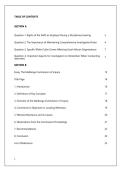
TABLE OF CONTENTS
SECTION A
Question 1: Rights of the SAPS as Employer During a Disciplinary Hearing 2
Question 2: The Importance of Maintaining Comprehensive Investigative Notes 4
Question 3: Specific White-Collar Crimes Affecting South African Organisations 7
Question 4: Important Aspects for Investigators to Remember When Conducting 7
Interviews
SECTION B
Essay: The Madlanga Commission of Inquiry 15
Title Page 16
1. Introduction 16
2. Definitions of Key Concepts 17
3. Overview of the Madlanga Commission of Inquiry 18
4. Commission's Objectives in Locating Witnesses 19
5. Witness Reluctance and Its Causes 20
6. Observations from the Commission Proceedings 21
7. Recommendations 22
8. Conclusion 24
List of References 25
1
, SECTION A
QUESTION 1
Rights of the SAPS as Employer During a Disciplinary Hearing
When members of the South African Police Service (SAPS) involved in misconduct are
disciplined, the SAPS as the employer must afford the accused employees certain
fundamental rights during the disciplinary hearing. These rights are essential to ensure
procedural fairness and compliance with labour legislation, particularly the Labour
Relations Act 66 of 1995 and Schedule 8: Code of Good Practice.
The rights of the SAPS as the employer include:
1. The right to discipline employees
The employer has the right to institute disciplinary proceedings against employees who
have transgressed workplace rules or engaged in misconduct. Study Unit 10, section
10.16 of the SEP2603 study guide confirms this right, stating that "the employer has the
right to discipline employees" (SEP2603 Study Guide, 2015, p. 148). This is
fundamental to maintaining discipline and order within the organisation.
2. The right to appoint a chairperson and initiator
The employer is entitled to appoint a chairperson for the disciplinary hearing who must
be impartial and independent, not having been involved in investigating the matter.
Additionally, the employer may appoint an initiator to present the case against the
accused employee. The chairperson of the disciplinary enquiry "must, insofar as it is
possible, be a person who is able to make an independent decision based on the facts
presented at the enquiry" (SEP2603 Study Guide, 2015, Study Unit 10, section 10.9, p.
143).
2
SECTION A
Question 1: Rights of the SAPS as Employer During a Disciplinary Hearing 2
Question 2: The Importance of Maintaining Comprehensive Investigative Notes 4
Question 3: Specific White-Collar Crimes Affecting South African Organisations 7
Question 4: Important Aspects for Investigators to Remember When Conducting 7
Interviews
SECTION B
Essay: The Madlanga Commission of Inquiry 15
Title Page 16
1. Introduction 16
2. Definitions of Key Concepts 17
3. Overview of the Madlanga Commission of Inquiry 18
4. Commission's Objectives in Locating Witnesses 19
5. Witness Reluctance and Its Causes 20
6. Observations from the Commission Proceedings 21
7. Recommendations 22
8. Conclusion 24
List of References 25
1
, SECTION A
QUESTION 1
Rights of the SAPS as Employer During a Disciplinary Hearing
When members of the South African Police Service (SAPS) involved in misconduct are
disciplined, the SAPS as the employer must afford the accused employees certain
fundamental rights during the disciplinary hearing. These rights are essential to ensure
procedural fairness and compliance with labour legislation, particularly the Labour
Relations Act 66 of 1995 and Schedule 8: Code of Good Practice.
The rights of the SAPS as the employer include:
1. The right to discipline employees
The employer has the right to institute disciplinary proceedings against employees who
have transgressed workplace rules or engaged in misconduct. Study Unit 10, section
10.16 of the SEP2603 study guide confirms this right, stating that "the employer has the
right to discipline employees" (SEP2603 Study Guide, 2015, p. 148). This is
fundamental to maintaining discipline and order within the organisation.
2. The right to appoint a chairperson and initiator
The employer is entitled to appoint a chairperson for the disciplinary hearing who must
be impartial and independent, not having been involved in investigating the matter.
Additionally, the employer may appoint an initiator to present the case against the
accused employee. The chairperson of the disciplinary enquiry "must, insofar as it is
possible, be a person who is able to make an independent decision based on the facts
presented at the enquiry" (SEP2603 Study Guide, 2015, Study Unit 10, section 10.9, p.
143).
2


