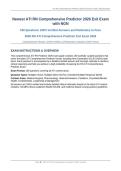
ATI RN Comprehensive Predictor 2026 Exit Exam | NGN | 180 Questions
Newest ATI RN Comprehensive Predictor 2026 Exit Exam
with NGN
180 Questions 100% Verified Answers and Rationales to Pass
2026 RN ATI Comprehensive Predictor Exit Exam 2026
Comprehensive Review | 100% Verified | All Rationales Included | NGN Format
EXAM INSTRUCTIONS & OVERVIEW
This comprehensive ATI RN Predictor 2026 exam guide contains 180 carefully curated questions that
mirror the latest ATI Comprehensive Predictor format, including Next Generation NCLEX (NGN) style
items. Each question is accompanied by a detailed verified answer and thorough rationale to reinforce
clinical reasoning and help you achieve a high probability of passing the RN ATI Comprehensive
Predictor Exam.
Exam Format: 180 questions covering all ATI content areas
Question Types: Multiple Choice, Multiple Select (SATA), Extended Multiple Response (NGN)
Content Areas: Medical-Surgical, Pharmacology, Maternal-Newborn, Pediatrics, Psychiatric/Mental
Health, Fundamentals, Leadership & Management
All answers are 100% verified and include detailed clinical rationales based on the latest ATI content
modules, NCSBN Clinical Judgment Model (NCJM), and evidence-based nursing practice guidelines.
Page 1 | 2026 ATI RN Comprehensive Predictor | 100% Verified
, ATI RN Comprehensive Predictor 2026 Exit Exam | NGN | 180 Questions
EXAMINATION QUESTIONS WITH VERIFIED ANSWERS & RATIONALES
QUESTION 1 [Multiple Choice]
A nurse is caring for a client who is postoperative following a hip arthroplasty. Which of the
following actions should the nurse take to prevent dislocation of the prosthesis?
A. Place a pillow between the client's legs
B. Position the client with the affected hip in adduction
C. Encourage the client to cross their legs at the ankles
D. Place the client in a prone position
CORRECT ANSWER: A
RATIONALE: After hip arthroplasty, the nurse should maintain hip abduction by placing a pillow
(abduction pillow) between the client's legs. This prevents adduction, which can cause dislocation of
the prosthetic joint. Adduction, crossing the legs, and prone positioning all increase the risk of
dislocation.
QUESTION 2 [Multiple Choice]
A nurse is reviewing the medical record of a client who has chronic kidney disease. Which of
the following laboratory values should the nurse report to the provider?
A. BUN 18 mg/dL
B. Serum creatinine 1.0 mg/dL
C. Serum potassium 6.2 mEq/L
D. Serum sodium 138 mEq/L
CORRECT ANSWER: C
RATIONALE: A serum potassium of 6.2 mEq/L (hyperkalemia) is a critical finding in a client with
chronic kidney disease. The kidneys are responsible for excreting potassium, and hyperkalemia can
cause life-threatening cardiac dysrhythmias. Normal potassium is 3.5–5.0 mEq/L. The other values are
within normal range.
QUESTION 3 [Multiple Select]
A nurse is preparing to administer a blood transfusion. Which of the following actions should
the nurse take? (Select all that apply.)
A. Verify the blood type with another nurse
B. Use a 22-gauge IV catheter for the infusion
C. Prime the blood tubing with normal saline
D. Infuse the blood within 4 hours of initiation
E. Monitor vital signs every 15 minutes for the first hour
CORRECT ANSWER: A, C, D, E
RATIONALE: Correct actions include verifying blood type with two nurses (safety check), priming
tubing with normal saline (compatible), completing infusion within 4 hours (prevents bacterial growth),
and monitoring vitals every 15 minutes during the first hour (detects transfusion reactions). A minimum
18-gauge catheter should be used—not 22-gauge—to prevent hemolysis.
Page 2 | 2026 ATI RN Comprehensive Predictor | 100% Verified
, ATI RN Comprehensive Predictor 2026 Exit Exam | NGN | 180 Questions
QUESTION 4 [Multiple Choice]
A nurse is assessing a client who has left-sided heart failure. Which of the following findings
should the nurse expect?
A. Peripheral edema
B. Ascites
C. Crackles in the lung bases
D. Jugular vein distension
CORRECT ANSWER: C
RATIONALE: Left-sided heart failure causes backup of blood into the pulmonary circulation, resulting
in pulmonary edema. The nurse would expect crackles (rales) in the lung bases due to fluid
accumulation. Peripheral edema, ascites, and jugular vein distension are signs of right-sided heart
failure.
QUESTION 5 [Multiple Choice]
A nurse is caring for a client who has diabetes mellitus and reports feeling shaky and sweaty.
The client's blood glucose is 58 mg/dL. Which of the following actions should the nurse take
first?
A. Notify the provider
B. Administer 4 oz of orange juice
C. Administer 50% dextrose IV
D. Recheck blood glucose in 30 minutes
CORRECT ANSWER: B
RATIONALE: The client is experiencing hypoglycemia (blood glucose < 70 mg/dL). For a conscious
client who can swallow safely, the nurse should administer 15 grams of fast-acting carbohydrate such
as 4 oz of orange juice using the '15-15 rule.' The client's ability to swallow makes oral treatment the
first choice over IV dextrose.
QUESTION 6 [Multiple Choice]
A nurse is caring for a client who is in labor and receiving oxytocin (Pitocin) via IV infusion. The
nurse notes the client is having contractions every 2 minutes lasting 95 seconds with a
nonreassuring fetal heart rate pattern. Which of the following actions should the nurse take
first?
A. Increase the IV fluid rate
B. Discontinue the oxytocin infusion
C. Notify the provider
D. Administer oxygen via face mask
CORRECT ANSWER: B
RATIONALE: Uterine tachysystole (contractions more frequent than every 2 minutes or lasting longer
than 90 seconds) with a nonreassuring fetal heart rate is an emergency. The priority action is to
discontinue the oxytocin to reduce uterine stimulation. Subsequent actions include repositioning,
oxygen, IV fluids, and notifying the provider.
Page 3 | 2026 ATI RN Comprehensive Predictor | 100% Verified
, ATI RN Comprehensive Predictor 2026 Exit Exam | NGN | 180 Questions
QUESTION 7 [Multiple Choice]
A nurse is planning care for a client who has a new ileostomy. Which of the following should be
included in the teaching?
A. Expect the stoma output to be formed stool
B. Change the pouching system every 7 to 10 days
C. Empty the pouch when it is one-third to one-half full
D. Apply a skin barrier cream directly to the stoma
CORRECT ANSWER: C
RATIONALE: The nurse should teach the client to empty the pouch when it is one-third to one-half full
to prevent leakage and the weight of the pouch from pulling away from the skin. Ileostomy output is
liquid, not formed. The pouching system should be changed every 3 to 7 days. Skin barrier is applied to
the peristomal skin, not the stoma itself.
QUESTION 8 [Multiple Choice]
A nurse is caring for a client who is receiving total parenteral nutrition (TPN). Which of the
following is the priority assessment?
A. Blood glucose levels every 4 to 6 hours
B. Daily weight
C. Urine output every 8 hours
D. Peripheral IV site condition
CORRECT ANSWER: A
RATIONALE: Monitoring blood glucose is the priority assessment because TPN solutions are highly
concentrated in dextrose, placing the client at risk for hyperglycemia. Hyperglycemia can lead to
hyperosmolar hyperglycemic state, which is life-threatening. While daily weight, urine output, and IV
site monitoring are important, blood glucose monitoring is the priority.
QUESTION 9 [Multiple Select]
A nurse is caring for a client who has a prescription for seizure precautions. Which of the
following interventions should the nurse implement? (Select all that apply.)
A. Pad the side rails of the bed
B. Keep a tongue blade at the bedside
C. Maintain IV access
D. Keep the bed in the lowest position
E. Keep suction equipment at the bedside
CORRECT ANSWER: A, C, D, E
RATIONALE: Seizure precautions include padding side rails, maintaining IV access for emergency
medications, keeping the bed in the lowest position, and keeping suction equipment available. Placing
a tongue blade at the bedside is incorrect because nothing should ever be inserted into the mouth
during a seizure, as it can cause injury.
Page 4 | 2026 ATI RN Comprehensive Predictor | 100% Verified
Newest ATI RN Comprehensive Predictor 2026 Exit Exam
with NGN
180 Questions 100% Verified Answers and Rationales to Pass
2026 RN ATI Comprehensive Predictor Exit Exam 2026
Comprehensive Review | 100% Verified | All Rationales Included | NGN Format
EXAM INSTRUCTIONS & OVERVIEW
This comprehensive ATI RN Predictor 2026 exam guide contains 180 carefully curated questions that
mirror the latest ATI Comprehensive Predictor format, including Next Generation NCLEX (NGN) style
items. Each question is accompanied by a detailed verified answer and thorough rationale to reinforce
clinical reasoning and help you achieve a high probability of passing the RN ATI Comprehensive
Predictor Exam.
Exam Format: 180 questions covering all ATI content areas
Question Types: Multiple Choice, Multiple Select (SATA), Extended Multiple Response (NGN)
Content Areas: Medical-Surgical, Pharmacology, Maternal-Newborn, Pediatrics, Psychiatric/Mental
Health, Fundamentals, Leadership & Management
All answers are 100% verified and include detailed clinical rationales based on the latest ATI content
modules, NCSBN Clinical Judgment Model (NCJM), and evidence-based nursing practice guidelines.
Page 1 | 2026 ATI RN Comprehensive Predictor | 100% Verified
, ATI RN Comprehensive Predictor 2026 Exit Exam | NGN | 180 Questions
EXAMINATION QUESTIONS WITH VERIFIED ANSWERS & RATIONALES
QUESTION 1 [Multiple Choice]
A nurse is caring for a client who is postoperative following a hip arthroplasty. Which of the
following actions should the nurse take to prevent dislocation of the prosthesis?
A. Place a pillow between the client's legs
B. Position the client with the affected hip in adduction
C. Encourage the client to cross their legs at the ankles
D. Place the client in a prone position
CORRECT ANSWER: A
RATIONALE: After hip arthroplasty, the nurse should maintain hip abduction by placing a pillow
(abduction pillow) between the client's legs. This prevents adduction, which can cause dislocation of
the prosthetic joint. Adduction, crossing the legs, and prone positioning all increase the risk of
dislocation.
QUESTION 2 [Multiple Choice]
A nurse is reviewing the medical record of a client who has chronic kidney disease. Which of
the following laboratory values should the nurse report to the provider?
A. BUN 18 mg/dL
B. Serum creatinine 1.0 mg/dL
C. Serum potassium 6.2 mEq/L
D. Serum sodium 138 mEq/L
CORRECT ANSWER: C
RATIONALE: A serum potassium of 6.2 mEq/L (hyperkalemia) is a critical finding in a client with
chronic kidney disease. The kidneys are responsible for excreting potassium, and hyperkalemia can
cause life-threatening cardiac dysrhythmias. Normal potassium is 3.5–5.0 mEq/L. The other values are
within normal range.
QUESTION 3 [Multiple Select]
A nurse is preparing to administer a blood transfusion. Which of the following actions should
the nurse take? (Select all that apply.)
A. Verify the blood type with another nurse
B. Use a 22-gauge IV catheter for the infusion
C. Prime the blood tubing with normal saline
D. Infuse the blood within 4 hours of initiation
E. Monitor vital signs every 15 minutes for the first hour
CORRECT ANSWER: A, C, D, E
RATIONALE: Correct actions include verifying blood type with two nurses (safety check), priming
tubing with normal saline (compatible), completing infusion within 4 hours (prevents bacterial growth),
and monitoring vitals every 15 minutes during the first hour (detects transfusion reactions). A minimum
18-gauge catheter should be used—not 22-gauge—to prevent hemolysis.
Page 2 | 2026 ATI RN Comprehensive Predictor | 100% Verified
, ATI RN Comprehensive Predictor 2026 Exit Exam | NGN | 180 Questions
QUESTION 4 [Multiple Choice]
A nurse is assessing a client who has left-sided heart failure. Which of the following findings
should the nurse expect?
A. Peripheral edema
B. Ascites
C. Crackles in the lung bases
D. Jugular vein distension
CORRECT ANSWER: C
RATIONALE: Left-sided heart failure causes backup of blood into the pulmonary circulation, resulting
in pulmonary edema. The nurse would expect crackles (rales) in the lung bases due to fluid
accumulation. Peripheral edema, ascites, and jugular vein distension are signs of right-sided heart
failure.
QUESTION 5 [Multiple Choice]
A nurse is caring for a client who has diabetes mellitus and reports feeling shaky and sweaty.
The client's blood glucose is 58 mg/dL. Which of the following actions should the nurse take
first?
A. Notify the provider
B. Administer 4 oz of orange juice
C. Administer 50% dextrose IV
D. Recheck blood glucose in 30 minutes
CORRECT ANSWER: B
RATIONALE: The client is experiencing hypoglycemia (blood glucose < 70 mg/dL). For a conscious
client who can swallow safely, the nurse should administer 15 grams of fast-acting carbohydrate such
as 4 oz of orange juice using the '15-15 rule.' The client's ability to swallow makes oral treatment the
first choice over IV dextrose.
QUESTION 6 [Multiple Choice]
A nurse is caring for a client who is in labor and receiving oxytocin (Pitocin) via IV infusion. The
nurse notes the client is having contractions every 2 minutes lasting 95 seconds with a
nonreassuring fetal heart rate pattern. Which of the following actions should the nurse take
first?
A. Increase the IV fluid rate
B. Discontinue the oxytocin infusion
C. Notify the provider
D. Administer oxygen via face mask
CORRECT ANSWER: B
RATIONALE: Uterine tachysystole (contractions more frequent than every 2 minutes or lasting longer
than 90 seconds) with a nonreassuring fetal heart rate is an emergency. The priority action is to
discontinue the oxytocin to reduce uterine stimulation. Subsequent actions include repositioning,
oxygen, IV fluids, and notifying the provider.
Page 3 | 2026 ATI RN Comprehensive Predictor | 100% Verified
, ATI RN Comprehensive Predictor 2026 Exit Exam | NGN | 180 Questions
QUESTION 7 [Multiple Choice]
A nurse is planning care for a client who has a new ileostomy. Which of the following should be
included in the teaching?
A. Expect the stoma output to be formed stool
B. Change the pouching system every 7 to 10 days
C. Empty the pouch when it is one-third to one-half full
D. Apply a skin barrier cream directly to the stoma
CORRECT ANSWER: C
RATIONALE: The nurse should teach the client to empty the pouch when it is one-third to one-half full
to prevent leakage and the weight of the pouch from pulling away from the skin. Ileostomy output is
liquid, not formed. The pouching system should be changed every 3 to 7 days. Skin barrier is applied to
the peristomal skin, not the stoma itself.
QUESTION 8 [Multiple Choice]
A nurse is caring for a client who is receiving total parenteral nutrition (TPN). Which of the
following is the priority assessment?
A. Blood glucose levels every 4 to 6 hours
B. Daily weight
C. Urine output every 8 hours
D. Peripheral IV site condition
CORRECT ANSWER: A
RATIONALE: Monitoring blood glucose is the priority assessment because TPN solutions are highly
concentrated in dextrose, placing the client at risk for hyperglycemia. Hyperglycemia can lead to
hyperosmolar hyperglycemic state, which is life-threatening. While daily weight, urine output, and IV
site monitoring are important, blood glucose monitoring is the priority.
QUESTION 9 [Multiple Select]
A nurse is caring for a client who has a prescription for seizure precautions. Which of the
following interventions should the nurse implement? (Select all that apply.)
A. Pad the side rails of the bed
B. Keep a tongue blade at the bedside
C. Maintain IV access
D. Keep the bed in the lowest position
E. Keep suction equipment at the bedside
CORRECT ANSWER: A, C, D, E
RATIONALE: Seizure precautions include padding side rails, maintaining IV access for emergency
medications, keeping the bed in the lowest position, and keeping suction equipment available. Placing
a tongue blade at the bedside is incorrect because nothing should ever be inserted into the mouth
during a seizure, as it can cause injury.
Page 4 | 2026 ATI RN Comprehensive Predictor | 100% Verified