ENG1503
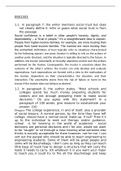
1.1. In paragraph 7, the writer mentions social trust but does
not clearly define it. Infer or guess what social trust is from
the passage.
Social confidence is a belief in other people's honesty, dignity, and
dependability – a "trust in people." It's a straightforward idea to explain.
People from higher-income families, for example, are more trusting than
people from lower-income families. The married are more trusting than
the unmarried. Definitions of trust typically refer to situations characterized
by the following aspects: one party (trustor) is willing to rely on the actions of
another party (trustee), and the situation is typically directed to the future. In
addition, the trustor (voluntarily or forcedly) abandons control over the actions
performed by the trustee. Consequently, the trustor is uncertain about the
outcome of the other's actions; the trustor can only develop and evaluate
expectations. Such expectations are formed with a view to the motivations of
the trustee, dependent on their characteristics, the situation, and their
interaction. The uncertainty stems from the risk of failure or harm to the
trustor if the trustee does not behave as desired.
1.2. In paragraph 8, the author states, “Most schools and
colleges spend too much money preparing students for
careers and not enough preparing them to make social
decisions.” Do you agree with this statement? In a
paragraph of 100 words, give reasons to substantiate your
answer. (10)
Disagree The college experience, in and of itself, also a provider
of social lessons. A normal person, by the time they have left
college, should have a normal social make-up. If not? Then it’s
up to the individual to seek out therapy and/or guidance.
school is for learning in the world of academia - social
decisions are personal decisions and I for one, would not want
to be “taught" or sit through a class hearing what someone else
thinks is socially acceptable for them however, not for me. I can
sort out the people who should be able to teach engineering to
engineering students. Some of them will be great people and
some will be douchebags; I don’t care as long as they can teach
little bags of mush how to design a structure that will carry the
loads it needs to carry. (Or whatever it is you want your major
to teach you.)I could try to fire all the douchebags and keep
1.1. In paragraph 7, the writer mentions social trust but does
not clearly define it. Infer or guess what social trust is from
the passage.
Social confidence is a belief in other people's honesty, dignity, and
dependability – a "trust in people." It's a straightforward idea to explain.
People from higher-income families, for example, are more trusting than
people from lower-income families. The married are more trusting than
the unmarried. Definitions of trust typically refer to situations characterized
by the following aspects: one party (trustor) is willing to rely on the actions of
another party (trustee), and the situation is typically directed to the future. In
addition, the trustor (voluntarily or forcedly) abandons control over the actions
performed by the trustee. Consequently, the trustor is uncertain about the
outcome of the other's actions; the trustor can only develop and evaluate
expectations. Such expectations are formed with a view to the motivations of
the trustee, dependent on their characteristics, the situation, and their
interaction. The uncertainty stems from the risk of failure or harm to the
trustor if the trustee does not behave as desired.
1.2. In paragraph 8, the author states, “Most schools and
colleges spend too much money preparing students for
careers and not enough preparing them to make social
decisions.” Do you agree with this statement? In a
paragraph of 100 words, give reasons to substantiate your
answer. (10)
Disagree The college experience, in and of itself, also a provider
of social lessons. A normal person, by the time they have left
college, should have a normal social make-up. If not? Then it’s
up to the individual to seek out therapy and/or guidance.
school is for learning in the world of academia - social
decisions are personal decisions and I for one, would not want
to be “taught" or sit through a class hearing what someone else
thinks is socially acceptable for them however, not for me. I can
sort out the people who should be able to teach engineering to
engineering students. Some of them will be great people and
some will be douchebags; I don’t care as long as they can teach
little bags of mush how to design a structure that will carry the
loads it needs to carry. (Or whatever it is you want your major
to teach you.)I could try to fire all the douchebags and keep