
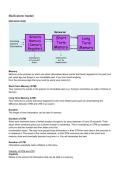
Multi-store model
Multi store model
Memory
Memory is the process by which we retain information about events that have happened in the past (not
just years ago but things in our immediate past. If you can recall anything
from the previous page then you must be using your memory!)
Short Term Memory (STM)
Your memory for events in the present or-immediate past (e.g. Trying to remember an order of drinks at
the bar)
Long Term Memory (LTM)
Your memory for events that have happened in the more distant past (such as remembering the
difference between STM and LTM in an exam)
Duration
The length of time information can be held in memory
Duration of STM
Short term memories have a limited duration thought to be about between 18 and 30 seconds. Think
about when someone gives you a phone number to remember. This is maintained in STM by repetition
until you dial the number and then fades once the
conversation starts. The way most people keep information in their STM for more than a few seconds is
to rehearse it. The result of this verbal rehearsal | is that STM memories are held in the short term
memory store and eventually become long term i.e. You will remember the item.
Duration of LTM
Information potentially lasts a lifetime in this store.
Capacity of STM and LTM
Capacity
Refers to the amount of information that can be held in a memory
,Capacity of STM
Short Term Memory has a very limited capacity,
Miller proposed that the span of immediate memory is 7 plus or minus two(5 to9).
Capacity of LTM
Long Term Memory has potentially unlimited capacity.
Coding of Memories in STM & LTM
Coding
Refers to the format in which information is stored in different memory |
stores. Information enters the brain via the senses (e.g. Eyes and ears). It is then stored in various forms
for example visually like a picture), acoustically (sounds), or semantically (the meaning of the
experience).
Encoding of STM
Information in STM is mainly encoded acoustically (i.e. Information is represented as sound)
Encoding of LTM
Information in LTM tends to be encoded semantically (i.e. Information is represented by its meaning)
Encoding
Encoding is the way information is changed so that it can be stored in memory. There are three main
ways in which information can be encoded (changed):
1) visual (picture)
2) acoustic (sound)
3) semantic (meaning).
Capacity
Capacity concerns how much information can be stored.
Duration
Duration refers to the period of time information can last in-memory stores.
Incoming Sensory Information
This is the information from our environment that is received through our senses.
Sensory Memory
● The information from our environment is stored in the sensory memory.
● It is coded in many different sensory forms. E.g. visual and auditory.
● The duration of this information is very short –milliseconds as we usually pay no attention to this
information (0.25-0.5s).
● The capacity of the SM is unlimited.
Short Term Memory
● If attention is paid to information in the SM it will be transferred to the STM.
● Information in our STM is stuff that happened recently.
, ● The STM only has a limited capacity (7 +/- 2) so information we want to remember has to go
elsewhere.
● The duration of information is the STM is less than 18 seconds.
● Information is stored mainly acoustically.
Long Term Memory
● If the information in the short-term is rehearsed frequently (through maintenance rehearsal) it will
enter the LTM.
● Once here we should be able to remember the information forever, unless it is lost in some way.
● The capacity of the LTM is unlimited.
● For information to be accessed in the LTM it must be transferred back to the STM.
● Primarily encoded semantically.
Multi store model of memory and the theorists
Evaluating the Multi-Store Model of Memory
● Richard Atkinson and Richard Shiffrin’s (1968) MSM has been hugely influential, and has been
evaluated through the use of subsequent research and case-studies.
● In this lesson we will use this research to evaluate the usefulness of the MSM.
Evaluating the Multi-Store Model of Memory - STM
● The STM store is depicted as a unitary store that primarily encodes information acoustically.
○ Shallice and Warrington (1970)
● The two researchers studied a patient called KF who had suffered a traumatic brain injury from a
motorcycle accident. KF’s memory was affected, but in a very unique way.
● S+W tested KF’s ability to recall series of digits, they introduced this both visually and
acoustically.
● KF had struggled to recall digits that were read out to him, but was much more successful when
reading the digits himself.
Evaluating the Multi-Store Model of Memory- LTM+STM
● The STM and LTM are different stores with different methods of encoding.
○ Baddeley (1966)
● Baddeley researched the LTM and STM encoding processes and found that we tend to mix up
auditorily similar words if we’re given very little time to process (STM) and we mix up words that
have similar meaning when giving lots of time to process (LTM).
Evaluating the Multi-Store Model of Memory- LTM+STM
Multi store model
Memory
Memory is the process by which we retain information about events that have happened in the past (not
just years ago but things in our immediate past. If you can recall anything
from the previous page then you must be using your memory!)
Short Term Memory (STM)
Your memory for events in the present or-immediate past (e.g. Trying to remember an order of drinks at
the bar)
Long Term Memory (LTM)
Your memory for events that have happened in the more distant past (such as remembering the
difference between STM and LTM in an exam)
Duration
The length of time information can be held in memory
Duration of STM
Short term memories have a limited duration thought to be about between 18 and 30 seconds. Think
about when someone gives you a phone number to remember. This is maintained in STM by repetition
until you dial the number and then fades once the
conversation starts. The way most people keep information in their STM for more than a few seconds is
to rehearse it. The result of this verbal rehearsal | is that STM memories are held in the short term
memory store and eventually become long term i.e. You will remember the item.
Duration of LTM
Information potentially lasts a lifetime in this store.
Capacity of STM and LTM
Capacity
Refers to the amount of information that can be held in a memory
,Capacity of STM
Short Term Memory has a very limited capacity,
Miller proposed that the span of immediate memory is 7 plus or minus two(5 to9).
Capacity of LTM
Long Term Memory has potentially unlimited capacity.
Coding of Memories in STM & LTM
Coding
Refers to the format in which information is stored in different memory |
stores. Information enters the brain via the senses (e.g. Eyes and ears). It is then stored in various forms
for example visually like a picture), acoustically (sounds), or semantically (the meaning of the
experience).
Encoding of STM
Information in STM is mainly encoded acoustically (i.e. Information is represented as sound)
Encoding of LTM
Information in LTM tends to be encoded semantically (i.e. Information is represented by its meaning)
Encoding
Encoding is the way information is changed so that it can be stored in memory. There are three main
ways in which information can be encoded (changed):
1) visual (picture)
2) acoustic (sound)
3) semantic (meaning).
Capacity
Capacity concerns how much information can be stored.
Duration
Duration refers to the period of time information can last in-memory stores.
Incoming Sensory Information
This is the information from our environment that is received through our senses.
Sensory Memory
● The information from our environment is stored in the sensory memory.
● It is coded in many different sensory forms. E.g. visual and auditory.
● The duration of this information is very short –milliseconds as we usually pay no attention to this
information (0.25-0.5s).
● The capacity of the SM is unlimited.
Short Term Memory
● If attention is paid to information in the SM it will be transferred to the STM.
● Information in our STM is stuff that happened recently.
, ● The STM only has a limited capacity (7 +/- 2) so information we want to remember has to go
elsewhere.
● The duration of information is the STM is less than 18 seconds.
● Information is stored mainly acoustically.
Long Term Memory
● If the information in the short-term is rehearsed frequently (through maintenance rehearsal) it will
enter the LTM.
● Once here we should be able to remember the information forever, unless it is lost in some way.
● The capacity of the LTM is unlimited.
● For information to be accessed in the LTM it must be transferred back to the STM.
● Primarily encoded semantically.
Multi store model of memory and the theorists
Evaluating the Multi-Store Model of Memory
● Richard Atkinson and Richard Shiffrin’s (1968) MSM has been hugely influential, and has been
evaluated through the use of subsequent research and case-studies.
● In this lesson we will use this research to evaluate the usefulness of the MSM.
Evaluating the Multi-Store Model of Memory - STM
● The STM store is depicted as a unitary store that primarily encodes information acoustically.
○ Shallice and Warrington (1970)
● The two researchers studied a patient called KF who had suffered a traumatic brain injury from a
motorcycle accident. KF’s memory was affected, but in a very unique way.
● S+W tested KF’s ability to recall series of digits, they introduced this both visually and
acoustically.
● KF had struggled to recall digits that were read out to him, but was much more successful when
reading the digits himself.
Evaluating the Multi-Store Model of Memory- LTM+STM
● The STM and LTM are different stores with different methods of encoding.
○ Baddeley (1966)
● Baddeley researched the LTM and STM encoding processes and found that we tend to mix up
auditorily similar words if we’re given very little time to process (STM) and we mix up words that
have similar meaning when giving lots of time to process (LTM).
Evaluating the Multi-Store Model of Memory- LTM+STM


