

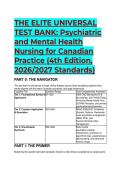
THE ELITE UNIVERSAL
TEST BANK: Psychiatric
and Mental Health
Nursing for Canadian
Practice (4th Edition,
2026/2027 Standards)
PART 0: THE NAVIGATOR
This test bank is architected to forge clinical mastery across three escalating cognitive tiers,
strictly aligned with the latest Canadian psychiatric and legal frameworks.
Cognitive Tier Question Range Core Competencies Assessed
Tier 1: Foundational Syntax & Q1–Q28 2026 CNO Standards (AI &
Application Boundaries), 2027 MAID Delay,
Provincial Mental Health Acts,
OCAP® Principles, and primary
psychopharmacodynamics.
Tier 2: Complex Application Q29–Q58 RNAO 2026/2027 Guidelines
& Simulation (Suicide, Delirium, Restraints),
acute psychiatric emergencies
(NMS, EPS), and
trauma-informed milieu
management.
Tier 3: Grandmaster Q59–Q88 Multi-morbid
Synthesis psychiatric-medical
intersections, predictive AI
algorithmic bias, polypharmacy
deprescribing, and advanced
forensic triage.
PART I: THE PRIMER
Mastering this specific test bank translates directly to elite clinical competence by replacing the
,rote memorization of symptom checklists with a mechanistic, first-principles understanding of
dynamic psychopathology and the rigorous 2026/2027 Canadian legal-ethical framework. You
will not merely pass the exam; you will operate as a decisive clinical architect.
The "Critical Axioms" Cheat Sheet
Domain The 2026/2027 "Hard Deck" Rule
CNO AI Liability Signing an AI-generated clinical note transfers
absolute legal accountability to the nurse.
Hallucinations constitute legal falsification.
CNO Boundaries The March 2026 update establishes an
absolute "Unfriend Mandate." Connecting with
clients on personal social media is professional
misconduct.
MAID Legislation MAID for individuals whose sole underlying
condition is a mental illness is legally prohibited
until March 17, 2027.
Provincial Detention ON: Form 1 = 72 hrs. BC: Form 4 = Detention,
Form 5 = Consent to treat. AB: 1st Form 1 = 24
hrs, 2nd Form 1 = Formal Patient.
Indigenous OCAP® First Nations hold absolute Ownership, Control,
Access, and Possession over their health data.
Research is collectively owned.
PART II: THE ELITE TEST BANK
Tier 1: Foundational Syntax & Application
Q1: An RN uses an employer-approved ambient AI scribe to document a psychiatric intake. The
AI hallucinates a history of "previous suicide attempts" that the patient never stated. The RN
signs the chart unread. Under the February 2026 CNO Documentation standard, which
conclusion is MOST ACCURATE? A) The AI vendor holds vicarious liability for the software
error. B) The RN must submit a late entry to correct the technical artifact. C) The RN is legally
guilty of falsifying a medical record. D) The health authority is solely responsible for
implementing flawed technology.
● The Answer: C (The RN is legally guilty of falsifying a medical record.)
● Distractor Analysis:
○ A is incorrect: Liability cannot be transferred to a software vendor once a licensed
professional authenticates the document.
○ B is incorrect: Signing a fabricated history is not a mere omission; it is a structural
breach of integrity.
○ D is incorrect: Employer approval does not negate the individual nurse's duty to
verify the data.
The Mentor's Analysis: Artificial intelligence is a scribe, not a proxy. When you sign the
electronic health record, you legally own every generated syllable. Professional/Academic
Intuition: Never authenticate unverified AI data; algorithmic hallucinations carry the same
legal penalty as intentional falsification.
Q2: A psychiatric nurse receives a friend request on Instagram from a vulnerable former patient
,discharged three months ago. Based on the CNO Professional Boundaries standard (Effective
March 1, 2026), what is the ONLY appropriate action? A) Accept the request to monitor their
wellbeing, maintaining strict therapeutic communication. B) Decline the request to avoid a
structural breach of professional boundaries. C) Accept the request if the patient initiated the
contact and is no longer under direct care. D) Redirect the patient to a hospital-approved social
media page via direct message.
● The Answer: B (Decline the request to avoid a structural breach of professional
boundaries.)
● Distractor Analysis:
○ A is incorrect: The 2026 update explicitly bans connecting with clients on personal
platforms.
○ C is incorrect: The standard does not permit digital connections regardless of
discharge status.
○ D is incorrect: Engaging in a direct message constitutes a connection and violates
the standard.
The Mentor's Analysis: The 2026 standard eliminated the "grey area" of social media. The
digital perimeter is absolute. Professional/Academic Intuition: The "Unfriend Mandate" is
non-negotiable; personal social media connections with patients constitute immediate
professional misconduct.
Q3: A 45-year-old patient with severe Treatment-Resistant Depression (TRD) requests Medical
Assistance in Dying (MAID). The patient has no other medical conditions. Based on Canadian
federal legislation, which statement is MOST ACCURATE? A) The patient is eligible if two
independent psychiatrists approve the request. B) The patient is ineligible until March 17, 2027,
due to the mental illness exclusion. C) The patient is eligible because TRD qualifies as a
grievous and irremediable neurocognitive disorder. D) The patient is permanently ineligible as
psychiatric conditions are universally excluded.
● The Answer: B (The patient is ineligible until March 17, 2027, due to the mental illness
exclusion.)
● Distractor Analysis:
○ A is incorrect: Independent clinical approval cannot override the federal legislative
sunset clause.
○ C is incorrect: TRD is a primary psychiatric disorder, not an exempt neurocognitive
disorder (like Dementia).
○ D is incorrect: The exclusion is temporary (a sunset clause), not a permanent ban.
The Mentor's Analysis: Legal parameters dictate clinical pathways. The Canadian government
extended the exclusion for mental illness as a sole underlying condition to ensure system
readiness. Professional/Academic Intuition: Mental illness as a sole indicator for MAID is
legally suspended until March 17, 2027.
Q4: A patient in British Columbia is involuntarily admitted under Form 4.1 and Form 4.2. The
psychiatrist orders an intramuscular antipsychotic, but the patient refuses. Before administering
the medication, which legal documentation MUST be completed? A) Form 1 (Request for
Psychiatric Assessment) B) Form 5 (Consent for Treatment) C) Form 6 (Renewal Certificate) D)
Form 12 (Review Panel Hearing)
● The Answer: B (Form 5 (Consent for Treatment))
● Distractor Analysis:
○ A is incorrect: Form 1 is not part of the BC Mental Health Act; it is utilized in Ontario
and Alberta.
○ C is incorrect: Form 6 is for renewing involuntary status after one month.
, ○ D is incorrect: Form 12 is an Alberta document. BC utilizes Form 7 for Review
Panels.
The Mentor's Analysis: Involuntary admission does not automatically equate to involuntary
treatment in BC. The director's authorization to treat against the patient's will must be
structurally documented. Professional/Academic Intuition: In BC, a Form 4 traps the body; a
Form 5 legally permits the chemical intervention.
Q5: A patient with Treatment-Resistant Depression (TRD) is initiated on intranasal Esketamine.
According to 2026 Canadian psychopharmacological guidelines, which protocol is
NON-NEGOTIABLE? A) It must be administered as a monotherapy. B) It must be administered
in combination with a newly initiated oral antipsychotic. C) It must be administered concurrently
with an oral antidepressant. D) It can only be administered via continuous intravenous infusion.
● The Answer: C (It must be administered concurrently with an oral antidepressant.)
● Distractor Analysis:
○ A is incorrect: Esketamine is strictly indicated as an adjunctive therapy, never
monotherapy.
○ B is incorrect: It requires an oral antidepressant, not an antipsychotic.
○ D is incorrect: Esketamine is an intranasal spray, whereas racemic ketamine is
administered IV.
The Mentor's Analysis: Esketamine acts as a rapid NMDA receptor antagonist to achieve acute
stabilization, but the oral antidepressant is required to maintain the baseline neurochemical
architecture. Professional/Academic Intuition: Esketamine provides the rapid-response
bridge; the oral antidepressant builds the required foundation.
Q6: In Ontario, a police officer brings a patient to the emergency department under Section 17
of the Mental Health Act. The physician examines the patient and signs a Form 1. What is the
immediate legal implication for the patient? A) They are involuntarily committed for 30 days. B)
They can be legally held for a psychiatric assessment for up to 72 hours. C) They must
immediately appear before a Justice of the Peace. D) They lose the right to consent to or refuse
medical treatment.
● The Answer: B (They can be legally held for a psychiatric assessment for up to 72 hours.)
● Distractor Analysis:
○ A is incorrect: A Form 3 is required to hold a patient for longer durations (14 days),
not a Form 1.
○ C is incorrect: A Form 2 is issued by a Justice of the Peace, but is not required if a
Form 1 is already active.
○ D is incorrect: A Form 1 governs detention, not the capacity to consent to treatment
(governed by the HCCA).
The Mentor's Analysis: A Form 1 is an assessment tool, not a treatment mandate. It simply buys
the clinical team 72 hours of secured time to determine the true depth of the patient's pathology.
Professional/Academic Intuition: Form 1 equals 72 hours of detention; it does NOT equate
to a loss of treatment capacity.
Q7: According to the 2025 Canadian Nurses Association (CNA) Code of Ethics, which principle
is explicitly elevated to address the legacy of residential schools and systemic health inequities?
A) The absolute mandate for digital health integration. B) The requirement to participate in
Medical Assistance in Dying (MAID). C) The foundational value of Truth, Reconciliation, and
Anti-Racism. D) The prioritization of quantitative research over qualitative narratives.
● The Answer: C (The foundational value of Truth, Reconciliation, and Anti-Racism.)
● Distractor Analysis:
○ A is incorrect: Digital integration is operational, not a primary ethical value in this
TEST BANK: Psychiatric
and Mental Health
Nursing for Canadian
Practice (4th Edition,
2026/2027 Standards)
PART 0: THE NAVIGATOR
This test bank is architected to forge clinical mastery across three escalating cognitive tiers,
strictly aligned with the latest Canadian psychiatric and legal frameworks.
Cognitive Tier Question Range Core Competencies Assessed
Tier 1: Foundational Syntax & Q1–Q28 2026 CNO Standards (AI &
Application Boundaries), 2027 MAID Delay,
Provincial Mental Health Acts,
OCAP® Principles, and primary
psychopharmacodynamics.
Tier 2: Complex Application Q29–Q58 RNAO 2026/2027 Guidelines
& Simulation (Suicide, Delirium, Restraints),
acute psychiatric emergencies
(NMS, EPS), and
trauma-informed milieu
management.
Tier 3: Grandmaster Q59–Q88 Multi-morbid
Synthesis psychiatric-medical
intersections, predictive AI
algorithmic bias, polypharmacy
deprescribing, and advanced
forensic triage.
PART I: THE PRIMER
Mastering this specific test bank translates directly to elite clinical competence by replacing the
,rote memorization of symptom checklists with a mechanistic, first-principles understanding of
dynamic psychopathology and the rigorous 2026/2027 Canadian legal-ethical framework. You
will not merely pass the exam; you will operate as a decisive clinical architect.
The "Critical Axioms" Cheat Sheet
Domain The 2026/2027 "Hard Deck" Rule
CNO AI Liability Signing an AI-generated clinical note transfers
absolute legal accountability to the nurse.
Hallucinations constitute legal falsification.
CNO Boundaries The March 2026 update establishes an
absolute "Unfriend Mandate." Connecting with
clients on personal social media is professional
misconduct.
MAID Legislation MAID for individuals whose sole underlying
condition is a mental illness is legally prohibited
until March 17, 2027.
Provincial Detention ON: Form 1 = 72 hrs. BC: Form 4 = Detention,
Form 5 = Consent to treat. AB: 1st Form 1 = 24
hrs, 2nd Form 1 = Formal Patient.
Indigenous OCAP® First Nations hold absolute Ownership, Control,
Access, and Possession over their health data.
Research is collectively owned.
PART II: THE ELITE TEST BANK
Tier 1: Foundational Syntax & Application
Q1: An RN uses an employer-approved ambient AI scribe to document a psychiatric intake. The
AI hallucinates a history of "previous suicide attempts" that the patient never stated. The RN
signs the chart unread. Under the February 2026 CNO Documentation standard, which
conclusion is MOST ACCURATE? A) The AI vendor holds vicarious liability for the software
error. B) The RN must submit a late entry to correct the technical artifact. C) The RN is legally
guilty of falsifying a medical record. D) The health authority is solely responsible for
implementing flawed technology.
● The Answer: C (The RN is legally guilty of falsifying a medical record.)
● Distractor Analysis:
○ A is incorrect: Liability cannot be transferred to a software vendor once a licensed
professional authenticates the document.
○ B is incorrect: Signing a fabricated history is not a mere omission; it is a structural
breach of integrity.
○ D is incorrect: Employer approval does not negate the individual nurse's duty to
verify the data.
The Mentor's Analysis: Artificial intelligence is a scribe, not a proxy. When you sign the
electronic health record, you legally own every generated syllable. Professional/Academic
Intuition: Never authenticate unverified AI data; algorithmic hallucinations carry the same
legal penalty as intentional falsification.
Q2: A psychiatric nurse receives a friend request on Instagram from a vulnerable former patient
,discharged three months ago. Based on the CNO Professional Boundaries standard (Effective
March 1, 2026), what is the ONLY appropriate action? A) Accept the request to monitor their
wellbeing, maintaining strict therapeutic communication. B) Decline the request to avoid a
structural breach of professional boundaries. C) Accept the request if the patient initiated the
contact and is no longer under direct care. D) Redirect the patient to a hospital-approved social
media page via direct message.
● The Answer: B (Decline the request to avoid a structural breach of professional
boundaries.)
● Distractor Analysis:
○ A is incorrect: The 2026 update explicitly bans connecting with clients on personal
platforms.
○ C is incorrect: The standard does not permit digital connections regardless of
discharge status.
○ D is incorrect: Engaging in a direct message constitutes a connection and violates
the standard.
The Mentor's Analysis: The 2026 standard eliminated the "grey area" of social media. The
digital perimeter is absolute. Professional/Academic Intuition: The "Unfriend Mandate" is
non-negotiable; personal social media connections with patients constitute immediate
professional misconduct.
Q3: A 45-year-old patient with severe Treatment-Resistant Depression (TRD) requests Medical
Assistance in Dying (MAID). The patient has no other medical conditions. Based on Canadian
federal legislation, which statement is MOST ACCURATE? A) The patient is eligible if two
independent psychiatrists approve the request. B) The patient is ineligible until March 17, 2027,
due to the mental illness exclusion. C) The patient is eligible because TRD qualifies as a
grievous and irremediable neurocognitive disorder. D) The patient is permanently ineligible as
psychiatric conditions are universally excluded.
● The Answer: B (The patient is ineligible until March 17, 2027, due to the mental illness
exclusion.)
● Distractor Analysis:
○ A is incorrect: Independent clinical approval cannot override the federal legislative
sunset clause.
○ C is incorrect: TRD is a primary psychiatric disorder, not an exempt neurocognitive
disorder (like Dementia).
○ D is incorrect: The exclusion is temporary (a sunset clause), not a permanent ban.
The Mentor's Analysis: Legal parameters dictate clinical pathways. The Canadian government
extended the exclusion for mental illness as a sole underlying condition to ensure system
readiness. Professional/Academic Intuition: Mental illness as a sole indicator for MAID is
legally suspended until March 17, 2027.
Q4: A patient in British Columbia is involuntarily admitted under Form 4.1 and Form 4.2. The
psychiatrist orders an intramuscular antipsychotic, but the patient refuses. Before administering
the medication, which legal documentation MUST be completed? A) Form 1 (Request for
Psychiatric Assessment) B) Form 5 (Consent for Treatment) C) Form 6 (Renewal Certificate) D)
Form 12 (Review Panel Hearing)
● The Answer: B (Form 5 (Consent for Treatment))
● Distractor Analysis:
○ A is incorrect: Form 1 is not part of the BC Mental Health Act; it is utilized in Ontario
and Alberta.
○ C is incorrect: Form 6 is for renewing involuntary status after one month.
, ○ D is incorrect: Form 12 is an Alberta document. BC utilizes Form 7 for Review
Panels.
The Mentor's Analysis: Involuntary admission does not automatically equate to involuntary
treatment in BC. The director's authorization to treat against the patient's will must be
structurally documented. Professional/Academic Intuition: In BC, a Form 4 traps the body; a
Form 5 legally permits the chemical intervention.
Q5: A patient with Treatment-Resistant Depression (TRD) is initiated on intranasal Esketamine.
According to 2026 Canadian psychopharmacological guidelines, which protocol is
NON-NEGOTIABLE? A) It must be administered as a monotherapy. B) It must be administered
in combination with a newly initiated oral antipsychotic. C) It must be administered concurrently
with an oral antidepressant. D) It can only be administered via continuous intravenous infusion.
● The Answer: C (It must be administered concurrently with an oral antidepressant.)
● Distractor Analysis:
○ A is incorrect: Esketamine is strictly indicated as an adjunctive therapy, never
monotherapy.
○ B is incorrect: It requires an oral antidepressant, not an antipsychotic.
○ D is incorrect: Esketamine is an intranasal spray, whereas racemic ketamine is
administered IV.
The Mentor's Analysis: Esketamine acts as a rapid NMDA receptor antagonist to achieve acute
stabilization, but the oral antidepressant is required to maintain the baseline neurochemical
architecture. Professional/Academic Intuition: Esketamine provides the rapid-response
bridge; the oral antidepressant builds the required foundation.
Q6: In Ontario, a police officer brings a patient to the emergency department under Section 17
of the Mental Health Act. The physician examines the patient and signs a Form 1. What is the
immediate legal implication for the patient? A) They are involuntarily committed for 30 days. B)
They can be legally held for a psychiatric assessment for up to 72 hours. C) They must
immediately appear before a Justice of the Peace. D) They lose the right to consent to or refuse
medical treatment.
● The Answer: B (They can be legally held for a psychiatric assessment for up to 72 hours.)
● Distractor Analysis:
○ A is incorrect: A Form 3 is required to hold a patient for longer durations (14 days),
not a Form 1.
○ C is incorrect: A Form 2 is issued by a Justice of the Peace, but is not required if a
Form 1 is already active.
○ D is incorrect: A Form 1 governs detention, not the capacity to consent to treatment
(governed by the HCCA).
The Mentor's Analysis: A Form 1 is an assessment tool, not a treatment mandate. It simply buys
the clinical team 72 hours of secured time to determine the true depth of the patient's pathology.
Professional/Academic Intuition: Form 1 equals 72 hours of detention; it does NOT equate
to a loss of treatment capacity.
Q7: According to the 2025 Canadian Nurses Association (CNA) Code of Ethics, which principle
is explicitly elevated to address the legacy of residential schools and systemic health inequities?
A) The absolute mandate for digital health integration. B) The requirement to participate in
Medical Assistance in Dying (MAID). C) The foundational value of Truth, Reconciliation, and
Anti-Racism. D) The prioritization of quantitative research over qualitative narratives.
● The Answer: C (The foundational value of Truth, Reconciliation, and Anti-Racism.)
● Distractor Analysis:
○ A is incorrect: Digital integration is operational, not a primary ethical value in this


