EMT-Chapter 24 -Gynecologic Emergencies Test Questions and Answers Graded A+
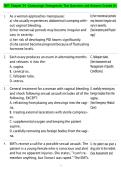
1. As a woman approaches menopause: b) her menstrual periods
a) she usually experiences abdominal cramping with- may become irregular and
out vaginal bleeding. vary in severity.
b) her menstrual periods may become irregular and (See Anatomy and Physiol-
vary in severity. ogy)
c) her risk of developing PID lowers significantly.
d) she cannot become pregnant because of fluctuating
hormone levels.
2. Each ovary produces an ovum in alternating months C. fallopian tube.
and releases it into the: (See Assessment and
A. vagina. Management of Specific
B. cervical os. Conditions)
C. fallopian tube.
D. uterus.
3. General treatment for a woman with vaginal bleeding D. carefully removing any
and shock following sexual assault includes all of the foreign bodies from the
following, EXCEPT: vagina.
A. refraining from placing any dressings into the vagi- (See Emergency Medical
na. Care)
B. treating external lacerations with sterile compress-
es.
C. supplemental oxygen and keeping the patient
supine.
D. carefully removing any foreign bodies from the vagi-
na.
4. EMTs receive a call for a possible sexual assault. The D. the patient was given a
patient is a young female who is conscious and alert drug prior to the incident.
and has no apparent injuries. She states, "I can't re- (See Assessment and
member anything, but I know I was raped." The EMTs
1/8
, EMT-Chapter 24 -Gynecologic Emergencies Test Questions and Answers Graded A+
should suspect that: Management of Specific
A. an underlying head injury is causing her amnesia. Conditions)
B. the patient knew her attacker, but is afraid to say.
C. the traumatic experience has created a mental
block.
D. the patient was given a drug prior to the incident.
5. In anticipation of receiving a fertilized ovum, the lining A. becomes engorged with
of the uterine wall: blood.
A. becomes engorged with blood. (See Anatomy and Physiol-
B. diverts blood flow to the vagina. ogy)
C. sheds and is expelled externally.
D. thins and begins to separate.
6. In contrast to bleeding caused by external trauma to A. may be relatively pain-
the vagina, bleeding caused by conditions such as less.
polyps or cancer: (See Pathophysiology)
A. may be relatively painless.
B. is typically not as severe.
C. often presents with acute pain.
D. can be controlled in the field.
7. Which of the following clinical presentations is MOST C. Lower abdominal pain,
consistent with pelvic inflammatory disease (PID)? fever, general malaise, and
A. Left lower quadrant pain, referred pain to the left foul-smelling vaginal dis-
shoulder, and fever charge
B. Upper abdominal cramping, severe headache, and (See Pathophysiology)
heavy vaginal bleeding
C. Lower abdominal pain, fever, general malaise, and
foul-smelling vaginal discharge
D. Pain around the umbilicus, low-grade fever, and
generalized weakness
2/8
1. As a woman approaches menopause: b) her menstrual periods
a) she usually experiences abdominal cramping with- may become irregular and
out vaginal bleeding. vary in severity.
b) her menstrual periods may become irregular and (See Anatomy and Physiol-
vary in severity. ogy)
c) her risk of developing PID lowers significantly.
d) she cannot become pregnant because of fluctuating
hormone levels.
2. Each ovary produces an ovum in alternating months C. fallopian tube.
and releases it into the: (See Assessment and
A. vagina. Management of Specific
B. cervical os. Conditions)
C. fallopian tube.
D. uterus.
3. General treatment for a woman with vaginal bleeding D. carefully removing any
and shock following sexual assault includes all of the foreign bodies from the
following, EXCEPT: vagina.
A. refraining from placing any dressings into the vagi- (See Emergency Medical
na. Care)
B. treating external lacerations with sterile compress-
es.
C. supplemental oxygen and keeping the patient
supine.
D. carefully removing any foreign bodies from the vagi-
na.
4. EMTs receive a call for a possible sexual assault. The D. the patient was given a
patient is a young female who is conscious and alert drug prior to the incident.
and has no apparent injuries. She states, "I can't re- (See Assessment and
member anything, but I know I was raped." The EMTs
1/8
, EMT-Chapter 24 -Gynecologic Emergencies Test Questions and Answers Graded A+
should suspect that: Management of Specific
A. an underlying head injury is causing her amnesia. Conditions)
B. the patient knew her attacker, but is afraid to say.
C. the traumatic experience has created a mental
block.
D. the patient was given a drug prior to the incident.
5. In anticipation of receiving a fertilized ovum, the lining A. becomes engorged with
of the uterine wall: blood.
A. becomes engorged with blood. (See Anatomy and Physiol-
B. diverts blood flow to the vagina. ogy)
C. sheds and is expelled externally.
D. thins and begins to separate.
6. In contrast to bleeding caused by external trauma to A. may be relatively pain-
the vagina, bleeding caused by conditions such as less.
polyps or cancer: (See Pathophysiology)
A. may be relatively painless.
B. is typically not as severe.
C. often presents with acute pain.
D. can be controlled in the field.
7. Which of the following clinical presentations is MOST C. Lower abdominal pain,
consistent with pelvic inflammatory disease (PID)? fever, general malaise, and
A. Left lower quadrant pain, referred pain to the left foul-smelling vaginal dis-
shoulder, and fever charge
B. Upper abdominal cramping, severe headache, and (See Pathophysiology)
heavy vaginal bleeding
C. Lower abdominal pain, fever, general malaise, and
foul-smelling vaginal discharge
D. Pain around the umbilicus, low-grade fever, and
generalized weakness
2/8