

H10: OTHER MODELS OF REGULATED CELL DEATH
Multiple choice + terminology (don’t learn mechanisms)
10.0 OVERVIEW
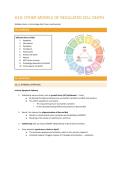
Different forms of RCD
1. Apoptosis
2. Necroptosis
3. Pyroptosis
4. Ferroptosis
5. Parthanatos
6. Entotic cell death
7. Netosis
8. MPT driven necrosis
9. Autophagy-dependent cell death
10. Immunogenic cell death
10.1 APOPTOSIS
10.1.1 INTRINSIC APOPTOSIS
Intrinsic Apoptosis Pathway
1. Initiated by various stimuli, such as growth factor (GF) withdrawal → how?
● By altering the balance between pro-survival Bcl-2 proteins and BH3-only proteins.
● This shift in equilibrium can lead to :
○ The sequestering of pro-survival Bcl-2 proteins
○ Or the directed binding of BH3-only proteins to Bax and Bak
○
2. Result : this induces the oligomerization of Bax and Bak
● Results in mitochondrial outer membrane permeabilization (MOMP)
● Resulting in the release of cytochrome c and Smac
●
3. Additionally: Bok can induce MOMP independently of Bcl-2 family members
4.
5. Once released, cytochrome c binds to Apaf-1
● This promotes apoptosome formation, which in turn recruits caspase-9
● Activated caspase-9 triggers caspase-3/7 cleavage and activation → Apoptosis
,10.1.2 EXTRINSIC APOPTOSIS
Extrinsic Apoptosis Pathway:
1. Initiated by the binding of select group of TNF family ligands to their receptors
2. Formation of the death-inducing signaling complex (DISC)
● Formed by the recruitment of: adapter molecules FADD/TRADD + Caspase-8
● Caspase 8 undergoes autoprocessing
○ It can directly activate caspase-3 or cleave Bid to generate tBid
○ You get triggering of the intrinsic apoptosis pathway
REGULATION APOPTOSIS
Regulation of Apoptosis:
● Caspase-3/7/9 activity inhibited by XIAP, counteracted by Smac
● Apoptosis can be induced by granzyme B and perforin from immune cells
● Once granzyme B is taken up by the target cell, it induces cell death by :
○ Activating caspase-3
○ Or by directly activating apoptosis effectors like CAD
10.1.3 OVERVIEW INTRINSIC AND EXTRINSIC APOPTOSIS
Remark : in this drawing the apoptosome is missing
Intrinsic Apoptosis Pathway
1. Initiated by various stimuli, such as growth factor (GF) withdrawal → how?
● Causes imbalance between pro-survival Bcl-2 proteins and BH3-only proteins.
○
2. Result: this induces the oligomerization of BAX and BAK
● MOMP → cytochrome c release
● Formation apoptosome: cyt c, Apaf-1, ATP and pro-casp-9
● Casp-1 activation → cleavages of casp-3/7 → apotposis
,10.2 NECROPTOSIS
Induction of necroptosis → by various stimuli
10.2.1 TNF-MEDIATED PATHWAY
Complex 1 = closed formation
1. TNF binds TNFR1 = initiates complex formation
2. Recruitment of TRADD → RIPK1 + TRAF2/5 + cIAP1/2
3. Formation 3 pro-survival complexes : 1. LUBAC 2. TAK 3. IKK
4. Leads to activation of NF-KB and MAPK signaling pathways → transcription pro-survival genes
Complex II
5. DUB = CYLD → deubiquitinase of RIPK1 = open conformation
6. RIP1 translocation to cytosol, forming complex II
7. RIP1 phosphorylates itself and RIPK3
8. RIP3 phosphorylates MLKL → MLKL oligomerizes → recruit to membrane → pore formation
10.2.2 TLR3/4-MEDIATED PATHWAY
TLR3/4-Mediated Pathway
● LPS or Poly(I:C)-induced TLR3/4 signaling can also stimulate necroptosis → how?
○ Adaptor protein TRIF mediates this pathway, engaging RIPK1 or RIPK3
10.2.3 Z-DNA SENSING PATHWAY
Z-DNA Sensing Pathway:
● Z-DNA is a specific form of DNA that can be formed during viral infections
● ZBP1 senses Z-DNA → ZBP1 binds to RIPK1 because of TIR domain
● This process can be inhibited by RIP1.
, 10.3 PYROPTOSIS
10.3.1 PYROPTOTIC CELL DEATH MECHANISMS
Important
= Pyroptotic cell death can be induced by various stimuli that activate inflammasomes
1. Canonical Inflammasome Activation
1) Priming: DAMPs/PAMPs bind to TLR
→ increased gene expression of pro-inflammatory cytokines and NLRP3
2) NLRP3 activation leads to its binding to ASC and caspase-1
→ inflammasome formation
○ NLRP3 binds to ASC (PYD)
○ ASC binds to caspase-1 (CARD)
3) Caspase-1 processes pro- IL-1β and pro-IL-18 to their active forms (IL-1β and IL-18)
4) Simultaneously, caspase-1 cleaves GSDMD = separation of the inhibitory C- and N-terminal domains
→ GSDMD-N translocates to the membrane → pore formation + cytokine release
2. Non-canonical Inflammasome Activation
1) Intracellular LPS binds to Casp4/5 (human) or Casp11 (mouse) → activation of caspase 4/5/11
2) Activated Casp4/5/11 processes GSDMD and caspase-1.
3) Cell lysis induced by this pathway can also activate canonical inflammasome signaling.
➔ Green arrows denote upregulation by gene expression.
➔ Black arrows indicate interactions, cleavage events, or inhibition.
Multiple choice + terminology (don’t learn mechanisms)
10.0 OVERVIEW
Different forms of RCD
1. Apoptosis
2. Necroptosis
3. Pyroptosis
4. Ferroptosis
5. Parthanatos
6. Entotic cell death
7. Netosis
8. MPT driven necrosis
9. Autophagy-dependent cell death
10. Immunogenic cell death
10.1 APOPTOSIS
10.1.1 INTRINSIC APOPTOSIS
Intrinsic Apoptosis Pathway
1. Initiated by various stimuli, such as growth factor (GF) withdrawal → how?
● By altering the balance between pro-survival Bcl-2 proteins and BH3-only proteins.
● This shift in equilibrium can lead to :
○ The sequestering of pro-survival Bcl-2 proteins
○ Or the directed binding of BH3-only proteins to Bax and Bak
○
2. Result : this induces the oligomerization of Bax and Bak
● Results in mitochondrial outer membrane permeabilization (MOMP)
● Resulting in the release of cytochrome c and Smac
●
3. Additionally: Bok can induce MOMP independently of Bcl-2 family members
4.
5. Once released, cytochrome c binds to Apaf-1
● This promotes apoptosome formation, which in turn recruits caspase-9
● Activated caspase-9 triggers caspase-3/7 cleavage and activation → Apoptosis
,10.1.2 EXTRINSIC APOPTOSIS
Extrinsic Apoptosis Pathway:
1. Initiated by the binding of select group of TNF family ligands to their receptors
2. Formation of the death-inducing signaling complex (DISC)
● Formed by the recruitment of: adapter molecules FADD/TRADD + Caspase-8
● Caspase 8 undergoes autoprocessing
○ It can directly activate caspase-3 or cleave Bid to generate tBid
○ You get triggering of the intrinsic apoptosis pathway
REGULATION APOPTOSIS
Regulation of Apoptosis:
● Caspase-3/7/9 activity inhibited by XIAP, counteracted by Smac
● Apoptosis can be induced by granzyme B and perforin from immune cells
● Once granzyme B is taken up by the target cell, it induces cell death by :
○ Activating caspase-3
○ Or by directly activating apoptosis effectors like CAD
10.1.3 OVERVIEW INTRINSIC AND EXTRINSIC APOPTOSIS
Remark : in this drawing the apoptosome is missing
Intrinsic Apoptosis Pathway
1. Initiated by various stimuli, such as growth factor (GF) withdrawal → how?
● Causes imbalance between pro-survival Bcl-2 proteins and BH3-only proteins.
○
2. Result: this induces the oligomerization of BAX and BAK
● MOMP → cytochrome c release
● Formation apoptosome: cyt c, Apaf-1, ATP and pro-casp-9
● Casp-1 activation → cleavages of casp-3/7 → apotposis
,10.2 NECROPTOSIS
Induction of necroptosis → by various stimuli
10.2.1 TNF-MEDIATED PATHWAY
Complex 1 = closed formation
1. TNF binds TNFR1 = initiates complex formation
2. Recruitment of TRADD → RIPK1 + TRAF2/5 + cIAP1/2
3. Formation 3 pro-survival complexes : 1. LUBAC 2. TAK 3. IKK
4. Leads to activation of NF-KB and MAPK signaling pathways → transcription pro-survival genes
Complex II
5. DUB = CYLD → deubiquitinase of RIPK1 = open conformation
6. RIP1 translocation to cytosol, forming complex II
7. RIP1 phosphorylates itself and RIPK3
8. RIP3 phosphorylates MLKL → MLKL oligomerizes → recruit to membrane → pore formation
10.2.2 TLR3/4-MEDIATED PATHWAY
TLR3/4-Mediated Pathway
● LPS or Poly(I:C)-induced TLR3/4 signaling can also stimulate necroptosis → how?
○ Adaptor protein TRIF mediates this pathway, engaging RIPK1 or RIPK3
10.2.3 Z-DNA SENSING PATHWAY
Z-DNA Sensing Pathway:
● Z-DNA is a specific form of DNA that can be formed during viral infections
● ZBP1 senses Z-DNA → ZBP1 binds to RIPK1 because of TIR domain
● This process can be inhibited by RIP1.
, 10.3 PYROPTOSIS
10.3.1 PYROPTOTIC CELL DEATH MECHANISMS
Important
= Pyroptotic cell death can be induced by various stimuli that activate inflammasomes
1. Canonical Inflammasome Activation
1) Priming: DAMPs/PAMPs bind to TLR
→ increased gene expression of pro-inflammatory cytokines and NLRP3
2) NLRP3 activation leads to its binding to ASC and caspase-1
→ inflammasome formation
○ NLRP3 binds to ASC (PYD)
○ ASC binds to caspase-1 (CARD)
3) Caspase-1 processes pro- IL-1β and pro-IL-18 to their active forms (IL-1β and IL-18)
4) Simultaneously, caspase-1 cleaves GSDMD = separation of the inhibitory C- and N-terminal domains
→ GSDMD-N translocates to the membrane → pore formation + cytokine release
2. Non-canonical Inflammasome Activation
1) Intracellular LPS binds to Casp4/5 (human) or Casp11 (mouse) → activation of caspase 4/5/11
2) Activated Casp4/5/11 processes GSDMD and caspase-1.
3) Cell lysis induced by this pathway can also activate canonical inflammasome signaling.
➔ Green arrows denote upregulation by gene expression.
➔ Black arrows indicate interactions, cleavage events, or inhibition.


