

Chapter 1 - Different Types of Business
24 September 2025 10:20
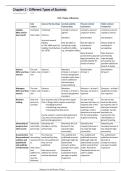
Part 1 Types of Business
Sole General Partnerships Limited Liability Private Limited Public Limited
traders Partnerships Companies Companies
Liability Unlimited Unlimited Limited to amount Limited to amount Limited to amount
Who and for agreed unpaid on shares unpaid on shares
how much? Sole trader Partners
Members Shareholders Shareholders
Joint and several
liability May be liable to May be liable to May be liable to
(s 9 PA 1890 and Civil contribute under contribute if contribute if
Liability Contributions modified IA 1986 – wrongdoing wrongdoing
Act 1978) e.g. wrongful trading
Note directors Note directors
protected by separate protected by
legal personality, but separate legal
possible liability for personality, but
breach of duties possible liability for
breach of duties
Owners The sole Partners Members Shareholders Shareholders
(Who and how trader, only At least 2 At least 2. At least 2 At least 1 At least 1
many?) one must be designated
members (who have
certain additional
administrative
responsibilities)
Managers The sole Partners Members Directors – at least 1. Directors – at least 2.
(Who and how trader, only At least 2 At least 2. At least 2 Having a secretary is Qualified secretary
many?) one must be designated optional. also required.
members.
Decision- Only one By a majority vote of the partners (apart For day-to-day For day-to-day
making person to from 3 things which require unanimity). business decisions, by business decisions,
consider. - Changing business majority vote of the by majority vote of
- Introducing new partner board at board the board at board
- Varying partnership terms meetings. Certain meetings. Certain
decisions are reserved decisions are
Can be varied in a partnership agreement for the shareholders reserved for the
Can only remove partner if it says so in at general meeting. shareholders at
partnership agreement. general meeting.
Ownership of Owned by Owned by the Owned by the LLP Owned by the Owned by the
property and sole trader members, not the because it has company because it company because it
other assets personally. partnership. separate legal has separate legal has separate legal
personality. personality. personality.
Accounts (Are No Yes, they are Yes, audited and Yes, audited and Yes, audited and
they produced, accounting produced but they published accounts published accounts published accounts.
audited, and requiremen are not audited and (although might be (although might be Records at
published?) ts. they are not abbreviated abbreviated accounts Companies House
and publicity published. accounts and/or and/or exempt from are open to public
of information Only name exempt from audit). audit). Records at inspection.
and Only names and Records at Companies House are
address for address for service Companies House open to public
service must be disclosed. are open to public inspection.
must be inspection.
disclosed.
Security Fixed Fixed security only Fixed and floating Fixed and floating Fixed and floating
Business Law and Practice 2 Page 1
,Security Fixed Fixed security only Fixed and floating Fixed and floating Fixed and floating
(What types security security security security
can be only
granted?)
Duties None Duties under Duties under Statutory duties Statutory duties
imposed on partnership members under s. 170-177 & under s. 170-177 &
managers by agreement (including agreement. 182 CA 2006 182 CA 2006
law implied duties under Fiduciary duties. & Insolvency Act 1986 & Insolvency Act
PA 1890). Fiduciary Some statutory 1986
duties: utmost good duties under the
faith, not to make a Insolvency Act 1986
secret profit as per reg. 5 LLPR
2001
Termination At will Terminated with Application to the Application to the Application to the
immediate effect by a registrar for registrar to strike off registrar to strike off
partner giving the voluntary striking the company if the co the company if the
other partners notice, off, subject to has not carried on any co has not carried on
which can be oral. various conditions activity for three any activity for three
Also dissolved by such as a majority of months; voluntary or months; voluntary or
death, bankruptcy, the members signing compulsory compulsory
charge or illegality the application. liquidation. liquidation.
and, if entered into
for a single
undertaking, by the
termination of that
undertaking. Can be
modified by a
partnership
agreement..
Constitution (if None Some rules under PA The LLP Regulations Detailed rules under Extensive rules
any) 1890. 2001, and LLP the CA 06. under the CA 06.
(Application of
Often supplemented Companies Act Always governed by Always governed by
with a partnership 2006) Regulations articles of association articles of
agreement. 2009 imposes (required). association
almost of all of the (required).
rules for companies
onto LLPs.
Often supplemented
with an LLP
agreement.
Incorporation None None if the definition Must file a form at Must file a form at Must file a form at
formalities (if of a partnership is Companies House Companies House Companies House
any) met. (LL IN01). (IN01). (IN01).
Small fee to pay. Small fee to pay. Small fee to pay.
Memorandum of Memorandum of
association required. association required.
Articles required Articles required
unless using default unless using default
articles. articles.
£50,000 is the
minimum allotted
share capital.
Type of tax Income tax Income Tax Income Tax Corporation Tax Corporation Tax
Business Law and Practice 2 Page 2
,1.9 What type of business is best?
Depends on several factors, we may need to advise clients on this
Liability
○ Most important consideration for many clients.
○ Limited liability (companies, LLPs) protects owners’ personal assets.
○ Unlimited liability (sole traders, general partnerships) puts personal assets at risk.
○ Importance depends on the nature of the business and available insurance.
Taxation
○ Tax treatment affects net income for owners.
○ Choice of business medium can impact income tax vs corporate tax.
○ Depends on financial circumstances of the business and owners.
Formalities
○ Sole trader/partnership: minimal setup, no formal documents required (except advisable partnership agreement).
○ Company/LLP: formal registration, filing, accounting, and compliance under CA 2006 / LLPA 2000.
○ Companies have ongoing administrative obligations: minutes, registers, accounts, possible audit.
○ LLPs require some filings but less onerous than companies.
Publicity / Privacy
○ Sole traders and partnerships: only identity and service address disclosed.
○ Companies and LLPs: must disclose financial info, directors, shareholders, and maintain public registers.
○ If privacy is important, unincorporated business is preferable.
Cost
○ Sole traders and partnerships: very low initial cost, though partnership agreements may require legal advice.
○ Companies/LLPs: registration fee, ongoing legal/accountancy costs, administrative expenses.
Status / Credibility
○ Companies often perceived as more professional and prestigious.
○ Clients and lenders may feel more reassured dealing with a company.
Finance / Raising Capital
○ Companies and LLPs can offer floating charges over assets for loans.
○ Sole traders/partnerships cannot offer floating charges, making companies more attractive to lenders.
Decision-making
○ Sole traders/partnerships: flexible, owner-driven.
○ Companies: formal decision-making structures (directors, shareholders, board meetings).
○ LLPs: combination of flexibility (like partnership) and limited liability.
Part 2 The Limited Company
1.10 Forming a company
Forming a Company
• Incorporation requires Form IN01 + memorandum of association + (if any) articles of association + fee, submitted
to Companies House (electronically or on paper).
Economic Crime and Corporate Transparency Act 2023 (ECCTA 2023)
• Extends Registrar of Companies’ powers.
• Measures include:
○ Rejecting inaccurate/fraudulent information in filings.
○ Removing inaccurate info from register.
○ Rejecting misleading/fraudulent company names.
• Only partially in force (as of 1 May 2025).
Identity Verification (IDV) under ECCTA 2023
Business Law and Practice 2 Page 3
, Identity Verification (IDV) under ECCTA 2023
• Applies to: directors, persons with significant control (PSCs), and anyone filing at Companies House.
• Purpose: improve trust, reduce fraud, increase accuracy/transparency.
• 8 April 2025: voluntary IDV introduced.
• Methods: online, Post Office, or via Authorised Corporate Service Providers (ACSPs).
• ACSPs: must be registered with Companies House + a UK AML supervisory body (e.g. SRA, Insolvency Practitioners
Association).
• Expected Autumn 2025: IDV compulsory for new incorporations; phased in for existing directors/PSCs.
• Failure to comply = criminal offence.
1.11 Who will make the application?
Application methods: online, by post, or via Companies House–enabled software.
Who applies:
○ Individuals (usually online or by post).
○ Solicitors, accountants, or company formation agents (often using authorised software).
○ Shelf companies may be used to avoid setting up from scratch.
Companies House Processing
• Application addressed to Registrar of Companies, processed by Companies House staff.
• Checks include:
○ Paperwork complete.
○ Disqualified Directors’ Register checked → ECCTA 2023 allows Companies House to reject disqualified
appointments.
○ Correct fee paid (same-day service available only by post or authorised software).
Certificate of Incorporation (ss 15 & 16 CA 2006)
• Company exists upon issue of certificate.
• Must state:
○ Company name & registered number.
○ Date of incorporation.
○ Limited/unlimited status (and if limited, by shares or by guarantee).
○ Private or public company.
○ Registered office location (England/Wales, Scotland, Northern Ireland).
• Signed/authenticated by Registrar.
• Conclusive evidence of compliance with CA 2006 & registration.
HMRC Registration
• Companies must register for corporation tax.
• Automatic if online incorporation.
• Separate application needed (within 3 months of starting business) if by post, agent, or third-party software.
1.12 Decisions to be made
Form IN01 requires applicants to provide key information/decisions about the proposed company.
Company name
Required ending:
○ Private companies → Limited / Ltd (or Welsh Cyfyngedig / Cyf) (s 59 CA 2006).
○ Public companies → plc / public limited company (or Welsh ccc / cwmni cyfyngedig
cyhoeddus) (s 58 CA 2006).
Similarity to existing names:
○ Cannot be the same/similar to existing company (s 66 CA 2006).
○ Names Regs 2015, Sch 3 → explains when two names count as “same as” (e.g. “2” =
“two”).
○ Can only use “same as” name if within same group + consent.
○ Company Names Tribunal handles objections based on goodwill/passing off, not
Companies House.
Prohibited/restricted names:
Business Law and Practice 2 Page 4
24 September 2025 10:20
Part 1 Types of Business
Sole General Partnerships Limited Liability Private Limited Public Limited
traders Partnerships Companies Companies
Liability Unlimited Unlimited Limited to amount Limited to amount Limited to amount
Who and for agreed unpaid on shares unpaid on shares
how much? Sole trader Partners
Members Shareholders Shareholders
Joint and several
liability May be liable to May be liable to May be liable to
(s 9 PA 1890 and Civil contribute under contribute if contribute if
Liability Contributions modified IA 1986 – wrongdoing wrongdoing
Act 1978) e.g. wrongful trading
Note directors Note directors
protected by separate protected by
legal personality, but separate legal
possible liability for personality, but
breach of duties possible liability for
breach of duties
Owners The sole Partners Members Shareholders Shareholders
(Who and how trader, only At least 2 At least 2. At least 2 At least 1 At least 1
many?) one must be designated
members (who have
certain additional
administrative
responsibilities)
Managers The sole Partners Members Directors – at least 1. Directors – at least 2.
(Who and how trader, only At least 2 At least 2. At least 2 Having a secretary is Qualified secretary
many?) one must be designated optional. also required.
members.
Decision- Only one By a majority vote of the partners (apart For day-to-day For day-to-day
making person to from 3 things which require unanimity). business decisions, by business decisions,
consider. - Changing business majority vote of the by majority vote of
- Introducing new partner board at board the board at board
- Varying partnership terms meetings. Certain meetings. Certain
decisions are reserved decisions are
Can be varied in a partnership agreement for the shareholders reserved for the
Can only remove partner if it says so in at general meeting. shareholders at
partnership agreement. general meeting.
Ownership of Owned by Owned by the Owned by the LLP Owned by the Owned by the
property and sole trader members, not the because it has company because it company because it
other assets personally. partnership. separate legal has separate legal has separate legal
personality. personality. personality.
Accounts (Are No Yes, they are Yes, audited and Yes, audited and Yes, audited and
they produced, accounting produced but they published accounts published accounts published accounts.
audited, and requiremen are not audited and (although might be (although might be Records at
published?) ts. they are not abbreviated abbreviated accounts Companies House
and publicity published. accounts and/or and/or exempt from are open to public
of information Only name exempt from audit). audit). Records at inspection.
and Only names and Records at Companies House are
address for address for service Companies House open to public
service must be disclosed. are open to public inspection.
must be inspection.
disclosed.
Security Fixed Fixed security only Fixed and floating Fixed and floating Fixed and floating
Business Law and Practice 2 Page 1
,Security Fixed Fixed security only Fixed and floating Fixed and floating Fixed and floating
(What types security security security security
can be only
granted?)
Duties None Duties under Duties under Statutory duties Statutory duties
imposed on partnership members under s. 170-177 & under s. 170-177 &
managers by agreement (including agreement. 182 CA 2006 182 CA 2006
law implied duties under Fiduciary duties. & Insolvency Act 1986 & Insolvency Act
PA 1890). Fiduciary Some statutory 1986
duties: utmost good duties under the
faith, not to make a Insolvency Act 1986
secret profit as per reg. 5 LLPR
2001
Termination At will Terminated with Application to the Application to the Application to the
immediate effect by a registrar for registrar to strike off registrar to strike off
partner giving the voluntary striking the company if the co the company if the
other partners notice, off, subject to has not carried on any co has not carried on
which can be oral. various conditions activity for three any activity for three
Also dissolved by such as a majority of months; voluntary or months; voluntary or
death, bankruptcy, the members signing compulsory compulsory
charge or illegality the application. liquidation. liquidation.
and, if entered into
for a single
undertaking, by the
termination of that
undertaking. Can be
modified by a
partnership
agreement..
Constitution (if None Some rules under PA The LLP Regulations Detailed rules under Extensive rules
any) 1890. 2001, and LLP the CA 06. under the CA 06.
(Application of
Often supplemented Companies Act Always governed by Always governed by
with a partnership 2006) Regulations articles of association articles of
agreement. 2009 imposes (required). association
almost of all of the (required).
rules for companies
onto LLPs.
Often supplemented
with an LLP
agreement.
Incorporation None None if the definition Must file a form at Must file a form at Must file a form at
formalities (if of a partnership is Companies House Companies House Companies House
any) met. (LL IN01). (IN01). (IN01).
Small fee to pay. Small fee to pay. Small fee to pay.
Memorandum of Memorandum of
association required. association required.
Articles required Articles required
unless using default unless using default
articles. articles.
£50,000 is the
minimum allotted
share capital.
Type of tax Income tax Income Tax Income Tax Corporation Tax Corporation Tax
Business Law and Practice 2 Page 2
,1.9 What type of business is best?
Depends on several factors, we may need to advise clients on this
Liability
○ Most important consideration for many clients.
○ Limited liability (companies, LLPs) protects owners’ personal assets.
○ Unlimited liability (sole traders, general partnerships) puts personal assets at risk.
○ Importance depends on the nature of the business and available insurance.
Taxation
○ Tax treatment affects net income for owners.
○ Choice of business medium can impact income tax vs corporate tax.
○ Depends on financial circumstances of the business and owners.
Formalities
○ Sole trader/partnership: minimal setup, no formal documents required (except advisable partnership agreement).
○ Company/LLP: formal registration, filing, accounting, and compliance under CA 2006 / LLPA 2000.
○ Companies have ongoing administrative obligations: minutes, registers, accounts, possible audit.
○ LLPs require some filings but less onerous than companies.
Publicity / Privacy
○ Sole traders and partnerships: only identity and service address disclosed.
○ Companies and LLPs: must disclose financial info, directors, shareholders, and maintain public registers.
○ If privacy is important, unincorporated business is preferable.
Cost
○ Sole traders and partnerships: very low initial cost, though partnership agreements may require legal advice.
○ Companies/LLPs: registration fee, ongoing legal/accountancy costs, administrative expenses.
Status / Credibility
○ Companies often perceived as more professional and prestigious.
○ Clients and lenders may feel more reassured dealing with a company.
Finance / Raising Capital
○ Companies and LLPs can offer floating charges over assets for loans.
○ Sole traders/partnerships cannot offer floating charges, making companies more attractive to lenders.
Decision-making
○ Sole traders/partnerships: flexible, owner-driven.
○ Companies: formal decision-making structures (directors, shareholders, board meetings).
○ LLPs: combination of flexibility (like partnership) and limited liability.
Part 2 The Limited Company
1.10 Forming a company
Forming a Company
• Incorporation requires Form IN01 + memorandum of association + (if any) articles of association + fee, submitted
to Companies House (electronically or on paper).
Economic Crime and Corporate Transparency Act 2023 (ECCTA 2023)
• Extends Registrar of Companies’ powers.
• Measures include:
○ Rejecting inaccurate/fraudulent information in filings.
○ Removing inaccurate info from register.
○ Rejecting misleading/fraudulent company names.
• Only partially in force (as of 1 May 2025).
Identity Verification (IDV) under ECCTA 2023
Business Law and Practice 2 Page 3
, Identity Verification (IDV) under ECCTA 2023
• Applies to: directors, persons with significant control (PSCs), and anyone filing at Companies House.
• Purpose: improve trust, reduce fraud, increase accuracy/transparency.
• 8 April 2025: voluntary IDV introduced.
• Methods: online, Post Office, or via Authorised Corporate Service Providers (ACSPs).
• ACSPs: must be registered with Companies House + a UK AML supervisory body (e.g. SRA, Insolvency Practitioners
Association).
• Expected Autumn 2025: IDV compulsory for new incorporations; phased in for existing directors/PSCs.
• Failure to comply = criminal offence.
1.11 Who will make the application?
Application methods: online, by post, or via Companies House–enabled software.
Who applies:
○ Individuals (usually online or by post).
○ Solicitors, accountants, or company formation agents (often using authorised software).
○ Shelf companies may be used to avoid setting up from scratch.
Companies House Processing
• Application addressed to Registrar of Companies, processed by Companies House staff.
• Checks include:
○ Paperwork complete.
○ Disqualified Directors’ Register checked → ECCTA 2023 allows Companies House to reject disqualified
appointments.
○ Correct fee paid (same-day service available only by post or authorised software).
Certificate of Incorporation (ss 15 & 16 CA 2006)
• Company exists upon issue of certificate.
• Must state:
○ Company name & registered number.
○ Date of incorporation.
○ Limited/unlimited status (and if limited, by shares or by guarantee).
○ Private or public company.
○ Registered office location (England/Wales, Scotland, Northern Ireland).
• Signed/authenticated by Registrar.
• Conclusive evidence of compliance with CA 2006 & registration.
HMRC Registration
• Companies must register for corporation tax.
• Automatic if online incorporation.
• Separate application needed (within 3 months of starting business) if by post, agent, or third-party software.
1.12 Decisions to be made
Form IN01 requires applicants to provide key information/decisions about the proposed company.
Company name
Required ending:
○ Private companies → Limited / Ltd (or Welsh Cyfyngedig / Cyf) (s 59 CA 2006).
○ Public companies → plc / public limited company (or Welsh ccc / cwmni cyfyngedig
cyhoeddus) (s 58 CA 2006).
Similarity to existing names:
○ Cannot be the same/similar to existing company (s 66 CA 2006).
○ Names Regs 2015, Sch 3 → explains when two names count as “same as” (e.g. “2” =
“two”).
○ Can only use “same as” name if within same group + consent.
○ Company Names Tribunal handles objections based on goodwill/passing off, not
Companies House.
Prohibited/restricted names:
Business Law and Practice 2 Page 4


