

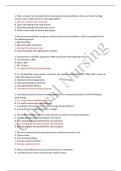
1. When caring for an intubated client receiving mechanical ventilation, the nurse hears the high-
pressure alarm. Which action is most appropriate?
A. Remove secretions by suctioning.
B. Lower the setting of the tidal volume.
C. Check that tubing connections are secure.
D. Obtain a specimen for arterial blood gases.
2. Neuromuscular blockers are given to patients who are on ventilators in ARF to accomplish all of
the following except:
a. Maintain PEEP.
b. Maintain better ventilation.
C. Increase the respiratory rate.
g
D. Keep the patient from fighting the ventilator
sin
3. Indications for ventilator support for ARDS include all of the following except:
A. O2 saturation < 90%.
B. PaO2 < 60%.
C. RR > 35 b/m
D. VC equal to 60 mL/kg of body weight.
of the following occur except:
A. Improved arterial oxygenation.
ur
4. It is decided that a client needs a ventilator. Her physician prescribes PEEP. When PEEP is used, all
N
B. Improved ventilation–perfusion.
C. Increased alveolar dilation.
D. Increased functional residual capacity.
al
5. Intermittent positive-pressure breathing differs from incentive spirometry in all the following
ways except:
A. It is a mechanical aid to lung expansion.
ic
B. It is used to encourage hyperinflation.
C. It produces a forced flow of air into the lungs during inhalation.
D. It provides for the breathing of air or oxygen.
in
6. Choose the blood gas sequence that indicates a need for mechanical ventilation.
A. Decreasing PaO2, decreasing PaCO2, normal pH.
B. Increasing PaO2, decreasing PaCO2, increasing pH.
Cl
C. Decreasing PaO2, increasing PaCO2, decreasing pH.
D. Increasing PaO2, decreasing PaCO2, decreasing pH.
7. The most commonly used positive-pressure ventilator currently is the:
A. Chest cuirass.
B. Time-cycled ventilator.
C. Pressure-cycled ventilator.
D. Volume-cycled ventilator.
8. Which of the following occurs in positive-pressure ventilation-
A. Increases venous return and decreases cardiac output.
, B. Decreases venous return and increases cardiac output.
C. Decreases venous return and decreases cardiac output.
D. Increases venous return and increases cardiac output.
9. The sigh mechanism on an assist-control ventilator needs to be adjusted to provide
_________________ sigh(s) per hour at a rate that is __________________ times the tidal volume.
A. 1 and 1
B. 1 to 2 and 2
C. 1 to 3 and 1.5
D. 3 to 6 and 3.5
10. A 29-year-old man with an opioid overdose, has been maintained on a volume-cycled ventilator
g
for 3 weeks, a major nursing assessment would be:
A. Breath sounds.
sin
B. Nutritional needs.
C. Psychological status.
D. Spontaneous ventilatory efforts.
11. Positive-pressure ventilation can alter cardiac function. The nurse assesses for indicators of
A. Bradycardia and bradypnea.
B. Diaphoresis and oliguria.
C. Restlessness and confusion.
ur
hypoxia and hypoxemia, which would include all of the following except:
N
D. Transient hypertension.
12. The nurse wants to determine early whether a patient is “bucking” his ventilator, so that he can
initiate preventive measures if necessary. The nurse should assess for signs and symptoms related
al
to:
A. Hypercarbia.
B. Hypoxia.
ic
C. Inadequate minute volume.
D. All of the above.
in
13. A 68 years old trauma victim, is to be weaned from his ventilator, before weaning, the clients
ventilatory capacity should be such that he:
A. Can maintain an inspiratory force of at least 20 cm H2O pressure.
B. Has a PaO2 greater than 60% and an FiO2 lower than 40%.
Cl
C. Is able to generate a minimum VC of 10 to 15 mL/kg of body weight.
D. Is capable of all of the above.
14. Ventilators are classified as either positive pressure or negative pressure ventilators. Which of
the following statements is true?
A. Positive pressure ventilators enclose all or part of the body.
B. Positive pressure ventilators pull air into the lungs.
C. Negative pressure ventilators is invasive
D. Positive pressure ventilators can deliver a consistent volume of air with each breath, a pre -set
pressure of air, or total breathing for the client at set intervals.
pressure alarm. Which action is most appropriate?
A. Remove secretions by suctioning.
B. Lower the setting of the tidal volume.
C. Check that tubing connections are secure.
D. Obtain a specimen for arterial blood gases.
2. Neuromuscular blockers are given to patients who are on ventilators in ARF to accomplish all of
the following except:
a. Maintain PEEP.
b. Maintain better ventilation.
C. Increase the respiratory rate.
g
D. Keep the patient from fighting the ventilator
sin
3. Indications for ventilator support for ARDS include all of the following except:
A. O2 saturation < 90%.
B. PaO2 < 60%.
C. RR > 35 b/m
D. VC equal to 60 mL/kg of body weight.
of the following occur except:
A. Improved arterial oxygenation.
ur
4. It is decided that a client needs a ventilator. Her physician prescribes PEEP. When PEEP is used, all
N
B. Improved ventilation–perfusion.
C. Increased alveolar dilation.
D. Increased functional residual capacity.
al
5. Intermittent positive-pressure breathing differs from incentive spirometry in all the following
ways except:
A. It is a mechanical aid to lung expansion.
ic
B. It is used to encourage hyperinflation.
C. It produces a forced flow of air into the lungs during inhalation.
D. It provides for the breathing of air or oxygen.
in
6. Choose the blood gas sequence that indicates a need for mechanical ventilation.
A. Decreasing PaO2, decreasing PaCO2, normal pH.
B. Increasing PaO2, decreasing PaCO2, increasing pH.
Cl
C. Decreasing PaO2, increasing PaCO2, decreasing pH.
D. Increasing PaO2, decreasing PaCO2, decreasing pH.
7. The most commonly used positive-pressure ventilator currently is the:
A. Chest cuirass.
B. Time-cycled ventilator.
C. Pressure-cycled ventilator.
D. Volume-cycled ventilator.
8. Which of the following occurs in positive-pressure ventilation-
A. Increases venous return and decreases cardiac output.
, B. Decreases venous return and increases cardiac output.
C. Decreases venous return and decreases cardiac output.
D. Increases venous return and increases cardiac output.
9. The sigh mechanism on an assist-control ventilator needs to be adjusted to provide
_________________ sigh(s) per hour at a rate that is __________________ times the tidal volume.
A. 1 and 1
B. 1 to 2 and 2
C. 1 to 3 and 1.5
D. 3 to 6 and 3.5
10. A 29-year-old man with an opioid overdose, has been maintained on a volume-cycled ventilator
g
for 3 weeks, a major nursing assessment would be:
A. Breath sounds.
sin
B. Nutritional needs.
C. Psychological status.
D. Spontaneous ventilatory efforts.
11. Positive-pressure ventilation can alter cardiac function. The nurse assesses for indicators of
A. Bradycardia and bradypnea.
B. Diaphoresis and oliguria.
C. Restlessness and confusion.
ur
hypoxia and hypoxemia, which would include all of the following except:
N
D. Transient hypertension.
12. The nurse wants to determine early whether a patient is “bucking” his ventilator, so that he can
initiate preventive measures if necessary. The nurse should assess for signs and symptoms related
al
to:
A. Hypercarbia.
B. Hypoxia.
ic
C. Inadequate minute volume.
D. All of the above.
in
13. A 68 years old trauma victim, is to be weaned from his ventilator, before weaning, the clients
ventilatory capacity should be such that he:
A. Can maintain an inspiratory force of at least 20 cm H2O pressure.
B. Has a PaO2 greater than 60% and an FiO2 lower than 40%.
Cl
C. Is able to generate a minimum VC of 10 to 15 mL/kg of body weight.
D. Is capable of all of the above.
14. Ventilators are classified as either positive pressure or negative pressure ventilators. Which of
the following statements is true?
A. Positive pressure ventilators enclose all or part of the body.
B. Positive pressure ventilators pull air into the lungs.
C. Negative pressure ventilators is invasive
D. Positive pressure ventilators can deliver a consistent volume of air with each breath, a pre -set
pressure of air, or total breathing for the client at set intervals.


