Written by students who passed Immediately available after payment Read online or as PDF Wrong document? Swap it for free 4.6 TrustPilot
logo-home
Exam (elaborations)

NR-283 Pathophysiology Week 4 Quiz 2026/2027 | ACTUAL EXAM Verified Q&A with Rationales | Chamberlain | Pass Guaranteed - A+ Graded

Rating
-
Sold
-
Pages
9
Grade
A+
Uploaded on
10-04-2026
Written in
2025/2026

Pass your NR-283 Pathophysiology Week 4 Quiz at Chamberlain University with this comprehensive resource featuring verified questions, answers, and detailed rationales – all 100% correct and A+ graded for the 2026/2027 curriculum. This A+ Graded resource for the NR-283 Pathophysiology Week 4 Quiz (2026/2027 | Chamberlain University) contains verified questions, answers, and rationales covering all essential topics related to infectious diseases and neoplasia (cancer). Comprehensive Content Coverage Includes: Infectious Diseases: Chain of infection: Infectious agent (pathogen) → reservoir (human, animal, environmental) → portal of exit → mode of transmission (contact – direct, indirect, droplet; airborne; vehicle; vector-borne) → portal of entry → susceptible host. Bacterial infections: Classification by shape (cocci, bacilli, spirilla), Gram stain (positive – thick peptidoglycan, purple; negative – thin peptidoglycan, pink), oxygen requirements (aerobic, anaerobic, facultative). Exotoxins (proteins released by bacteria – neurotoxins, enterotoxins, cytotoxins; highly potent, specific targets) vs. endotoxins (lipopolysaccharide in Gram-negative cell wall – released upon lysis, causes fever, shock, DIC). Examples – Streptococcus pyogenes (pharyngitis, rheumatic fever), Staphylococcus aureus (skin infections, toxic shock, MRSA), Escherichia coli (UTI, traveler's diarrhea), Clostridium tetani (tetanus – exotoxin), Neisseria meningitidis (meningitis – endotoxin). Viral infections: Structure (DNA or RNA, capsid, envelope). Viral replication cycle (attachment, penetration, uncoating, synthesis, assembly, release). Latent vs. lytic infections. Examples – influenza (orthomyxovirus, antigenic drift/shift), HIV (retrovirus, reverse transcriptase, CD4+ T cell depletion), herpes simplex (latent in ganglia, reactivation), varicella-zoster (chickenpox then shingles), hepatitis B and C (chronic liver disease, cirrhosis, HCC), COVID-19 (SARS-CoV-2, ACE2 receptor). Fungal infections (mycoses): Superficial (dermatophytes – tinea), subcutaneous (sporotrichosis), systemic (histoplasmosis, coccidioidomycosis, candidiasis – immunocompromised). Opportunistic fungi (Aspergillus, Cryptococcus in HIV/AIDS). Parasitic infections: Protozoa (malaria – Plasmodium, toxoplasmosis – Toxoplasma, giardiasis – Giardia), helminths (roundworms – Ascaris; tapeworms – Taenia; flukes – Schistosoma). Vector-borne transmission (mosquito – malaria, West Nile; tick – Lyme disease, babesiosis). Host response to infection: Fever (endogenous pyrogens – IL-1, TNF-α, IL-6; prostaglandin E2 in hypothalamus), leukocytosis (neutrophilia in bacterial, lymphocytosis in viral), acute phase reactants. Sepsis and septic shock – systemic inflammatory response syndrome (SIRS) due to infection, endothelial dysfunction, hypotension, organ failure. Neoplasia (Cancer Biology): Definitions: Neoplasm (abnormal mass of tissue with unregulated growth), benign (localized, well-differentiated, no metastasis, usually curable) vs. malignant (invasive, poorly differentiated, metastasis, life-threatening). Cancer (malignant tumor). Oncology (study of cancer). Carcinogenesis: Genetic and epigenetic alterations. Oncogenes (gain-of-function – promote cell growth – ras, myc, HER2/neu). Tumor suppressor genes (loss-of-function – inhibit cell growth – p53 "guardian of genome", Rb retinoblastoma, APC, BRCA1/BRCA2). Mutations – initiation (irreversible genetic change), promotion (proliferation of initiated cells), progression (additional mutations, increased malignancy). Carcinogens: Chemical (tobacco smoke – lung, bladder; asbestos – mesothelioma; benzene – leukemia; aflatoxin – liver), radiation (UV – skin cancer; ionizing radiation – thyroid, leukemia), viral (HPV – cervical, oropharyngeal; HBV/HCV – liver; EBV – lymphoma; HTLV-1 – leukemia), bacterial (H. pylori – gastric cancer), parasitic (Schistosoma – bladder cancer). Hormonal (estrogen – breast, endometrial). Characteristics of cancer cells (Hallmarks of Cancer): Sustained proliferative signaling, evading growth suppressors, resisting cell death (apoptosis), enabling replicative immortality (telomerase activation), inducing angiogenesis, activating invasion and metastasis, reprogramming energy metabolism (Warburg effect), evading immune destruction, tumor-promoting inflammation, genome instability. Tumor differentiation and grade: Well-differentiated (resembles normal tissue, low grade) → poorly differentiated (anaplasia – loss of differentiation, high grade). Anaplastic cells – pleomorphism, hyperchromatic nuclei, high nuclear-to-cytoplasmic ratio, atypical mitoses. Metastasis: Spread to distant sites via lymphatic vessels (lymph node metastases), blood vessels (hematogenous – liver, lung, bone, brain), or direct seeding (body cavities). Steps – invasion of ECM, intravasation, circulation, extravasation, colonization. Cancer staging (TNM system): T (tumor size and local invasion), N (lymph node involvement), M (distant metastasis). Stage 0 (in situ) to Stage IV (distant metastasis). Prognosis and treatment decisions based on stage. Paraneoplastic syndromes: Cancer-related symptoms not due to direct tumor invasion or metastasis. Examples – hypercalcemia (squamous cell lung cancer, breast cancer – PTHrP), SIADH (small cell lung cancer – hyponatremia), Cushing's syndrome (small cell lung cancer – ACTH), Lambert-Eaton syndrome (small cell lung cancer), digital clubbing (bronchogenic carcinoma), Trousseau syndrome (migratory thrombophlebitis – pancreatic, lung cancer). Tumor markers: Substances produced by tumors detectable in blood. Examples – PSA (prostate), CA-125 (ovarian), CEA (colorectal), AFP (liver), CA 19-9 (pancreatic), hCG (choriocarcinoma, testicular). Use for screening, monitoring response, detecting recurrence. Effects of cancer: Local effects (pain, obstruction, bleeding), systemic effects (cachexia – weight loss, muscle wasting; fatigue, anemia, immunosuppression, paraneoplastic syndromes). Cancer cachexia – cytokine-mediated (TNF-α, IL-6, IFN-γ), increased resting energy expenditure, anorexia. Each question includes a detailed rationale explaining the pathophysiologic mechanism, clinical correlation, and correct answer reasoning – ensuring you understand the "why" behind every correct choice. With fully verified Q&A plus rationales and our Pass Guarantee, this is the definitive tool to ace your Week 4 Quiz on the first attempt. Get instant access now a nd start studying today.

Show more Read less
Institution
NR-283 Pathophysiology
Course
NR-283 Pathophysiology

Content preview

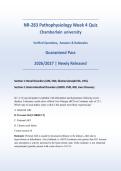
NR-283 Pathophysiology Week 4 Quiz
Chamberlain university

Verified Questions, Answers & Rationales

Guaranteed Pass

2026/2027 | Newly Released


Section 1: Renal Disorders (AKI, CKD, Glomerulonephritis, UTIs)
Section 2: Gastrointestinal Disorders (GERD, PUD, IBD, Liver Disease)


Q1: A 72-year-old patient is admitted with dehydration and hypotension following severe
diarrhea. Laboratory results show a Blood Urea Nitrogen (BUN) to Creatinine ratio of 25:1.
Which type of acute kidney injury (AKI) is this patient most likely experiencing?

A. Intrarenal AKI

B. Prerenal AKI [CORRECT]

C. Postrenal AKI

D. Chronic renal failure
Correct Answer: B

Rationale: Prerenal AKI is caused by decreased perfusion to the kidneys, often due to
hypovolemia or dehydration. A key hallmark is a BUN:Creatinine ratio greater than 20:1 because
urea absorption is actively increased in the hypovolemic state, while creatinine is not. Intrarenal
and postrenal typically present with a ratio closer to 10-15:1.

, Q2: A patient with a history of poorly controlled diabetes mellitus presents with oliguria and
elevated serum creatinine. A urinalysis reveals muddy brown casts. Which of the following is the
most likely cause of this patient's acute kidney injury?

A. Prerenal azotemia

B. Acute tubular necrosis (ATN) [CORRECT]

C. Benign prostatic hyperplasia (BPH)

D. Glomerulonephritis

Correct Answer: B
Rationale: Muddy brown casts are pathognomonic for Acute Tubular Necrosis (ATN), an
intrarenal cause of AKI. ATN is often caused by ischemia (shock) or nephrotoxins (like
antibiotics or contrast dye), though diabetes is a major risk factor. Prerenal causes do not
typically cause casts, and BPH is a postrenal cause.


Q3: Which of the following conditions is classified as a postrenal cause of acute kidney injury?

A. Sepsis

B. Nephrotoxic drugs

C. Bilateral ureteral obstruction [CORRECT]

D. Heart failure

Correct Answer: C

Rationale: Postrenal AKI is caused by obstruction of urine flow. This can occur due to kidney
stones, tumors, or bilateral ureteral obstruction (unilateral obstruction usually does not cause AKI
unless there is only one functioning kidney). Sepsis and heart failure are prerenal/intrarenal, and
nephrotoxic drugs are intrarenal.


Q4: A patient is diagnosed with Stage 3 Chronic Kidney Disease (CKD). Based on the GFR
classifications used in pathophysiology, which of the following Glomerular Filtration Rate
(GFR) ranges corresponds to this stage?

A. GFR > 90 mL/min

B. GFR 60-89 mL/min

C. GFR 30-59 mL/min [CORRECT]

.

Written for

Institution
NR-283 Pathophysiology
Course
NR-283 Pathophysiology

Document information

Uploaded on
April 10, 2026
Number of pages
9
Written in
2025/2026
Type
Exam (elaborations)
Contains
Questions & answers
$12.00
Get access to the full document:

Wrong document? Swap it for free Within 14 days of purchase and before downloading, you can choose a different document. You can simply spend the amount again.
Written by students who passed
Immediately available after payment
Read online or as PDF


Also available in package deal

Thumbnail
Package deal
NR-283 Pathophysiology Week 3 & Week 4 Quizzes BUNDLE 2026/2027 | Verified Q&A with Rationales | Chamberlain | Pass Guaranteed - A+ Graded
-
2 2026
$ 16.00 More info

Get to know the seller

Seller avatar
Reputation scores are based on the amount of documents a seller has sold for a fee and the reviews they have received for those documents. There are three levels: Bronze, Silver and Gold. The better the reputation, the more your can rely on the quality of the sellers work.
TutorRicks Chamberlain College Of Nursing
View profile
Follow You need to be logged in order to follow users or courses
Sold
322
Member since
2 year
Number of followers
50
Documents
2827
Last sold
1 day ago

3.7

43 reviews

5
22
4
4
3
8
2
1
1
8

Recently viewed by you

Why students choose Stuvia

Created by fellow students, verified by reviews

Quality you can trust: written by students who passed their tests and reviewed by others who've used these notes.

Didn't get what you expected? Choose another document

No worries! You can instantly pick a different document that better fits what you're looking for.

Pay as you like, start learning right away

No subscription, no commitments. Pay the way you're used to via credit card and download your PDF document instantly.

Student with book image

“Bought, downloaded, and aced it. It really can be that simple.”

Alisha Student

Working on your references?

Create accurate citations in APA, MLA and Harvard with our free citation generator.

Working on your references?

Frequently asked questions