RN Comprehensive Online Practice B Questions with Verified Answers
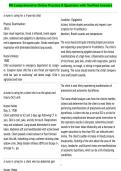
A nurse is caring for a 5-year-old child
Condition: Epiglottis
Physical Examination: Actions: Initiate droplet precautions and request a pre-
1510: scription for IV antibiotics
Upon visual inspection, throat is inflamed, tonsils appear Monitors: Breath sounds and temperature
pink, reddened and epiglottis is edematous and cherry
red in appearance. Skin appears pale. Stridor noted upon The nurse should anticipate initiating droplet precautions
inspiration with diminished bilateral lung sounds. and requesting a prescription for IV antibiotics. The child is
most likely experiencing epiglottis because of the clinical
Nurse's Notes: manifestations of a high fever, inflammation and redness
1500 of the throat, pale skin, stridor with inspiration, painful
Child accompanied to emergency department by caregiv- swallowing, no cough, is sitting in tripod position, and
er. Caregiver states child has a sore throat and reports the drooling. The nurse should monitor the child's tempera-
child has "pain on swallowing" and denies cough. Child is ture and breath sounds.
agitated and lean
The client is most likely experiencing manifestations of
pneumonia and autonomic dysreflexia.
A nurse is caring for a client who is on the spinal cord
injury (SCI) unit The nurse should analyze cues from the client's manifes-
tations and determine that the client is most likely ex-
Nurses' Notes
periencing manifestations of pneumonia and autonomic
Day 3, 1700
dysreflexia. A client who has a cervical SCI is at risk for
Client admitted to SCI unit 3 days ago following C7 in-
respiratory complications because spinal innervation to
jury. Skin is cool, pale, and dry to touch. Respirations
the respiratory muscles is disrupted. Adventitious breath
easy and unlabored. Lung sounds diminished in lower
sounds in the lower lobes bilaterally and a decrease in
lobes. Abdomen soft and nondistended with active bowel
oxygen saturation to less than 92% can indicate pneu-
sounds. Client passed a small amount of hard formed
monia. The client's sudden increase in blood pressure,
stool this AM. Indwelling urinary catheter draining clear
bradycardia, flushing of the skin above the area of the
yellow urine. Deep tendon reflexes (DTR) are biceps 1+,
injury, headache, and blurred vision are manifestations
triceps 1+, pa
of autonomic dysreflexia, which can be a life-threatening
condition.
A nurse is caring for a client who has abdominal pain
,Hepatitis A: Client's risk from fecal-oral transmission, lab-
oratory results, and physical examination findings
Hepatitis B: Antiviral treatment, laboratory results, client's
risk from bloodborne transmission, physical examination
findings
Hepatitis C: Antiviral treatment, laboratory results, client's
risk from bloodborne transmission, and physical exami-
nation findings
When analyzing cues, the nurse should recognize that
manifestations of hepatitis A, hepatitis B, and hepatitis C
include jaundice, yellow sclerae, right upper quandrant
pain upon palpation, dark yellow urine, and elevated AST
and ALT levels. When analyzing cues, the nurse should
also recognize the client's risk for contracting hepatitis A
through the fecal-oral route during recent travel to an
underdeveloped country and the client's occupational risk
as a perioperative nurse for contracting hepatitis B and
hepatitis C through bloodborne transmission. The nurse
should recognize that the current standard of practice for
A nurse is caring for a client on a medical-surgical unit
Click to highlight the findings that require follow up. To
Vital Signs deselect a finding, click on the finding again.
0700 - Noted 2 cm x 2 cm (0.8 in x 0.8 in) painful edematous
Temperature 37.6 C (99.7 F) area on sacrum
Heart rate 100/min - Client repositioned every 4 hr
Respiratory rate 22/min
When recognizing cues, the nurse should determine that
Blood pressure 115/70 mmHg
the client's painful edematous area on their sacrum and
Oxygen saturation 98% on room air
that the client has only been repositioned every 4 hr re-
,Nurses' Notes
quires follow up. The client has manifestations of a pres-
1100
sure injury that need to be addressed. The client should
Client alert and oriented to person, place, and time. Client
be repositioned at least every 2 hr to prevent worsening of
had episode of diarrhea, provided perineal care. Noted
the pressure injury and to relieve pressure from the sacral
2 cm x 2 cm (0.8 in x 0.8 in) painful edematous area on
area.
sacrum. Client repositioned every 4 hr.
A nurse in an outpatient mental health clinic is caring for
a client
Vital Signs
3 months ago
Blood pressure 116/68 mmHg
Heart rate 82/min
Select the 3 findings that require immediate follow up:
Respiratory rate 16/min
- Auditory hallucinations
Temperature 36.7 C (98.1 F)
- Speech
SaO2 97% on room air
- Restlessness
Today:
When recognizing cues, the nurse should identify that the
Blood pressure 128/76 mmHg
findings of restlessness, auditory hallucinations, and pres-
Heart rate 104/min
sured speech require immediate follow up. These findings
Respiratory rate 22/min
are indications of psychosis. The nurse should notify the
Temperature 37.4 (99.4 F)
provider for additional evaluation and treatment.
SaO2 97% on room air
Nurses' Notes
3 months ago
Client recently admitted with new diagnosis of schizo-
phrenia. Received inpatient treatment for 10 days and was
discharged 1 week ago.
A nurse is caring for a client who is postoperative following
coronary artery bypass surgery (CABG)
, Laboratory Results
0630
Sodium 145 mEq/L (136 to 145 mEq/L)
The client is at greatest risk for developing dysrhythmias,
Potassium 3.2 mEq/L (3.5 to 5 mEq/L)
as evidenced by electrolyte imbalance.
Chloride 116 mEq/L (98 to 106 mEq/L)
BUN 24 mg/dL (10 to 20 mg/dL) The nurse should analyze cues to determine the client is
Magnesium 1.5 mEq/L (1.3 to 2.1 mEq/L) at greatest risk for developing dysrhythmias related to hy-
Total calcium 9 mg/dL (9 to 10.5 mg/dL) pokalemia, as evidenced by the laboratory report and the
Phosphate 4.6 mg/dL (3 to 4.5 mg/dL) client's report of muscle cramping. Potassium and mag-
Glucose 95 mg/dL (74 to 106 mg/dL) nesium depletion are common manifestations in clients
WBC count 9,500/mm3 (5,000 to 10,000/mm3) who are postoperative following CABG. Due to medication
or hemodilation, it is important for the nurse to closely
I&O
monitor electrolytes.
0700
4 hr input 400 mL
4 hr output
A nurse is caring for a client who is pregnant in the acute
care setting
The nurse should first address the client's respiratory rate,
followed by the client's level of consciousness
Nurses' Notes
1400
When prioritizing hypotheses, the nurse should recog-
Client reports a constant low dull backache and pain-
nize that magnesium sulfate is a central nervous sys-
less abdominal tightening for the past 3 hr. Denies any
tem depressant that can attect respirations, conscious-
changes in vaginal discharge. External fetal monitor ap-
ness, and reflexes when toxic blood levels occur. Using
plied.
the airway, breathing, circulation priority framework, the
nurse should plan to first take action to support respi-
1430
rations, followed by action to increase the client's level
Contraction pattern: contractions every 4 to 5 min, lasting
of consciousness. The nurse should plan to discontinue
30 to 45 seconds, palpate mild in intensity
the magnesium sulfate infusion and administer calcium
Fetal heart rate: 150/min to 155/min, moderate variability,
gluconate as an antidote.
adequate accelerations present, no decelerations noted.
Provider in
A nurse is caring for an adolescent in the emergency
A nurse is caring for a 5-year-old child
Condition: Epiglottis
Physical Examination: Actions: Initiate droplet precautions and request a pre-
1510: scription for IV antibiotics
Upon visual inspection, throat is inflamed, tonsils appear Monitors: Breath sounds and temperature
pink, reddened and epiglottis is edematous and cherry
red in appearance. Skin appears pale. Stridor noted upon The nurse should anticipate initiating droplet precautions
inspiration with diminished bilateral lung sounds. and requesting a prescription for IV antibiotics. The child is
most likely experiencing epiglottis because of the clinical
Nurse's Notes: manifestations of a high fever, inflammation and redness
1500 of the throat, pale skin, stridor with inspiration, painful
Child accompanied to emergency department by caregiv- swallowing, no cough, is sitting in tripod position, and
er. Caregiver states child has a sore throat and reports the drooling. The nurse should monitor the child's tempera-
child has "pain on swallowing" and denies cough. Child is ture and breath sounds.
agitated and lean
The client is most likely experiencing manifestations of
pneumonia and autonomic dysreflexia.
A nurse is caring for a client who is on the spinal cord
injury (SCI) unit The nurse should analyze cues from the client's manifes-
tations and determine that the client is most likely ex-
Nurses' Notes
periencing manifestations of pneumonia and autonomic
Day 3, 1700
dysreflexia. A client who has a cervical SCI is at risk for
Client admitted to SCI unit 3 days ago following C7 in-
respiratory complications because spinal innervation to
jury. Skin is cool, pale, and dry to touch. Respirations
the respiratory muscles is disrupted. Adventitious breath
easy and unlabored. Lung sounds diminished in lower
sounds in the lower lobes bilaterally and a decrease in
lobes. Abdomen soft and nondistended with active bowel
oxygen saturation to less than 92% can indicate pneu-
sounds. Client passed a small amount of hard formed
monia. The client's sudden increase in blood pressure,
stool this AM. Indwelling urinary catheter draining clear
bradycardia, flushing of the skin above the area of the
yellow urine. Deep tendon reflexes (DTR) are biceps 1+,
injury, headache, and blurred vision are manifestations
triceps 1+, pa
of autonomic dysreflexia, which can be a life-threatening
condition.
A nurse is caring for a client who has abdominal pain
,Hepatitis A: Client's risk from fecal-oral transmission, lab-
oratory results, and physical examination findings
Hepatitis B: Antiviral treatment, laboratory results, client's
risk from bloodborne transmission, physical examination
findings
Hepatitis C: Antiviral treatment, laboratory results, client's
risk from bloodborne transmission, and physical exami-
nation findings
When analyzing cues, the nurse should recognize that
manifestations of hepatitis A, hepatitis B, and hepatitis C
include jaundice, yellow sclerae, right upper quandrant
pain upon palpation, dark yellow urine, and elevated AST
and ALT levels. When analyzing cues, the nurse should
also recognize the client's risk for contracting hepatitis A
through the fecal-oral route during recent travel to an
underdeveloped country and the client's occupational risk
as a perioperative nurse for contracting hepatitis B and
hepatitis C through bloodborne transmission. The nurse
should recognize that the current standard of practice for
A nurse is caring for a client on a medical-surgical unit
Click to highlight the findings that require follow up. To
Vital Signs deselect a finding, click on the finding again.
0700 - Noted 2 cm x 2 cm (0.8 in x 0.8 in) painful edematous
Temperature 37.6 C (99.7 F) area on sacrum
Heart rate 100/min - Client repositioned every 4 hr
Respiratory rate 22/min
When recognizing cues, the nurse should determine that
Blood pressure 115/70 mmHg
the client's painful edematous area on their sacrum and
Oxygen saturation 98% on room air
that the client has only been repositioned every 4 hr re-
,Nurses' Notes
quires follow up. The client has manifestations of a pres-
1100
sure injury that need to be addressed. The client should
Client alert and oriented to person, place, and time. Client
be repositioned at least every 2 hr to prevent worsening of
had episode of diarrhea, provided perineal care. Noted
the pressure injury and to relieve pressure from the sacral
2 cm x 2 cm (0.8 in x 0.8 in) painful edematous area on
area.
sacrum. Client repositioned every 4 hr.
A nurse in an outpatient mental health clinic is caring for
a client
Vital Signs
3 months ago
Blood pressure 116/68 mmHg
Heart rate 82/min
Select the 3 findings that require immediate follow up:
Respiratory rate 16/min
- Auditory hallucinations
Temperature 36.7 C (98.1 F)
- Speech
SaO2 97% on room air
- Restlessness
Today:
When recognizing cues, the nurse should identify that the
Blood pressure 128/76 mmHg
findings of restlessness, auditory hallucinations, and pres-
Heart rate 104/min
sured speech require immediate follow up. These findings
Respiratory rate 22/min
are indications of psychosis. The nurse should notify the
Temperature 37.4 (99.4 F)
provider for additional evaluation and treatment.
SaO2 97% on room air
Nurses' Notes
3 months ago
Client recently admitted with new diagnosis of schizo-
phrenia. Received inpatient treatment for 10 days and was
discharged 1 week ago.
A nurse is caring for a client who is postoperative following
coronary artery bypass surgery (CABG)
, Laboratory Results
0630
Sodium 145 mEq/L (136 to 145 mEq/L)
The client is at greatest risk for developing dysrhythmias,
Potassium 3.2 mEq/L (3.5 to 5 mEq/L)
as evidenced by electrolyte imbalance.
Chloride 116 mEq/L (98 to 106 mEq/L)
BUN 24 mg/dL (10 to 20 mg/dL) The nurse should analyze cues to determine the client is
Magnesium 1.5 mEq/L (1.3 to 2.1 mEq/L) at greatest risk for developing dysrhythmias related to hy-
Total calcium 9 mg/dL (9 to 10.5 mg/dL) pokalemia, as evidenced by the laboratory report and the
Phosphate 4.6 mg/dL (3 to 4.5 mg/dL) client's report of muscle cramping. Potassium and mag-
Glucose 95 mg/dL (74 to 106 mg/dL) nesium depletion are common manifestations in clients
WBC count 9,500/mm3 (5,000 to 10,000/mm3) who are postoperative following CABG. Due to medication
or hemodilation, it is important for the nurse to closely
I&O
monitor electrolytes.
0700
4 hr input 400 mL
4 hr output
A nurse is caring for a client who is pregnant in the acute
care setting
The nurse should first address the client's respiratory rate,
followed by the client's level of consciousness
Nurses' Notes
1400
When prioritizing hypotheses, the nurse should recog-
Client reports a constant low dull backache and pain-
nize that magnesium sulfate is a central nervous sys-
less abdominal tightening for the past 3 hr. Denies any
tem depressant that can attect respirations, conscious-
changes in vaginal discharge. External fetal monitor ap-
ness, and reflexes when toxic blood levels occur. Using
plied.
the airway, breathing, circulation priority framework, the
nurse should plan to first take action to support respi-
1430
rations, followed by action to increase the client's level
Contraction pattern: contractions every 4 to 5 min, lasting
of consciousness. The nurse should plan to discontinue
30 to 45 seconds, palpate mild in intensity
the magnesium sulfate infusion and administer calcium
Fetal heart rate: 150/min to 155/min, moderate variability,
gluconate as an antidote.
adequate accelerations present, no decelerations noted.
Provider in
A nurse is caring for an adolescent in the emergency