NHA CCMA Clinical Patient Care (General Patient Care): 2026.
NHA CCMA: Clinical Patient Care (General Patient Care)
Study online at https://quizlet.com/_6sxgs4
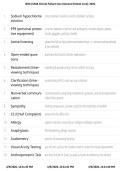
1. Sodium hypochlorite most common solutions used to disinfect surfaces
solution
2. PPE (personal protec- a barrier between a person and pathogens; includes gloves, gowns,
tive equipment) masks, goggles, and face shields
3. Active listening allows the MA to fully understand what the pt. is communicating verbally
& non-verbally
4. Open-ended ques- questions that lead to further explanation
tions
5. Restatement (Inter- repeating & paraphrasing info to confirm accuracy
viewing technique)
6. Clarification (Inter- summarizing info to clear up any confusion
viewing technique)
7. Nonverbal communi- communication using body movements, gestures, and facial expressions
cation rather than speech
8. Sympathy feeling compassion, sorrow or pity for the hardships of another
9. CC (Chief Complaint) reason for the office visit
10. Allergy adverse reaction caused by an antigen-antibody response
11. Anaphylaxis life threatening allergic reaction
12. Audiometry process of measuring hearing
13. Visual Acuity Testing use of tools such as the Snellen chart to screen for visual impairments
14. Anthropometric Test test that include ht. & wt. (as well as head circumference for infants)
1/8
4/9/2026, 12:41:43 PM 4/9/2026, 12:41:41 PM 4/9/2026, 12:41:40 PM
, NHA CCMA Clinical Patient Care (General Patient Care): 2026.
NHA CCMA: Clinical Patient Care (General Patient Care)
Study online at https://quizlet.com/_6sxgs4
15. Vital Signs (VS) temperature, pulse, respiration, blood pressure
16. Scoliosis abnormal lateral curvature of the spine
17. Pyrexia fever
18. 98.6 F (37 C) normal body temperature
19. Fingers used to pal- 2nd & the 3rd fingers
pate the pulse
20. Radial pulse site thumb side of the wrist
21. Brachial pulse site inside the upper arm
22. Carotid pulse site neck, just below the jaw bone
23. Auscultation listening with a stethoscope
24. Palpatation the art of touching
25. Newborn average HR 120-160 bpm
26. Infant average HR 80-140 bpm
27. Toddler average HR 80-130 bpm
28. Preschool average HR 80-120 bpm
29. School-age average 70-100 bpm
HR
30. Adult average HR 60-100 bpm
31. Respiration evaluated by rate, rhythm & depth
2/8
4/9/2026, 12:41:43 PM 4/9/2026, 12:41:41 PM 4/9/2026, 12:41:40 PM
NHA CCMA: Clinical Patient Care (General Patient Care)
Study online at https://quizlet.com/_6sxgs4
1. Sodium hypochlorite most common solutions used to disinfect surfaces
solution
2. PPE (personal protec- a barrier between a person and pathogens; includes gloves, gowns,
tive equipment) masks, goggles, and face shields
3. Active listening allows the MA to fully understand what the pt. is communicating verbally
& non-verbally
4. Open-ended ques- questions that lead to further explanation
tions
5. Restatement (Inter- repeating & paraphrasing info to confirm accuracy
viewing technique)
6. Clarification (Inter- summarizing info to clear up any confusion
viewing technique)
7. Nonverbal communi- communication using body movements, gestures, and facial expressions
cation rather than speech
8. Sympathy feeling compassion, sorrow or pity for the hardships of another
9. CC (Chief Complaint) reason for the office visit
10. Allergy adverse reaction caused by an antigen-antibody response
11. Anaphylaxis life threatening allergic reaction
12. Audiometry process of measuring hearing
13. Visual Acuity Testing use of tools such as the Snellen chart to screen for visual impairments
14. Anthropometric Test test that include ht. & wt. (as well as head circumference for infants)
1/8
4/9/2026, 12:41:43 PM 4/9/2026, 12:41:41 PM 4/9/2026, 12:41:40 PM
, NHA CCMA Clinical Patient Care (General Patient Care): 2026.
NHA CCMA: Clinical Patient Care (General Patient Care)
Study online at https://quizlet.com/_6sxgs4
15. Vital Signs (VS) temperature, pulse, respiration, blood pressure
16. Scoliosis abnormal lateral curvature of the spine
17. Pyrexia fever
18. 98.6 F (37 C) normal body temperature
19. Fingers used to pal- 2nd & the 3rd fingers
pate the pulse
20. Radial pulse site thumb side of the wrist
21. Brachial pulse site inside the upper arm
22. Carotid pulse site neck, just below the jaw bone
23. Auscultation listening with a stethoscope
24. Palpatation the art of touching
25. Newborn average HR 120-160 bpm
26. Infant average HR 80-140 bpm
27. Toddler average HR 80-130 bpm
28. Preschool average HR 80-120 bpm
29. School-age average 70-100 bpm
HR
30. Adult average HR 60-100 bpm
31. Respiration evaluated by rate, rhythm & depth
2/8
4/9/2026, 12:41:43 PM 4/9/2026, 12:41:41 PM 4/9/2026, 12:41:40 PM