

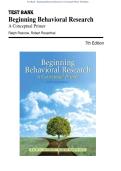
Test Bank - Beginning Behavioral Research A Conceptual Primer 7th Edition
TEST BANK
Beginning Behavioral Research
A Conceptual Primer
Ralph Rosnow, Robert Rosenthal
7th Edition
, Test Bank - Beginning Behavioral Research A Conceptual Primer 7th Edition
Table of Contents
PART I GETTING STARTED
Chapter 1 Behavioral Research and the Scientific Method
Chapter 2 From Hunches to Testable Hypotheses
Chapter 3 Ethical Considerations and Guidelines
PART II OBSERVATION AND MEASUREMENT
Chapter 4 Methods of Systematic Observation
Chapter 5 Methods for Looking Within Ourselves
Chapter 6 Reliability and Validity in Measurement and Research
PART III DESIGN AND IMPLEMENTATION
Chapter 7 Randomized Experiments and Causal Inference
Chapter 8 Nonrandomized Research and Causal Reasoning
Chapter 9 Survey Research and Subject Recruitment
PART IV DESCRIBING DATA AND DRAWING INFERENCES
Chapter 10 Summarizing the Data
Chapter 11 Correlating Variables
Chapter 12 Understanding p Values and Effect Size Indicators
PART V STATISTICAL TESTS
Chapter 13 The Comparison of Two Conditions
Chapter 14 Comparisons of More Than Two Conditions
Chapter 15 The Analysis of Frequency Tables
, Test Bank - Beginning Behavioral Research A Conceptual Primer 7th Edition
CHAPTER 1: BEHAVIORAL RESEARCH AND THE SCIENTIFIC METHOD
CHAPTER OUTLINE
I. Why Study Research Methods and Data Analysis?
A. The term “researching” (i.e., exploring a problem systematically) is traditionally
called the scientific method in college science courses.
1. This “method” is used in all scientific fields.
2. However, its applications vary from one discipline to another.
B. Why should we know the scientific method or study techniques of research?
1. We can enhance our understanding of the influence that science has on our
lives.
2. We can learn to differentiate between good science and pseudoscience.
3. We can acquire information and skills useful in our daily lives.
4. We can learn about the limits of particular studies and methods.
5. We may find that studying and doing research can be an exciting career.
II. What Alternatives Are There to the Scientific Method?
A. Charles Sanders Peirce (1839–1914) described four distinct strategies for formulating
strongly held beliefs.
B. The four strategies for the “fixation of belief.”
1. Method of tenacity is clinging stubbornly and mindlessly to claims or beliefs
just because they have been around a while.
2. Method of authority is the acceptance of an idea as being valid because
someone in a position of power or authority states it.
3. The a priori method is the use of one’s individual powers of reason and logic
to make sense of the world.
4. The scientific method provides a framework with which to draw on
independent realities to evaluate claims.
III. How Do Scientists Use Empirical Reasoning and the Scientific Method?
A. The scientific method involves the use of empirical reasoning.
B. Empirical reasoning is a combination of logic, carefully organized observation, and
measurement.
C. It is the use of empirical reasoning that all scientists have in common, despite
differences in the particular methods of empirical inquiry they may employ.
D. Empirical reasoning entered into behavioral science during the late nineteenth century
when individuals such as Wilhelm Wundt (1832–1920) and William James (1843–
1910) began employing the scientific method utilized by physicists and biologists to
study psychological behavior.
E. Francis Galton (1822–1911) demonstrated the application of empirical reasoning to
questions thought to lie completely outside of science.
1
, Test Bank - Beginning Behavioral Research A Conceptual Primer 7th Edition
IV. Applications in Behavioral Research
A. Empirical reasoning has been applied to questions about human nature, cognition,
perception, and behavior.
B. Stephen J. Ceci and his colleagues employed empirical reasoning to investigate the
accuracy of children’s eyewitness testimony.
C. Solomon Asch used empirical reasoning to study conformity and the reasons why
people go along with certain consensual opinions.
V. How Do Extraempirical Factors Come into Play?
A. Although the scientific method is distinguished by its reliance on the primary use of
empirical procedures, extraempirical factors also play an important role in
ascertaining what is true.
B. Aesthetic considerations play a part.
.
C. Opinions and arguments are articulated in the accepted rhetoric (rhetoric of
justification) of the particular field they represent.
1. Rhetoric includes specialized terms and structure of reporting.
2. Peer-reviewed journals rely upon this rhetoric.
D. Researchers have a penchant for poignant analogies and metaphors for visualizing one
thing in terms of another (i.e., perceptibility).
VI. What Does Behavioral Research Cover?
A. Behavioral Research is an umbrella term that includes covers the use of empirical
reasoning (viz., careful logic, organized observation, and measurement) from
different methodological vantage points in an effort to understand how and why
people act, perceive, feel, and think as they do in a variety of disciplines such as
psychologists, behavioral economists, political scientists, sociologists, and cultural
anthropologists.
B. The objective of behavioral and social science is to describe and explain how and why
humans think, feel, and behave as they do.
C. To develop a more complete and integrated picture of human nature, behavioral and
social scientists have come to embrace methodological pluralism, which means that
by necessity, researchers use different tools and designs (different methods) because
each is limited in some way, yet each method represents and reflects a particular
perspective on the phenomenon of interest and the multifaceted complexity of human
nature.
VII. How Does Research Go From Descriptive to Relational to Experimental?
A. Descriptive conclusions tell us how things are.
1. The goal of descriptive research is the careful mapping out of a situation or set of
events.
2. Causal explanations are not of direct concern except perhaps speculatively.
3. This orientation is often considered a necessary first step in the development of a
program of research because it establishes the logical and empirical foundation of
any future undertaking.
2
, Test Bank - Beginning Behavioral Research A Conceptual Primer 7th Edition
4. Descriptive research is rarely regarded as sufficient as it does not allow one to
address questions concerning why something happens or how what happens is
related to other events.
B. Relational (or “correlational”) conclusions tell us how things are in relation to other
things.
1. Relational (or correlational) research involves measuring and relating two or more
variables or conditions.
2. Based on coordinated observations, one should be able to make a quantitative
statement concerning the relationship, or correlation, between the variable of
interest.
a. Are X and Y significantly related?
b. What is the pattern of the relationship (e.g., linear or nonlinear)?
c. What is the strength of the relationship?
C. Experimental conclusions tell us how things are and how they got to be that way.
1. The objective is the identification of causes (i.e., what leads to what) through the
manipulation of conditions thought to be responsible for the effect.
2. Relational research rarely provides causal explanations, and then only under very
special circumstances.
VIII. What are the Characteristics of Good Researchers?
A. Enthusiasm
B. Open-mindedness
C. Common sense
D. Role-taking ability
E. Creativity and inventiveness
F. Confidence in one’s own judgment
G. Ability to communicate
H. Care about details
I. Integrity and honest scholarship
LECTURE IDEAS AND ACTIVITIES
1. To demonstrate the pervasiveness of science in modern society as well as the utility of
understanding the process of science, assemble a collection of articles that report on recent
scientific findings. The science section of the Tuesday New York Times is particularly useful for
finding such articles (http://www.nytimes.com). Another Internet resource is Science Daily
(http://www.sciencedaily.com). Discuss the findings reported in these articles, emphasizing how
an understanding of the scientific process can help one better evaluate or question the findings or
conclusions reported in the media.
2. Jacobson, Mulick, and Schwartz (1995) discuss how the reliance on pseudoscientific findings
has led to the acceptance by professionals of some therapeutic treatments that appear to have
negligible, if any, benefit for the afflicted individual. Jacobson et al. argue that one example of
the reliance on pseudoscientific research practices to establish the efficacy of a therapeutic
3
, Test Bank - Beginning Behavioral Research A Conceptual Primer 7th Edition
intervention is the controversial case of facilitated communication. Jacobson et al. describe the
disparity between the controlled, scientific research studies that have found very little, if any,
support for this type of intervention with autistic individuals and its unquestioned acceptance by
its proponents. Jacobson et al. discuss possible reasons why proponents of facilitated
communication have rejected sound scientific practices in favor of practices that can be
described as representing pseudoscience. Not surprisingly, this article sparked debate concerning
whether scientific practices can really establish the efficacy of facilitated communication (e.g.,
Allen & Allen, 1996; Biklen, 1996; Fernald, 1996; Jacobson et al., 1996; Knox, 1996). You
might want to assign these articles and have your students debate the criteria that one should use
to establish the effectiveness of a treatment intervention. You may also want to discuss whether
treatments that have become popular based solely on pseudoscientific evidence are really that
detrimental to society as a whole or to the individuals they are intended to help. In other words,
is it always necessary to establish the efficacy of a treatment intervention using practices that can
be characterized as “good science”?
Allen, B., & Allen, S. (1996). Can the scientific method be applied to human interaction?
American Psychologist, 51, 986.
Biklen, D. (1996). Learning from the experiences of people with disabilities. American
Psychologist, 51, 985–986.
Fernald, D. (1996). Tapping too softly. American Psychologist, 51, 988.
Jacobson, J. W., Mulick, J. A., & Schwartz, A. A. (1995). A history of facilitated
Communication: Science, pseudoscience, and antiscience. American Psychologist, 50,
750-765.
Jacobson, J. W., Mulick, J. A., & Schwartz, A. A. (1996). If a tree falls in the woods... American
Psychologist, 51, 988–989.
Knox, L. A. (1996). The facilitated communication witch-hunt. American Psychologist, 51, 986–
987.
3. More information on the life of Charles Sanders Peirce as well as hypertext versions of his
writings are available at a website dedicated to this American philosopher
(http://www.peirce.org).
4. Before discussing Peirce’s methods of “fixing belief,” have students write down five things
they believe to be true. Once they have completed their lists, have each student share his or her
list with another student. As one student reads each “truth” from his or her list, the student’s
partner should simply ask, “Why do you believe that this is true?” to each item, recording the
student’s response. As a class, discuss the nature of the arguments that were used to fend off the
challenges to the veracity of the student’s beliefs. This exercise easily leads into a discussion of
Peirce’s methods of “fixing belief.” You may want to categorize the types of arguments the
students used to justify the veracity of their beliefs using Peirce’s four methods of fixing belief.
5. To help students to critically consider the underlying foundation of claims of veracity, you
might incorporate the following writing assignment into discussion of Peirce’s methods of
4
, Test Bank - Beginning Behavioral Research A Conceptual Primer 7th Edition
“fixing belief.” The assignment involves the analysis of the famous 1897 editorial entitled,
“Yes, Virginia, There Is a Santa Claus.” This editorial is actually a reply to a letter from an
eight-year-old girl named Virginia O’Hanlon who was asking the editor of the now defunct
newspaper, the New York Sun, the truth about the existence of Santa Claus. The editor, Francis
Church, utilizes three of Peirce’s methods to establish that Santa Claus does exist while at the
same time rejecting the scientific method as a means for answering this question. Have students
write a two- to three-page paper evaluating this exchange between Virginia and Church in terms
of Peirce’s four methods.
Virginia’s letter and Church’s subsequent reply is widely available in the public domain on the
Internet. Here is the exchange between the two individuals:
Dear Editor: I am 8 years old. Some of my little friends say there is no Santa Claus. Papa
says, ‘If you see it in The Sun it’s so.’ Please tell me the truth, is there a Santa Claus?”
Virginia O’Hanlon
115 WEST 95TH ST.
Virginia, your little friends are wrong. They have been affected by the skepticism of a
skeptical age. They do not believe except they see. They think that nothing can be which
is not comprehensible by their little minds. All minds, Virginia, whether they be men’s or
children’s, are little. In this great universe of ours man is a mere insect, an ant, in his
intellect, as compared with the boundless world about him, as measured by the
intelligence capable of grasping the whole of truth and knowledge.
Yes, Virginia, there is a Santa Claus. He exists as certainly as love and generosity and
devotion exist, and you know that they abound and give to your life its highest beauty
and joy. Alas! how dreary would be the world if there were no Santa Claus! It would be
as dreary as if there were no Virginias. There would be no childlike faith then, no poetry,
no romance to make tolerable this existence. We should have not enjoyment, except in
sense and sight, The eternal light with which childhood fills the world would lie
extinguished.
Not believe in Santa Claus! You might as well not believe in fairies! You might get your
papa to hire men to watch in all the chimneys on Christmas Eve to catch Santa Claus, but
even if they did not see Santa Claus coming down, what would that prove? Nobody sees
Santa Claus, but that is no sign that there is no Santa Claus. The most real things in the
world are those that neither children nor men can see. Did you ever see fairies dancing on
the lawn? Of course not, but that’s no proof that they are not there. Nobody can conceive
or imagine all the wonders there are unseen and unseeable in the world.
You tear apart the baby’s rattle and see what makes the noise inside, but there is a veil
covering the unseen world which not the strongest man, nor even the united strength of
all the strongest men that ever lived, could tear apart. Only faith, fancy, poetry, love,
romance can push aside that curtain and view and picture the supernal beauty and glory
beyond. Is it all real? Ah, Virginia, in all this world there is nothing else real and abiding.
No Santa Claus! Thank God! he lives, and he lives forever. A thousand years from now,
5
TEST BANK
Beginning Behavioral Research
A Conceptual Primer
Ralph Rosnow, Robert Rosenthal
7th Edition
, Test Bank - Beginning Behavioral Research A Conceptual Primer 7th Edition
Table of Contents
PART I GETTING STARTED
Chapter 1 Behavioral Research and the Scientific Method
Chapter 2 From Hunches to Testable Hypotheses
Chapter 3 Ethical Considerations and Guidelines
PART II OBSERVATION AND MEASUREMENT
Chapter 4 Methods of Systematic Observation
Chapter 5 Methods for Looking Within Ourselves
Chapter 6 Reliability and Validity in Measurement and Research
PART III DESIGN AND IMPLEMENTATION
Chapter 7 Randomized Experiments and Causal Inference
Chapter 8 Nonrandomized Research and Causal Reasoning
Chapter 9 Survey Research and Subject Recruitment
PART IV DESCRIBING DATA AND DRAWING INFERENCES
Chapter 10 Summarizing the Data
Chapter 11 Correlating Variables
Chapter 12 Understanding p Values and Effect Size Indicators
PART V STATISTICAL TESTS
Chapter 13 The Comparison of Two Conditions
Chapter 14 Comparisons of More Than Two Conditions
Chapter 15 The Analysis of Frequency Tables
, Test Bank - Beginning Behavioral Research A Conceptual Primer 7th Edition
CHAPTER 1: BEHAVIORAL RESEARCH AND THE SCIENTIFIC METHOD
CHAPTER OUTLINE
I. Why Study Research Methods and Data Analysis?
A. The term “researching” (i.e., exploring a problem systematically) is traditionally
called the scientific method in college science courses.
1. This “method” is used in all scientific fields.
2. However, its applications vary from one discipline to another.
B. Why should we know the scientific method or study techniques of research?
1. We can enhance our understanding of the influence that science has on our
lives.
2. We can learn to differentiate between good science and pseudoscience.
3. We can acquire information and skills useful in our daily lives.
4. We can learn about the limits of particular studies and methods.
5. We may find that studying and doing research can be an exciting career.
II. What Alternatives Are There to the Scientific Method?
A. Charles Sanders Peirce (1839–1914) described four distinct strategies for formulating
strongly held beliefs.
B. The four strategies for the “fixation of belief.”
1. Method of tenacity is clinging stubbornly and mindlessly to claims or beliefs
just because they have been around a while.
2. Method of authority is the acceptance of an idea as being valid because
someone in a position of power or authority states it.
3. The a priori method is the use of one’s individual powers of reason and logic
to make sense of the world.
4. The scientific method provides a framework with which to draw on
independent realities to evaluate claims.
III. How Do Scientists Use Empirical Reasoning and the Scientific Method?
A. The scientific method involves the use of empirical reasoning.
B. Empirical reasoning is a combination of logic, carefully organized observation, and
measurement.
C. It is the use of empirical reasoning that all scientists have in common, despite
differences in the particular methods of empirical inquiry they may employ.
D. Empirical reasoning entered into behavioral science during the late nineteenth century
when individuals such as Wilhelm Wundt (1832–1920) and William James (1843–
1910) began employing the scientific method utilized by physicists and biologists to
study psychological behavior.
E. Francis Galton (1822–1911) demonstrated the application of empirical reasoning to
questions thought to lie completely outside of science.
1
, Test Bank - Beginning Behavioral Research A Conceptual Primer 7th Edition
IV. Applications in Behavioral Research
A. Empirical reasoning has been applied to questions about human nature, cognition,
perception, and behavior.
B. Stephen J. Ceci and his colleagues employed empirical reasoning to investigate the
accuracy of children’s eyewitness testimony.
C. Solomon Asch used empirical reasoning to study conformity and the reasons why
people go along with certain consensual opinions.
V. How Do Extraempirical Factors Come into Play?
A. Although the scientific method is distinguished by its reliance on the primary use of
empirical procedures, extraempirical factors also play an important role in
ascertaining what is true.
B. Aesthetic considerations play a part.
.
C. Opinions and arguments are articulated in the accepted rhetoric (rhetoric of
justification) of the particular field they represent.
1. Rhetoric includes specialized terms and structure of reporting.
2. Peer-reviewed journals rely upon this rhetoric.
D. Researchers have a penchant for poignant analogies and metaphors for visualizing one
thing in terms of another (i.e., perceptibility).
VI. What Does Behavioral Research Cover?
A. Behavioral Research is an umbrella term that includes covers the use of empirical
reasoning (viz., careful logic, organized observation, and measurement) from
different methodological vantage points in an effort to understand how and why
people act, perceive, feel, and think as they do in a variety of disciplines such as
psychologists, behavioral economists, political scientists, sociologists, and cultural
anthropologists.
B. The objective of behavioral and social science is to describe and explain how and why
humans think, feel, and behave as they do.
C. To develop a more complete and integrated picture of human nature, behavioral and
social scientists have come to embrace methodological pluralism, which means that
by necessity, researchers use different tools and designs (different methods) because
each is limited in some way, yet each method represents and reflects a particular
perspective on the phenomenon of interest and the multifaceted complexity of human
nature.
VII. How Does Research Go From Descriptive to Relational to Experimental?
A. Descriptive conclusions tell us how things are.
1. The goal of descriptive research is the careful mapping out of a situation or set of
events.
2. Causal explanations are not of direct concern except perhaps speculatively.
3. This orientation is often considered a necessary first step in the development of a
program of research because it establishes the logical and empirical foundation of
any future undertaking.
2
, Test Bank - Beginning Behavioral Research A Conceptual Primer 7th Edition
4. Descriptive research is rarely regarded as sufficient as it does not allow one to
address questions concerning why something happens or how what happens is
related to other events.
B. Relational (or “correlational”) conclusions tell us how things are in relation to other
things.
1. Relational (or correlational) research involves measuring and relating two or more
variables or conditions.
2. Based on coordinated observations, one should be able to make a quantitative
statement concerning the relationship, or correlation, between the variable of
interest.
a. Are X and Y significantly related?
b. What is the pattern of the relationship (e.g., linear or nonlinear)?
c. What is the strength of the relationship?
C. Experimental conclusions tell us how things are and how they got to be that way.
1. The objective is the identification of causes (i.e., what leads to what) through the
manipulation of conditions thought to be responsible for the effect.
2. Relational research rarely provides causal explanations, and then only under very
special circumstances.
VIII. What are the Characteristics of Good Researchers?
A. Enthusiasm
B. Open-mindedness
C. Common sense
D. Role-taking ability
E. Creativity and inventiveness
F. Confidence in one’s own judgment
G. Ability to communicate
H. Care about details
I. Integrity and honest scholarship
LECTURE IDEAS AND ACTIVITIES
1. To demonstrate the pervasiveness of science in modern society as well as the utility of
understanding the process of science, assemble a collection of articles that report on recent
scientific findings. The science section of the Tuesday New York Times is particularly useful for
finding such articles (http://www.nytimes.com). Another Internet resource is Science Daily
(http://www.sciencedaily.com). Discuss the findings reported in these articles, emphasizing how
an understanding of the scientific process can help one better evaluate or question the findings or
conclusions reported in the media.
2. Jacobson, Mulick, and Schwartz (1995) discuss how the reliance on pseudoscientific findings
has led to the acceptance by professionals of some therapeutic treatments that appear to have
negligible, if any, benefit for the afflicted individual. Jacobson et al. argue that one example of
the reliance on pseudoscientific research practices to establish the efficacy of a therapeutic
3
, Test Bank - Beginning Behavioral Research A Conceptual Primer 7th Edition
intervention is the controversial case of facilitated communication. Jacobson et al. describe the
disparity between the controlled, scientific research studies that have found very little, if any,
support for this type of intervention with autistic individuals and its unquestioned acceptance by
its proponents. Jacobson et al. discuss possible reasons why proponents of facilitated
communication have rejected sound scientific practices in favor of practices that can be
described as representing pseudoscience. Not surprisingly, this article sparked debate concerning
whether scientific practices can really establish the efficacy of facilitated communication (e.g.,
Allen & Allen, 1996; Biklen, 1996; Fernald, 1996; Jacobson et al., 1996; Knox, 1996). You
might want to assign these articles and have your students debate the criteria that one should use
to establish the effectiveness of a treatment intervention. You may also want to discuss whether
treatments that have become popular based solely on pseudoscientific evidence are really that
detrimental to society as a whole or to the individuals they are intended to help. In other words,
is it always necessary to establish the efficacy of a treatment intervention using practices that can
be characterized as “good science”?
Allen, B., & Allen, S. (1996). Can the scientific method be applied to human interaction?
American Psychologist, 51, 986.
Biklen, D. (1996). Learning from the experiences of people with disabilities. American
Psychologist, 51, 985–986.
Fernald, D. (1996). Tapping too softly. American Psychologist, 51, 988.
Jacobson, J. W., Mulick, J. A., & Schwartz, A. A. (1995). A history of facilitated
Communication: Science, pseudoscience, and antiscience. American Psychologist, 50,
750-765.
Jacobson, J. W., Mulick, J. A., & Schwartz, A. A. (1996). If a tree falls in the woods... American
Psychologist, 51, 988–989.
Knox, L. A. (1996). The facilitated communication witch-hunt. American Psychologist, 51, 986–
987.
3. More information on the life of Charles Sanders Peirce as well as hypertext versions of his
writings are available at a website dedicated to this American philosopher
(http://www.peirce.org).
4. Before discussing Peirce’s methods of “fixing belief,” have students write down five things
they believe to be true. Once they have completed their lists, have each student share his or her
list with another student. As one student reads each “truth” from his or her list, the student’s
partner should simply ask, “Why do you believe that this is true?” to each item, recording the
student’s response. As a class, discuss the nature of the arguments that were used to fend off the
challenges to the veracity of the student’s beliefs. This exercise easily leads into a discussion of
Peirce’s methods of “fixing belief.” You may want to categorize the types of arguments the
students used to justify the veracity of their beliefs using Peirce’s four methods of fixing belief.
5. To help students to critically consider the underlying foundation of claims of veracity, you
might incorporate the following writing assignment into discussion of Peirce’s methods of
4
, Test Bank - Beginning Behavioral Research A Conceptual Primer 7th Edition
“fixing belief.” The assignment involves the analysis of the famous 1897 editorial entitled,
“Yes, Virginia, There Is a Santa Claus.” This editorial is actually a reply to a letter from an
eight-year-old girl named Virginia O’Hanlon who was asking the editor of the now defunct
newspaper, the New York Sun, the truth about the existence of Santa Claus. The editor, Francis
Church, utilizes three of Peirce’s methods to establish that Santa Claus does exist while at the
same time rejecting the scientific method as a means for answering this question. Have students
write a two- to three-page paper evaluating this exchange between Virginia and Church in terms
of Peirce’s four methods.
Virginia’s letter and Church’s subsequent reply is widely available in the public domain on the
Internet. Here is the exchange between the two individuals:
Dear Editor: I am 8 years old. Some of my little friends say there is no Santa Claus. Papa
says, ‘If you see it in The Sun it’s so.’ Please tell me the truth, is there a Santa Claus?”
Virginia O’Hanlon
115 WEST 95TH ST.
Virginia, your little friends are wrong. They have been affected by the skepticism of a
skeptical age. They do not believe except they see. They think that nothing can be which
is not comprehensible by their little minds. All minds, Virginia, whether they be men’s or
children’s, are little. In this great universe of ours man is a mere insect, an ant, in his
intellect, as compared with the boundless world about him, as measured by the
intelligence capable of grasping the whole of truth and knowledge.
Yes, Virginia, there is a Santa Claus. He exists as certainly as love and generosity and
devotion exist, and you know that they abound and give to your life its highest beauty
and joy. Alas! how dreary would be the world if there were no Santa Claus! It would be
as dreary as if there were no Virginias. There would be no childlike faith then, no poetry,
no romance to make tolerable this existence. We should have not enjoyment, except in
sense and sight, The eternal light with which childhood fills the world would lie
extinguished.
Not believe in Santa Claus! You might as well not believe in fairies! You might get your
papa to hire men to watch in all the chimneys on Christmas Eve to catch Santa Claus, but
even if they did not see Santa Claus coming down, what would that prove? Nobody sees
Santa Claus, but that is no sign that there is no Santa Claus. The most real things in the
world are those that neither children nor men can see. Did you ever see fairies dancing on
the lawn? Of course not, but that’s no proof that they are not there. Nobody can conceive
or imagine all the wonders there are unseen and unseeable in the world.
You tear apart the baby’s rattle and see what makes the noise inside, but there is a veil
covering the unseen world which not the strongest man, nor even the united strength of
all the strongest men that ever lived, could tear apart. Only faith, fancy, poetry, love,
romance can push aside that curtain and view and picture the supernal beauty and glory
beyond. Is it all real? Ah, Virginia, in all this world there is nothing else real and abiding.
No Santa Claus! Thank God! he lives, and he lives forever. A thousand years from now,
5


