

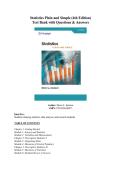
Statistics Plain and Simple (4th Edition)
Test Bank with Questions & Answers
Author: Sherri L. Jackson
ISBN: 9781305638907
Ideal For:
Students studying statistics, data analysis, and research methods
TABLE OF CONTENTS
Chapter 1: Getting Started
Module 1: Science and Statistics
Module 2: Variables and Measurement
Chapter 2: Descriptive Statistics I
Module 3: Organizing Data
Module 4: Measures of Central Tendency
Chapter 3: Descriptive Statistics II
Module 5: Measures of Variation
Module 6: Standard Scores (z Scores)
,Chapter 4: Probability and Hypothesis Testing
Module 7: Probability
Module 8: Hypothesis Testing and Inferential Statistics
Chapter 5: The z and t Tests
Module 9: The Single-Sample z Test
Module 10: The Single-Sample t Test
Chapter 6: Two-Group t Tests
Module 11: The t Test for Independent Groups (Samples)
Module 12: t Test for Correlated Groups (Samples)
Chapter 7: Introduction to Analysis of Variance (ANOVA)
Module 13: Comparing More Than Two Groups
Module 14: One-Way Between-Subjects Analysis of Variance (ANOVA)
Chapter 8: Repeated Measures and Two-Factor ANOVAs
Module 15: One-Way Repeated Measures ANOVA
Module 16: Using Designs with More Than One Independent Variable
Module 17: Two-Way Between-Subjects ANOVA
Chapter 9: Correlational Procedures
Module 18: Correlational Research
Module 19: Correlation Coefficients
Module 20: Advanced Correlational Techniques: Regression Analysis
Chapter 10: Nonparametric Procedures
Module 21: Chi-Square Tests
Module 22: Tests for Ordinal Data
CHAPTER NO. 01: GETTING STARTED
MODULE 1: SCIENCE AND STATISTICS
Multiple Choice Questions
1. A hypothesis is _____, and a theory is _____.
a. an organized system of assumptions and principles that attempts to explain certain phenomena
and how they are related; a prediction regarding the outcome of a study
b. a prediction regarding the outcome of a study; an organized system of assumptions and
principles that attempts to explain certain phenomena and how they are related
c. not used in science; used in science
d. used in science; not used in science
Answer: b
CHAPTER OPENING—UNDERSTAND
2. An event or behavior that has at least two values is a _____.
a. hypothesis
b. theory
c. variable
d. constant
Answer: c
CHAPTER OPENING—UNDERSTAND
, 3. The three goals of science are to:
a. describe, research, and explain.
b. describe, predict, and research.
c. predict, explain, and research.
d. describe, predict, and explain.
Answer: d
GOALS OF SCIENCE—UNDERSTAND
4. When we identify factors that indicate when an event or events will occur, we have used:
a. prediction.
b. description.
c. explanation.
d. falsifiability.
Answer: a
GOALS OF SCIENCE—UNDERSTAND
5. Which of the following allows us to identify the causes that determine when and why a behavior
occurs?
a. Prediction
b. Description
c. Explanation
d. Falsifiability
Answer: c
GOALS OF SCIENCE—UNDERSTAND
6. As Jim was interested in the nest building behavior of wrens, he went into the fields to observe them.
Jim was using the _____ method of research.
a. case study
b. laboratory observational
c. naturalistic observational
d. correlational
Answer: c
AN INTRODUCTION TO RESEARCH METHODS IN SCIENCE—APPLY
7. Observing the behavior of humans or other animals in a contrived and controlled situation involves
using the _____ method.
a. laboratory observational
b. naturalistic observational
c. correlational
d. survey
Answer: a
AN INTRODUCTION TO RESEARCH METHODS IN SCIENCE—UNDERSTAND
8. An in-depth study of one or more individuals is:
a. laboratory observation.
b. naturalistic observation.
, c. a survey.
d. a case study.
Answer: d
AN INTRODUCTION TO RESEARCH METHODS IN SCIENCE—UNDERSTAND
9. When we question individuals on a topic or topics and then describe their responses, we are using the
_____ method, and when we conduct an in-depth study of one or more individuals, we are using the
_____ method.
a. case study; survey
b. survey; case study
c. case study; observational
d. observational; case study
Answer: b
AN INTRODUCTION TO RESEARCH METHODS IN SCIENCE—UNDERSTAND
10. A method that assesses the degree of relationship between two variables is the _____ method.
a. survey
b. observational
c. case study
d. correlational
Answer: d
AN INTRODUCTION TO RESEARCH METHODS IN SCIENCE—UNDERSTAND
11. The group of people who participate in a study represents _____, and all of the people about whom a
study is meant to generalize represent _____.
a. the sample; the population
b. the population; the sample
c. a positive correlation; a negative correlation
d. a negative correlation; a positive correlation
Answer: a
AN INTRODUCTION TO RESEARCH METHODS IN SCIENCE—UNDERSTAND
12. Variables increasing or decreasing together is to _____ and variables moving in an opposite direction
is to _____.
a. quasi-experimental method; experimental method
b. experimental method; quasi-experimental method
c. positive correlation; negative correlation
d. negative correlation; positive correlation
Answer: c
AN INTRODUCTION TO RESEARCH METHODS IN SCIENCE—THINK CRITICALLY
13. Which of the following is a subject (participant) variable?
a. Hair color
b. Gender
c. Political affiliation
d. All of the above
Test Bank with Questions & Answers
Author: Sherri L. Jackson
ISBN: 9781305638907
Ideal For:
Students studying statistics, data analysis, and research methods
TABLE OF CONTENTS
Chapter 1: Getting Started
Module 1: Science and Statistics
Module 2: Variables and Measurement
Chapter 2: Descriptive Statistics I
Module 3: Organizing Data
Module 4: Measures of Central Tendency
Chapter 3: Descriptive Statistics II
Module 5: Measures of Variation
Module 6: Standard Scores (z Scores)
,Chapter 4: Probability and Hypothesis Testing
Module 7: Probability
Module 8: Hypothesis Testing and Inferential Statistics
Chapter 5: The z and t Tests
Module 9: The Single-Sample z Test
Module 10: The Single-Sample t Test
Chapter 6: Two-Group t Tests
Module 11: The t Test for Independent Groups (Samples)
Module 12: t Test for Correlated Groups (Samples)
Chapter 7: Introduction to Analysis of Variance (ANOVA)
Module 13: Comparing More Than Two Groups
Module 14: One-Way Between-Subjects Analysis of Variance (ANOVA)
Chapter 8: Repeated Measures and Two-Factor ANOVAs
Module 15: One-Way Repeated Measures ANOVA
Module 16: Using Designs with More Than One Independent Variable
Module 17: Two-Way Between-Subjects ANOVA
Chapter 9: Correlational Procedures
Module 18: Correlational Research
Module 19: Correlation Coefficients
Module 20: Advanced Correlational Techniques: Regression Analysis
Chapter 10: Nonparametric Procedures
Module 21: Chi-Square Tests
Module 22: Tests for Ordinal Data
CHAPTER NO. 01: GETTING STARTED
MODULE 1: SCIENCE AND STATISTICS
Multiple Choice Questions
1. A hypothesis is _____, and a theory is _____.
a. an organized system of assumptions and principles that attempts to explain certain phenomena
and how they are related; a prediction regarding the outcome of a study
b. a prediction regarding the outcome of a study; an organized system of assumptions and
principles that attempts to explain certain phenomena and how they are related
c. not used in science; used in science
d. used in science; not used in science
Answer: b
CHAPTER OPENING—UNDERSTAND
2. An event or behavior that has at least two values is a _____.
a. hypothesis
b. theory
c. variable
d. constant
Answer: c
CHAPTER OPENING—UNDERSTAND
, 3. The three goals of science are to:
a. describe, research, and explain.
b. describe, predict, and research.
c. predict, explain, and research.
d. describe, predict, and explain.
Answer: d
GOALS OF SCIENCE—UNDERSTAND
4. When we identify factors that indicate when an event or events will occur, we have used:
a. prediction.
b. description.
c. explanation.
d. falsifiability.
Answer: a
GOALS OF SCIENCE—UNDERSTAND
5. Which of the following allows us to identify the causes that determine when and why a behavior
occurs?
a. Prediction
b. Description
c. Explanation
d. Falsifiability
Answer: c
GOALS OF SCIENCE—UNDERSTAND
6. As Jim was interested in the nest building behavior of wrens, he went into the fields to observe them.
Jim was using the _____ method of research.
a. case study
b. laboratory observational
c. naturalistic observational
d. correlational
Answer: c
AN INTRODUCTION TO RESEARCH METHODS IN SCIENCE—APPLY
7. Observing the behavior of humans or other animals in a contrived and controlled situation involves
using the _____ method.
a. laboratory observational
b. naturalistic observational
c. correlational
d. survey
Answer: a
AN INTRODUCTION TO RESEARCH METHODS IN SCIENCE—UNDERSTAND
8. An in-depth study of one or more individuals is:
a. laboratory observation.
b. naturalistic observation.
, c. a survey.
d. a case study.
Answer: d
AN INTRODUCTION TO RESEARCH METHODS IN SCIENCE—UNDERSTAND
9. When we question individuals on a topic or topics and then describe their responses, we are using the
_____ method, and when we conduct an in-depth study of one or more individuals, we are using the
_____ method.
a. case study; survey
b. survey; case study
c. case study; observational
d. observational; case study
Answer: b
AN INTRODUCTION TO RESEARCH METHODS IN SCIENCE—UNDERSTAND
10. A method that assesses the degree of relationship between two variables is the _____ method.
a. survey
b. observational
c. case study
d. correlational
Answer: d
AN INTRODUCTION TO RESEARCH METHODS IN SCIENCE—UNDERSTAND
11. The group of people who participate in a study represents _____, and all of the people about whom a
study is meant to generalize represent _____.
a. the sample; the population
b. the population; the sample
c. a positive correlation; a negative correlation
d. a negative correlation; a positive correlation
Answer: a
AN INTRODUCTION TO RESEARCH METHODS IN SCIENCE—UNDERSTAND
12. Variables increasing or decreasing together is to _____ and variables moving in an opposite direction
is to _____.
a. quasi-experimental method; experimental method
b. experimental method; quasi-experimental method
c. positive correlation; negative correlation
d. negative correlation; positive correlation
Answer: c
AN INTRODUCTION TO RESEARCH METHODS IN SCIENCE—THINK CRITICALLY
13. Which of the following is a subject (participant) variable?
a. Hair color
b. Gender
c. Political affiliation
d. All of the above


