
Nclex Pediatrics Revision Guide On Different System Disorders
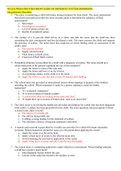
ATI NCLEX PEDIATRICS REVISION GUIDE ON DIFFERENT SYSTEM DISORDERS 1. The nurse is monitoring a child with burns during treatment for burn shock. The nurse understands that which assessment provides the most accurate guide to determine the adequacy of fluid resuscitation 2. The mother of a 3-year-old child arrives at a clinic and tells the nurse that the child has been scratching the skin continuously and has developed a rash. The nurse assesses the child and suspects the presence of scabies. The nurse bases this suspicion on which finding noted on assessment of the child’s skin 3. Permethrin (Elimite) is prescribed for a child with a diagnosis of scabies. The nurse should give which instruction to the parents regarding the use of this treatment 4. The school nurse has provided an instructional session about impetigo to parents of the children attending the school. Which statement, if made by a parent, indicates a need for further instruction 5. The clinic nurse is reviewing the health care providers prescription for a child who has been diagnosed with scabies. Lindane has been prescribed for the child. The nurse questions the prescription if which is noted in the child’s record 6. A topical corticosteroid is prescribed by a health care provider for a child with atopic dermatitis (eczema). Which instruction should the nurse give the parent about applying the cream 7. The school nurse is conducting pediculosis capitis (head lice) assessments. Which finding indicates a child has a positive head check 8. The nurse caring for a child who sustained a burn injury plans car based on which pediatric considerations associated with this injury 1. The nurse analyzes the lab results of a child with hemophilia. The nurse understands that which result will most likely be abnormal in this child 2. The nurse is providing home care instructions to the parents of a 10 year old child with hemophilia. Which sport activity should the nurse suggest for this child 3. The nursing student is presenting a clinical conference and discusses the cause of B-thalassemia. The nursing student informs the group that a child at greatest risk of developing this disorder is which one 4. A child with B-thalassemia is receiving long term blood transfusion therapy for the treatment of the disorder. Chelation therapy is prescribed as a result of too much iron from the transfusions. Which medication should the nurse anticipate to be prescribed 5. The clinic nurse instructs parents of a child with sickle cell anemia about the precipitating factors related to sick cell crisis. Which, if identified by the parents as a precipitating factor, indicates the need for further instruction 6. A 10-year-old child with hemophilia A has slipped on the ice and bumped his knee. The nurse should prepare to administer which prescription 7. The nurse is instructing the parents of a child with iron deficiency anemia regarding the administration of a liquid oral iron supplement. Which instruction should the nurse tell the parents 8. Lab studies are preformed for a child suspected to have iron deficiency anemia. The nurse reviews the lab results knowing that which result indicates this type of anemia? 9. The nurse is reviewing a health care provider’s prescriptions for a child with sickle cell anemia who was admitted to the hospital for the treatment of vaso-occlusive crisis. Which prescriptions documented in the child’s record should the nurse question? (select all) 10. The nurse is conducting staff in-service training on von Willebrand’s disease. Which should the nurse include as characteristics of von Willebrand’s disease? (Select all) 1. The nurse is monitoring a child for bleeding after surgery for removal of a brain tumor. The nurse checks the head dressing for the presence of blood and notes a colorless drainage on the back of the dressing. Which intervention should the nurse perform immediately 2. A child undergoes surgical removal of a brain tumor. During the postoperative period, the nurse is monitoring the child and notes that the child is restless, the pulse rate is elevated, and the blood pressure has decreased significantly from the baseline value. The nurse suspects that the child is in shock. Which is the most appropriate nursing action? 3. The mother of a 4 year old child tells the pediatric nurse that the child’s abdomen seems to be swollen. During further assessment of subjective data, the mother tells the nurse that the child is eating well and that the activity level of the child is unchanged. The nurse, suspecting the possibility of Willm’ tumor, should avoid which during the physical assessment? 4. The pediatric nurse specialist provides a teaching session to the nursing staff regarding osteosarcoma. Which statement by a member of the nursing staff indicates a need for information? 5. The nurse analyzes the lab values of a child with leukemia who is receving chemo. The nurse notes that the platelet count is 19,500. On the basis of this lab result, which intervention should the nurse include in the plan of care? 6. The nurse is monitoring a 3-year-old for signs and symptoms of increased ICP after a craniotomy. The nurse plans to monitor for which early sign or symptom of increased ICP? 7. A 4-year-old is admitted to the hospital for abdominal pain. The mom reports that the child ahs been pale and excessively tired and is bruising easily. On physical exam, lymphadenopathy and hepatosplenomegaly are noted. Diagnostic studies are being performed on the child because acute lymphocytic leukemia is suspected. The nurse understands that which diagnostic study should confirm this diagnosis? 8. A 6 year old with leukemia is hospitalized and is receiving combination chemotherapy. Lab results indicate that the child is neutropenic, and protective isolation procedures are initiated. The grandmother of the child visits and brings a fresh bouquet of flowers picked from her garden and asks the nurse for a vase for the flowers. Which response should the nurse provide to the grandmother? 9. A diagnosis of Hodgkin’s is suspected in a 12 year old child seen in a clinic. Several diagnostic studies are preformed to determine the presence of this disease. Which diagnostic test result will confirm the diagnosis of Hodgkin’s disease? 10. Which specific nursing interventions are implemented in the care of a child with leukemia who is at risk for infection? (Select all) 11. The nurse is performing an assessment on a 10 year old child suspected to have Hodgkin’s disease. The nurse understands that which assessment findings are specifically characteristic of this disease? (Select all) 1. A school-aged child with type 1 diabetes has soccer practice three afternoons a week. The school nurse provides instructions regarding how to prevent hypoglycemia during practice. Which should the school nurse tell the child to do? 2. The mother of a 6 year old who has type 1 diabetes calls a clinic nurse and tells the nurse that the child has been sick. The mom reports that she checked the child’s urine and it was positive for ketones. The nurse should instruct the mom to take which action 3. A HCP prescribes an IV solution of 5% dextrose and half normal saline (0.45%) with 40 mEq of potassium chloride for a child with hypotonic dehydration. The nurse performs which priority assessment before administering this IV prescription? 4. An adolescent client with type-1 diabetes is admitted to the ER for treatment of diabetic ketoacidosis. Which assessment findings should the nurse expect to note? 5. A mom brings her 3-week-old infant to a clinic for a phenylketonuria rescreening blood test. The test indicates a serum phenylalanine level of 1mg/dl. The nurse reviews this result and makes which interpretation? 6. A child with type-1 diabetes is brought to the ER by the mom, who states that the child has been complaining of abdominal pain and has been lethargic. Diabetic ketoacidosis is diagnosed. Anticiapting the plan of care, the nurse prepares to administer which type of IV infusion? 7. The nurse has just administered ibuprofen (Motrin IB) to a child with a temperature of 38.8C (102F). the nurse should also take which action? 8. A child has fluid volume deficit. The nurse performs an assessment and determines that the child is improving and the deficit is resolving if which finding is noted? 9. The nurse should implement which interventions for a child older than 2 years with type 1 diabetes who has a blood glucose level of 60? (select all) 1. The clinic nurse reviews the record of an infant and notes that the HCP has documented a diagnosis of suspected Hischprung’s disease. The nurse reviews the assessment findings documented in the record, knowing that which symptom most likely led the mother to seek health care for the infant? 2. An infant has just returned to the nursing unit after surgical repair of a cleft lip on the right side. The nurse should place the infant in which best position at this time? 3. The nurse reviews the record of a newborn infant and notes that a diagnosis of esophageal atresia with tracheoesophageal fistula is suspected. The nurse expects to note which most likely sign of this condition documented in the record? 4. The nurse provides feeding instructions to a parent of an infant diagnosed with gastroesopheageal reflux disease. Which instruction should the nurse give to the parent to assist in reducing the episodes of emesis? 5. A child is hospitalized because of persistent vomiting. The nurse should monitor the child closely for which problem? 6. The nurse is caring for a newborn with a suspected diagnosis of imperforate anus. The nurse monitors the infant, knowing that which is a clinical manifestation associated with this disorder? 7. The nurse admits a child to the hospital with a diagnosis of pyloric stenosis. On assessment, which data would thenurse expect to obtain when asking the mom about the child’s symptoms? 8. The nurse provides home care instructions to the parents of a child with celiac disease. The nurse should teach the parents to include which food item in the child’s diet? 9. The nurse is preparing to care for a child with a diagnosis of intussusception. The nurse reviews the child’s record and expects to note which symptom of this disorder documented? 10. Which interventions should the nurse include when preparing a care plan for a child with hepatitis? (Select all) 1. After a tonsillectomy, a child begins to vomit bright red blood. The nurse should take which initial action? 2. The mom of a 6 year old arrives at a clinic b/c the child has been experiencing scratchy, red, and swollen eyes. The nurse notes a discharge from the eyes and sends a culture to the lab for analysis. Chlamydial conjunctivitis is diagnosed. On the basis of this diagnosis, the nurse determines that which requires further investigation? 3. The nurse prepares a teaching plan for the mother of a child diagnosed with bacterial conjunctivitis. Which, if stated by the mom, indicates a need for further teaching? ....................................CONTINUED...........................................................................DOWNLOAD FOR FURTHER REVISION
Document information
- Uploaded on
- May 1, 2021
- Number of pages
- 23
- Written in
- 2020/2021
- Type
- Exam (elaborations)
- Contains
- Questions & answers


