

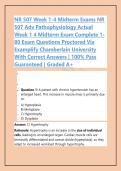
NR 507 Week 1-4 Midterm Exams NR
507 Adv Pathophysiology Actual
Week 1 4 Midterm Exam Complete 1-
80 Exam Questions Proctored Via
Examplify Chamberlain University
With Correct Answers | 100% Pass
Guaranteed | Graded A+
Question 1: A patient with chronic hypertension has an
enlarged heart. This increase in muscle mass is primarily due
to:
o A) Hyperplasia
o B) Metaplasia
o C) Hypertrophy
o D) Dysplasia
Answer: C) Hypertrophy
Rationale: Hypertrophy is an increase in the size of individual
cells, leading to an enlarged organ. Cardiac muscle cells are
terminally differentiated and cannot divide (hyperplasia), so they
adapt to increased workload through hypertrophy.
, Question 2: A 52-year-old male is diagnosed with lung
cancer. Genetic analysis reveals a mutation in the KRAS
proto-oncogene. Which of the following best describes the
role of proto-oncogenes in normal cellular function?
o A) They encode for proteins that inhibit cell division.
o B) They encode for proteins that promote normal cell growth
and division.
o C) They repair damaged DNA.
o D) They induce apoptosis in damaged cells.
Answer: B) They encode for proteins that promote normal cell
growth and division.
Rationale: Proto-oncogenes are normal genes that regulate cell
growth and division. When mutated, they
become oncogenes that drive uncontrolled proliferation. KRAS is
a proto-oncogene commonly mutated in lung, colon, and
pancreatic cancers.
Question 3: The irreversible point in cellular injury where cell
death is inevitable, even if the stressor is removed, is known
as:
o A) The point of no return
o B) Cellular apoptosis
o C) The necrotic point
o D) The "point of singularity"
Answer: A) The point of no return
Rationale: This is a key concept where mitochondrial damage
becomes so severe that ATP production ceases entirely, leading to
irreversible membrane and DNA damage. This point is also known
as the point at which necrosis becomes inevitable.
,🛡️ Immunity, Inflammation, & Hypersensitivity
Question 4: A 28-year-old female with systemic lupus
erythematosus (SLE) has a positive antinuclear antibody
(ANA) test. Which of the following best describes the
pathogenesis of SLE?
o A) Type I hypersensitivity reaction with IgE-mediated mast
cell activation.
o B) Type II hypersensitivity with antibody-mediated
cytotoxicity.
o C) Type III hypersensitivity with immune complex deposition.
o D) Type IV hypersensitivity with T-cell mediated tissue
destruction.
Answer: C) Type III hypersensitivity with immune complex
deposition.
Rationale: SLE is a Type III hypersensitivity reaction characterized
by the formation of immune complexes (autoantibodies bound
to self-antigens). These complexes deposit in small vessels,
kidneys, and joints, leading to complement activation and
inflammation.
Question 5: Which of the following are considered the "first
responders" of the innate immune system?
o A) Macrophages
o B) Lymphocytes
o C) Neutrophils
o D) Eosinophils
, Answer: C) Neutrophils
Rationale: Neutrophils are the most abundant type of white
blood cell and are the first to arrive at the site of an infection or
inflammation. They are phagocytic cells that form pus and are a
key part of the acute inflammatory response.
Question 6: A 6-month-old infant presents with recurrent,
severe infections. Immunologic evaluation reveals absence of
T cells and B cells. Which of the following is the most likely
diagnosis?
o A) Selective IgA deficiency
o B) Severe combined immunodeficiency (SCID)
o C) DiGeorge syndrome
o D) Chronic granulomatous disease
Answer: B) Severe combined immunodeficiency (SCID)
Rationale: SCID is characterized by severe defects in both T cell
and B cell development, leading to profound immunodeficiency.
Infants present with recurrent, life-threatening infections early in
life. It is a primary immunodeficiency caused by a genetic
defect.
Question 7: Hives (urticaria) are an example of a:
o A) Type 1 Hypersensitivity reaction
o B) Type 2 Hypersensitivity reaction
o C) Type 3 Hypersensitivity reaction
o D) Type 4 Hypersensitivity reaction
Answer: A) Type 1 Hypersensitivity reaction
Rationale: Hives (urticaria) are an example of a Type I
hypersensitivity reaction. These reactions are mediated by the
507 Adv Pathophysiology Actual
Week 1 4 Midterm Exam Complete 1-
80 Exam Questions Proctored Via
Examplify Chamberlain University
With Correct Answers | 100% Pass
Guaranteed | Graded A+
Question 1: A patient with chronic hypertension has an
enlarged heart. This increase in muscle mass is primarily due
to:
o A) Hyperplasia
o B) Metaplasia
o C) Hypertrophy
o D) Dysplasia
Answer: C) Hypertrophy
Rationale: Hypertrophy is an increase in the size of individual
cells, leading to an enlarged organ. Cardiac muscle cells are
terminally differentiated and cannot divide (hyperplasia), so they
adapt to increased workload through hypertrophy.
, Question 2: A 52-year-old male is diagnosed with lung
cancer. Genetic analysis reveals a mutation in the KRAS
proto-oncogene. Which of the following best describes the
role of proto-oncogenes in normal cellular function?
o A) They encode for proteins that inhibit cell division.
o B) They encode for proteins that promote normal cell growth
and division.
o C) They repair damaged DNA.
o D) They induce apoptosis in damaged cells.
Answer: B) They encode for proteins that promote normal cell
growth and division.
Rationale: Proto-oncogenes are normal genes that regulate cell
growth and division. When mutated, they
become oncogenes that drive uncontrolled proliferation. KRAS is
a proto-oncogene commonly mutated in lung, colon, and
pancreatic cancers.
Question 3: The irreversible point in cellular injury where cell
death is inevitable, even if the stressor is removed, is known
as:
o A) The point of no return
o B) Cellular apoptosis
o C) The necrotic point
o D) The "point of singularity"
Answer: A) The point of no return
Rationale: This is a key concept where mitochondrial damage
becomes so severe that ATP production ceases entirely, leading to
irreversible membrane and DNA damage. This point is also known
as the point at which necrosis becomes inevitable.
,🛡️ Immunity, Inflammation, & Hypersensitivity
Question 4: A 28-year-old female with systemic lupus
erythematosus (SLE) has a positive antinuclear antibody
(ANA) test. Which of the following best describes the
pathogenesis of SLE?
o A) Type I hypersensitivity reaction with IgE-mediated mast
cell activation.
o B) Type II hypersensitivity with antibody-mediated
cytotoxicity.
o C) Type III hypersensitivity with immune complex deposition.
o D) Type IV hypersensitivity with T-cell mediated tissue
destruction.
Answer: C) Type III hypersensitivity with immune complex
deposition.
Rationale: SLE is a Type III hypersensitivity reaction characterized
by the formation of immune complexes (autoantibodies bound
to self-antigens). These complexes deposit in small vessels,
kidneys, and joints, leading to complement activation and
inflammation.
Question 5: Which of the following are considered the "first
responders" of the innate immune system?
o A) Macrophages
o B) Lymphocytes
o C) Neutrophils
o D) Eosinophils
, Answer: C) Neutrophils
Rationale: Neutrophils are the most abundant type of white
blood cell and are the first to arrive at the site of an infection or
inflammation. They are phagocytic cells that form pus and are a
key part of the acute inflammatory response.
Question 6: A 6-month-old infant presents with recurrent,
severe infections. Immunologic evaluation reveals absence of
T cells and B cells. Which of the following is the most likely
diagnosis?
o A) Selective IgA deficiency
o B) Severe combined immunodeficiency (SCID)
o C) DiGeorge syndrome
o D) Chronic granulomatous disease
Answer: B) Severe combined immunodeficiency (SCID)
Rationale: SCID is characterized by severe defects in both T cell
and B cell development, leading to profound immunodeficiency.
Infants present with recurrent, life-threatening infections early in
life. It is a primary immunodeficiency caused by a genetic
defect.
Question 7: Hives (urticaria) are an example of a:
o A) Type 1 Hypersensitivity reaction
o B) Type 2 Hypersensitivity reaction
o C) Type 3 Hypersensitivity reaction
o D) Type 4 Hypersensitivity reaction
Answer: A) Type 1 Hypersensitivity reaction
Rationale: Hives (urticaria) are an example of a Type I
hypersensitivity reaction. These reactions are mediated by the


