

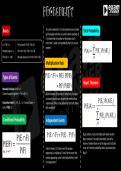
PROBABILITY
Ten cards numbered 1 to 10 are placed in a box, mixed
Basics up thoroughly and then one card is drawn randomly. If
Total Probability
it is known that the number on the drawn card is
0 <= P(E) <= 1 P(A but not B) = P(A) - P(A n B)
more than 3, what is the probability that it is an even
number?
P(Sample Space) = 1 P(A U B) = P(A) + P(B) - P(A n B)
P(not A) = 1 - P(A) Mutually Exclusive: P(A U B) = P(A) + P(B)
Multiplication Rule
Types of Events
Baye’s Theorem
Mutually Exclusive: A n B = ∅
(Cannot happen together) -> P(A n B) = 0 An urn contains 10 black and 5 white balls. Two balls
are drawn from the urn one after the other without
Exhaustive Events: E1 U E2 U ... En = Sample Space -> replacement. What is the probability that both drawn
Sum of P(Ei) = 1 balls are black?
Conditional Probability Independent Events
Bag I contains 3 red and 4 black balls while another
Bag II contains 5 red and 6 black balls. One ball is
drawn at random from one of the bags and it is found
A die is thrown. If E is the event ‘the number to be red. Find the probability that it was drawn from
appearing is a multiple of 3’ and F be the event ‘the Bag II.
number appearing is even’ then find whether E and F
are independent ?
,Ten cards numbered 1 to 10 are placed in a box, mixed up thoroughly and then one card is drawn randomly. If
it is known that the number on the drawn card is more than 3, what is the probability that it is an even
number?
,Ten cards numbered 1 to 10 are placed in a box, mixed up thoroughly and then one card is drawn randomly. If
it is known that the number on the drawn card is more than 3, what is the probability that it is an even
number?
, An urn contains 10 black and 5 white balls. Two balls are drawn from the urn one after the other without
replacement. What is the probability that both drawn balls are black?
Ten cards numbered 1 to 10 are placed in a box, mixed
Basics up thoroughly and then one card is drawn randomly. If
Total Probability
it is known that the number on the drawn card is
0 <= P(E) <= 1 P(A but not B) = P(A) - P(A n B)
more than 3, what is the probability that it is an even
number?
P(Sample Space) = 1 P(A U B) = P(A) + P(B) - P(A n B)
P(not A) = 1 - P(A) Mutually Exclusive: P(A U B) = P(A) + P(B)
Multiplication Rule
Types of Events
Baye’s Theorem
Mutually Exclusive: A n B = ∅
(Cannot happen together) -> P(A n B) = 0 An urn contains 10 black and 5 white balls. Two balls
are drawn from the urn one after the other without
Exhaustive Events: E1 U E2 U ... En = Sample Space -> replacement. What is the probability that both drawn
Sum of P(Ei) = 1 balls are black?
Conditional Probability Independent Events
Bag I contains 3 red and 4 black balls while another
Bag II contains 5 red and 6 black balls. One ball is
drawn at random from one of the bags and it is found
A die is thrown. If E is the event ‘the number to be red. Find the probability that it was drawn from
appearing is a multiple of 3’ and F be the event ‘the Bag II.
number appearing is even’ then find whether E and F
are independent ?
,Ten cards numbered 1 to 10 are placed in a box, mixed up thoroughly and then one card is drawn randomly. If
it is known that the number on the drawn card is more than 3, what is the probability that it is an even
number?
,Ten cards numbered 1 to 10 are placed in a box, mixed up thoroughly and then one card is drawn randomly. If
it is known that the number on the drawn card is more than 3, what is the probability that it is an even
number?
, An urn contains 10 black and 5 white balls. Two balls are drawn from the urn one after the other without
replacement. What is the probability that both drawn balls are black?


