Conduct a Hypothesis Test for Proportion A teacher claims that the proportion of students expected to pass an exam is greater than 80%. To test this claim, the teacher administers the
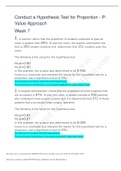
Conduct a Hypothesis Test for Proportion 1. A teacher claims that the proportion of students expected to pass an exam is greater than 80%. To test this claim, the teacher administers the - 1. A teacher claims that the proportion of students expected to pass an exam is greater than 80%. To test this claim, the teacher administers the test to 200 random students and determines that 151 students pass the exam. The following is the setup for this hypothesis test: H0:p=0.80 Ha:p0.80 In this example, the p-value was determined to be 0.944. Come to a conclusion and interpret the results for this hypothesis test for a proportion (use a significance level of 5%) The decision is to fail to reject the Null Hypothesis. The conclusion is that there is not enough evidence to support the claim. 2. A hospital administrator claims that the proportion of knee surgeries that are successful is 87%. To test this claim, a random sample of 450 patients who underwent knee surgery is taken and it is determined that 371 of these patients had a successful knee surgery operation. The following is the setup for this hypothesis test: H0:p=0.87 Ha:p≠0.87 In this example, the p-value was determined to be 0.004. Come to a conclusion and interpret the results for this hypothesis test for a proportion (use a significance level of 5%) the decision is to reject the Null Hypothesis. The conclusion is that there is enough evidence to reject the claim. 3. A college administrator claims that the proportion of students that are nursing majors is greater than 40%. To test this claim, a group of 400 students are randomly selected and its determined that 190 are nursing majors. The following is the setup for this hypothesis test: H0:p=0.40
Document information
- Uploaded on
- April 29, 2021
- Number of pages
- 9
- Written in
- 2020/2021
- Type
- Exam (elaborations)
- Contains
- Questions & answers