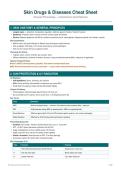
Skin Drugs & Diseases Cheat Sheet
Advanced Pharmacology — Comprehensive Quick Reference
1. SKIN ANATOMY & GENERAL PRINCIPLES
• Largest organ — protection, temperature regulation, defense against infection, Vitamin D source
• Epidermis: Protective layer; stratum corneum contains lipids and keratin
• Dermis: Between epidermis and SQ fat; contains connective tissue, sweat glands, sebaceous glands, hair follicles, vessels
Skin Examination
• Well-lit room; use hand-held light or Wood's lamp (fluoresces certain lesions)
• Skin scrapings, KOH prep, or 5% acetic acid prep for certain pathogens
• Rule out skin cancer with any suspicious lesion
Choosing the Vehicle
• Topicals: lotion, cream, ointment, gel, solution, foam
• Efficacy affected by: thickness of stratum corneum, drug concentration/permeability, frequency of application
General Treatment Rules
■ Use LOWEST steroid potency possible. Start below standard adult dose.
■ NO fluorinated steroids on face or perineum — causes striae and permanent tissue thinning.
2. SUN PROTECTION & UV RADIATION
UV Radiation
• UVB (Bad/Burn): Burns, wrinkling, skin cancers
• UVA: Some wrinkling; with decades of exposure may cause BCC
• Small daily UV exposure helps maintain bone/teeth stability
Vitamin D Pathway
• Photoreceptors (forearms/legs) absorb Vitamin D2 from sun
• D2 converted to D3 in kidney, then to active form: 1,25 dihydroxyvitamin D3
Key Terms
Term Definition
MED Minimal erythemal dose — minimum UV producing clear erythema after 1 exposure
SPF UVB protection rating: MED on protected skin / MED on unprotected skin
Broad Spectrum Effective against both UVA and UVB; protects against sunburn, skin cancer, photoaging
Water Resistant Effective for 40-80 minutes while swimming or sweating
Prescribing Sunscreen
• Sunblock (Zinc oxide / Titanium dioxide) blocks ALL rays vs. sunscreen
• SPF >16 for 5 years decreases melanoma risk by 50%
• Apply 3 tablespoons to cover all BSA every 120 minutes
• Apply sunscreen first; wait 30 min before insect repellant
• Infants <6 months: Small amounts of SPF 15 or less sparingly
• Sunscreen expires 36 months after manufacture date
Skin Phototypes (I-VI)
Type Features Tanning
I Pale white; blue/hazel eyes; blonde/red hair Always burns; never tans
II Fair skin; blue eyes Burns easily; tans rarely
III Darker white skin Tans after initial burn
Skin Drugs & Diseases Cheat Sheet Page 1
, Type Features Tanning
IV Light brown skin Burns minimally; tans easily
V Brown skin Rarely burns; tans darkly
VI Dark brown or black skin Never burns; tans darkly
Photoaging
• Damage from prolonged lifetime UV exposure: dark spots, wrinkles, droopy skin, yellowish tint, fragile blood vessels, leathery skin,
skin cancers
Skin Drugs & Diseases Cheat Sheet Page 2
Advanced Pharmacology — Comprehensive Quick Reference
1. SKIN ANATOMY & GENERAL PRINCIPLES
• Largest organ — protection, temperature regulation, defense against infection, Vitamin D source
• Epidermis: Protective layer; stratum corneum contains lipids and keratin
• Dermis: Between epidermis and SQ fat; contains connective tissue, sweat glands, sebaceous glands, hair follicles, vessels
Skin Examination
• Well-lit room; use hand-held light or Wood's lamp (fluoresces certain lesions)
• Skin scrapings, KOH prep, or 5% acetic acid prep for certain pathogens
• Rule out skin cancer with any suspicious lesion
Choosing the Vehicle
• Topicals: lotion, cream, ointment, gel, solution, foam
• Efficacy affected by: thickness of stratum corneum, drug concentration/permeability, frequency of application
General Treatment Rules
■ Use LOWEST steroid potency possible. Start below standard adult dose.
■ NO fluorinated steroids on face or perineum — causes striae and permanent tissue thinning.
2. SUN PROTECTION & UV RADIATION
UV Radiation
• UVB (Bad/Burn): Burns, wrinkling, skin cancers
• UVA: Some wrinkling; with decades of exposure may cause BCC
• Small daily UV exposure helps maintain bone/teeth stability
Vitamin D Pathway
• Photoreceptors (forearms/legs) absorb Vitamin D2 from sun
• D2 converted to D3 in kidney, then to active form: 1,25 dihydroxyvitamin D3
Key Terms
Term Definition
MED Minimal erythemal dose — minimum UV producing clear erythema after 1 exposure
SPF UVB protection rating: MED on protected skin / MED on unprotected skin
Broad Spectrum Effective against both UVA and UVB; protects against sunburn, skin cancer, photoaging
Water Resistant Effective for 40-80 minutes while swimming or sweating
Prescribing Sunscreen
• Sunblock (Zinc oxide / Titanium dioxide) blocks ALL rays vs. sunscreen
• SPF >16 for 5 years decreases melanoma risk by 50%
• Apply 3 tablespoons to cover all BSA every 120 minutes
• Apply sunscreen first; wait 30 min before insect repellant
• Infants <6 months: Small amounts of SPF 15 or less sparingly
• Sunscreen expires 36 months after manufacture date
Skin Phototypes (I-VI)
Type Features Tanning
I Pale white; blue/hazel eyes; blonde/red hair Always burns; never tans
II Fair skin; blue eyes Burns easily; tans rarely
III Darker white skin Tans after initial burn
Skin Drugs & Diseases Cheat Sheet Page 1
, Type Features Tanning
IV Light brown skin Burns minimally; tans easily
V Brown skin Rarely burns; tans darkly
VI Dark brown or black skin Never burns; tans darkly
Photoaging
• Damage from prolonged lifetime UV exposure: dark spots, wrinkles, droopy skin, yellowish tint, fragile blood vessels, leathery skin,
skin cancers
Skin Drugs & Diseases Cheat Sheet Page 2