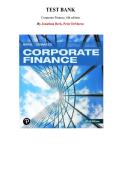
TEST BANK
Corporate Finance, 6th edition
By Jonathan Berk, Peter DeMarzo
LU
XE
LI
BR
AR
Y
, Table of Content
PART 1: INTRODUCTION
The Corporation and Financial Markets
Introduction to Financial Statement Analysis
Financial Decision Making and the Law of One Price
PART 2: TIME, MONEY, AND INTEREST RATES
The Time Value of Money
Interest Rates
Valuing Bonds
PART 3: VALUING PROJECTS AND FIRMS
Investment Decision Rules
Fundamentals of Capital Budgeting
LU
Valuing Stocks
PART 4: RISK AND RETURN
Capital Markets and the Pricing of Risk
Optimal Portfolio Choice and the Capital Asset Pricing Model
Estimating the Cost of Capital
XE
Investor Behavior and Capital Market Efficiency
PART 5: CAPITAL STRUCTURE
Capital Structure in a Perfect Market
Debt and Taxes
Financial Distress, Managerial Incentives, and Information
Payout Policy
LI
PART 6: ADVANCED VALUATION
Capital Budgeting and Valuation with Leverage
Valuation and Financial Modeling: A Case Study
PART 7: OPTIONS
BR
Financial Options
Option Valuation
Real Options
PART 8: LONG-TERM FINANCING
Raising Equity Capital
AR
Debt Financing
Leasing
PART 9: SHORT-TERM FINANCING
Working Capital Management
Short-Term Financial Planning
PART 10: SPECIAL TOPICS
Y
Mergers and Acquisitions
Corporate Governance
Risk Management
International Corporate Finance
, lkjhgfds
TEST BANK FOR
Corporate Finance, 6e (Berk/DeMarzo)
Chapter 1 The Corporation
All Chapters Included
1.1 The Four Types of Firms
1) A sole proprietorship is owned by:
A) one person. All Answers Included
B) two or more persons.
C) shareholders.
LU
D) bankers
Answer: A
Diff: 1
Section: 1.1 The Four Types of Firms
Skill: Definition
XE
2) Which of the following organization forms for a business does NOT avoid double taxation?
A) Limited partnership
B) "C" corporation
C) "S" corporation
D) Limited liability company
Answer: B
LI
Diff: 1
Section: 1.1 The Four Types of Firms
Skill: Conceptual
BR
3) Which of the following organization forms accounts for the most revenue?
A) "S" corporation
B) Limited partnership
C) "C" corporation
D) Limited liability company
Answer: C
AR
Diff: 1
Section: 1.1 The Four Types of Firms
Skill: Conceptual
4) Which of the following organization forms accounts for the greatest number of firms?
A) "S" corporation
Y
B) Limited partnership
C) Sole proprietorship
D) "C" corporation
Answer: C
Diff: 1
Section: 1.1 The Four Types of Firms
Skill: Conceptual
kjhgfds
, lkjhgfds
5) Which of the following is NOT an advantage of a sole proprietorship?
A) Single taxation
B) Ease of setup
C) Limited liability
D) No separation of ownership and control
Answer: C
Diff: 2
Section: 1.1 The Four Types of Firms
Skill: Conceptual
LU
6) Which of the following statements regarding limited partnerships is TRUE?
A) There is no limit on a limited partner's liability.
B) A limited partner's liability is limited by the amount of their investment.
C) A limited partner is not liable until all the assets of the general partners have been exhausted.
D) A general partner's liability is limited by the amount of their investment.
Answer: B
XE
Diff: 2
Section: 1.1 The Four Types of Firms
Skill: Conceptual
7) Which of the following is/are an advantage of incorporation?
A) Access to capital markets
LI
B) Limited liability
C) Unlimited life
D) All of the above
Answer: D
BR
Diff: 2
Section: 1.1 The Four Types of Firms
Skill: Conceptual
8) Which of the following statements is most correct?
A) An advantage to incorporation is that it allows for less regulation of the business.
AR
B) An advantage of a corporation is that it is subject to double taxation.
C) Unlike a partnership, a disadvantage of a corporation is that it has limited liability.
D) Corporations face more regulations when compared to partnerships.
Answer: D
Diff: 2
Section: 1.1 The Four Types of Firms
Y
Skill: Conceptual
kjhgfds
Corporate Finance, 6th edition
By Jonathan Berk, Peter DeMarzo
LU
XE
LI
BR
AR
Y
, Table of Content
PART 1: INTRODUCTION
The Corporation and Financial Markets
Introduction to Financial Statement Analysis
Financial Decision Making and the Law of One Price
PART 2: TIME, MONEY, AND INTEREST RATES
The Time Value of Money
Interest Rates
Valuing Bonds
PART 3: VALUING PROJECTS AND FIRMS
Investment Decision Rules
Fundamentals of Capital Budgeting
LU
Valuing Stocks
PART 4: RISK AND RETURN
Capital Markets and the Pricing of Risk
Optimal Portfolio Choice and the Capital Asset Pricing Model
Estimating the Cost of Capital
XE
Investor Behavior and Capital Market Efficiency
PART 5: CAPITAL STRUCTURE
Capital Structure in a Perfect Market
Debt and Taxes
Financial Distress, Managerial Incentives, and Information
Payout Policy
LI
PART 6: ADVANCED VALUATION
Capital Budgeting and Valuation with Leverage
Valuation and Financial Modeling: A Case Study
PART 7: OPTIONS
BR
Financial Options
Option Valuation
Real Options
PART 8: LONG-TERM FINANCING
Raising Equity Capital
AR
Debt Financing
Leasing
PART 9: SHORT-TERM FINANCING
Working Capital Management
Short-Term Financial Planning
PART 10: SPECIAL TOPICS
Y
Mergers and Acquisitions
Corporate Governance
Risk Management
International Corporate Finance
, lkjhgfds
TEST BANK FOR
Corporate Finance, 6e (Berk/DeMarzo)
Chapter 1 The Corporation
All Chapters Included
1.1 The Four Types of Firms
1) A sole proprietorship is owned by:
A) one person. All Answers Included
B) two or more persons.
C) shareholders.
LU
D) bankers
Answer: A
Diff: 1
Section: 1.1 The Four Types of Firms
Skill: Definition
XE
2) Which of the following organization forms for a business does NOT avoid double taxation?
A) Limited partnership
B) "C" corporation
C) "S" corporation
D) Limited liability company
Answer: B
LI
Diff: 1
Section: 1.1 The Four Types of Firms
Skill: Conceptual
BR
3) Which of the following organization forms accounts for the most revenue?
A) "S" corporation
B) Limited partnership
C) "C" corporation
D) Limited liability company
Answer: C
AR
Diff: 1
Section: 1.1 The Four Types of Firms
Skill: Conceptual
4) Which of the following organization forms accounts for the greatest number of firms?
A) "S" corporation
Y
B) Limited partnership
C) Sole proprietorship
D) "C" corporation
Answer: C
Diff: 1
Section: 1.1 The Four Types of Firms
Skill: Conceptual
kjhgfds
, lkjhgfds
5) Which of the following is NOT an advantage of a sole proprietorship?
A) Single taxation
B) Ease of setup
C) Limited liability
D) No separation of ownership and control
Answer: C
Diff: 2
Section: 1.1 The Four Types of Firms
Skill: Conceptual
LU
6) Which of the following statements regarding limited partnerships is TRUE?
A) There is no limit on a limited partner's liability.
B) A limited partner's liability is limited by the amount of their investment.
C) A limited partner is not liable until all the assets of the general partners have been exhausted.
D) A general partner's liability is limited by the amount of their investment.
Answer: B
XE
Diff: 2
Section: 1.1 The Four Types of Firms
Skill: Conceptual
7) Which of the following is/are an advantage of incorporation?
A) Access to capital markets
LI
B) Limited liability
C) Unlimited life
D) All of the above
Answer: D
BR
Diff: 2
Section: 1.1 The Four Types of Firms
Skill: Conceptual
8) Which of the following statements is most correct?
A) An advantage to incorporation is that it allows for less regulation of the business.
AR
B) An advantage of a corporation is that it is subject to double taxation.
C) Unlike a partnership, a disadvantage of a corporation is that it has limited liability.
D) Corporations face more regulations when compared to partnerships.
Answer: D
Diff: 2
Section: 1.1 The Four Types of Firms
Y
Skill: Conceptual
kjhgfds