
WGU D488 OA EXAMINATION SET 2026
SOLVED QUESTIONS GRADED A+
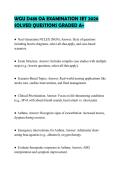
● Next Generation NCLEX (NGN). Answer: Style of questions
including bowtie diagrams, select-all-that-apply, and case-based
scenarios.
● Exam Structure. Answer: Includes complex case studies with multiple
steps (e.g., bowtie questions, select-all-that-apply).
● Scenario-Based Topics. Answer: Real-world nursing applications like
stroke care, cardiac interventions, and fluid management.
● Clinical Prioritization. Answer: Focus on life-threatening conditions
(e.g., MVA with absent breath sounds, heart attack vs. chest pain).
● Asthma. Answer: Recognize signs of exacerbation: increased mucus,
dyspnea during exercise.
● Emergency interventions for Asthma. Answer: Administer short-
acting beta-agonists (e.g., albuterol), oxygen therapy.
● Evaluate therapeutic responses in Asthma. Answer: ABG
interpretation and symptom improvement.
, ● COPD Oxygen therapy. Answer: Target SpO₂ 88-92% for hypoxia.
● COPD Dietary Consideration. Answer: High-protein, high-calorie
small meals to maintain energy levels.
● Heart Attack vs. Chest Pain. Answer: Differentiate myocardial
infarction (MI) from angina (e.g., persistent pain, diaphoresis, elevated
troponin for MI).
● Medications for Heart Attack. Answer: Morphine, oxygen,
nitroglycerin, aspirin (MONA protocol).
● Left-sided Heart Failure Symptoms. Answer: Pulmonary symptoms
(e.g., dyspnea, orthopnea, crackles).
● Right-sided Heart Failure Symptoms. Answer: Peripheral symptoms
(e.g., edema, ascites, JVD).
● Management of Heart Failure. Answer: Diuretics (potassium-sparing
vs. wasting), ACE inhibitors.
● Cardiac Medication Classifications. Answer: Common Classes: Beta-
blockers, Calcium channel blockers, Diuretics.
SOLVED QUESTIONS GRADED A+
● Next Generation NCLEX (NGN). Answer: Style of questions
including bowtie diagrams, select-all-that-apply, and case-based
scenarios.
● Exam Structure. Answer: Includes complex case studies with multiple
steps (e.g., bowtie questions, select-all-that-apply).
● Scenario-Based Topics. Answer: Real-world nursing applications like
stroke care, cardiac interventions, and fluid management.
● Clinical Prioritization. Answer: Focus on life-threatening conditions
(e.g., MVA with absent breath sounds, heart attack vs. chest pain).
● Asthma. Answer: Recognize signs of exacerbation: increased mucus,
dyspnea during exercise.
● Emergency interventions for Asthma. Answer: Administer short-
acting beta-agonists (e.g., albuterol), oxygen therapy.
● Evaluate therapeutic responses in Asthma. Answer: ABG
interpretation and symptom improvement.
, ● COPD Oxygen therapy. Answer: Target SpO₂ 88-92% for hypoxia.
● COPD Dietary Consideration. Answer: High-protein, high-calorie
small meals to maintain energy levels.
● Heart Attack vs. Chest Pain. Answer: Differentiate myocardial
infarction (MI) from angina (e.g., persistent pain, diaphoresis, elevated
troponin for MI).
● Medications for Heart Attack. Answer: Morphine, oxygen,
nitroglycerin, aspirin (MONA protocol).
● Left-sided Heart Failure Symptoms. Answer: Pulmonary symptoms
(e.g., dyspnea, orthopnea, crackles).
● Right-sided Heart Failure Symptoms. Answer: Peripheral symptoms
(e.g., edema, ascites, JVD).
● Management of Heart Failure. Answer: Diuretics (potassium-sparing
vs. wasting), ACE inhibitors.
● Cardiac Medication Classifications. Answer: Common Classes: Beta-
blockers, Calcium channel blockers, Diuretics.


