GALEN COLLEGE OF NURSING · DEPARTMENT OF PSYCHIATRIC NURSING
NUR 256 · EXAM 1
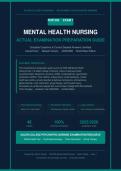
MENTAL HEALTH NURSING
ACTUAL EXAMINATION PREPARATION GUIDE
Complete Questions & Correct Detailed Answers (Verified)
Actual Exam · Newest Version · 2025/2026 · Brand New Edition
DOCUMENT DESCRIPTION
This comprehensive preparation guide covers the NUR 256 Mental Health
Nursing Exam 1 at Galen College of Nursing. Topics include psychiatric
neurotransmitters (dopamine, serotonin, GABA, norepinephrine), psychotropic
medications (SSRIs, TCAs, MAOIs, antipsychotics, mood stabilizers), mental
health law & ethics, anxiety disorders & defense mechanisms, schizophrenia,
bipolar disorder, crisis intervention, group therapy, and Freudian theory.
All answers are verified and aligned with current Galen College NUR 256 standards.
Total: 46 pages · Academic Year 2025/2026 · Verified Edition
✓ Psychopharmacology ✓ Psychiatric Disorders ✓ Legal & Ethics
Meds, NT & side effects Schizophrenia, bipolar, anxiety Torts, consent & confidentiality
46 100% 2025/2026
PAGES VERIFIED ANSWERS ACADEMIC YEAR
GALEN COLLEGE PSYCHIATRIC NURSING EXAMINATION RESOURCE
Mental Health Law · Psychopharmacology · Crisis Intervention · Group Therapy
Prepared by: Dennis Muriuki · NUR 256 Mental Health Nursing · Galen College · Exam 1
For Academic & Examination Use Only · All Content Verified
,1|Page
NUR 256 Mental Health Exam 1 Galen College Actual Exam
Newest 2025/2026 Complete Questions And Correct Detailed
Answers (Verified Answers) |Brand New Version!!
What illnesses are associated with the decrease/increase of Dopamine -
SOLUTION=decrease: Parkinson's disease, depression
increase: Schizophrenia, mania
What standards must a patient meet to be committed involuntarily? -
SOLUTION=Mentally ill, posing danger to themselves or others, gravely disabled,
in need of treatment and the mental illness prevents help-seeking on a voluntary
basis
Confidentiality is an ethical responsibility of healthcare professionals that prohibit
the disclosure of privileged information without the patient's consent. What would
be an exception to the rule? - SOLUTION=A therapist has the duty to warn a
patient's potential victim of potential harm. Duty to warn is an obligation to warn
third parties when they may in danger of the patient.
Unintentional Tort - SOLUTION=Unintended act against another person that
produces injury, or harm.
What're the five elements to prove negligence? - SOLUTION=duty, breach of duty,
cause in fact, proximate cause and damages.
What're competencies for quality and safe education for nurses? -
SOLUTION=Patient centered care, quality improvement, safety, informatics,
teamwork and collaboration, evidence-based practice.
,2|Page
How should the nurse address confidentiality when dealing with adolescents -
SOLUTION=The adolescent and their family should be provided with an overview
of how information sharing will work, what information will be shared, with whom
and when
What are special considerations the nurse should take into consideration when
assessing the older adult? PG 11 - SOLUTION=many older adults need special
attention. Be aware of physical limitations, they may be sensory, motor, or medical
Advance Directives - SOLUTION=Allow the patient to specify the type of
treatment they would like for their condition
Informed consent - SOLUTION=must be obtained before a patient can receive a
treatment or participate in a study/trial
Tort - SOLUTION=when one person hurts another and the injured person seeks
retribution
acting on questionable practice - SOLUTION=the obligation to report suspected
negligence or irresponsible behavior
Milieu environments - SOLUTION=Uses whole environment, very structured,
allows participation by the patient
Why may a patient not seek help for mental health? - SOLUTION=Stigma, fear of
being judged or shamed, uncomfortable sharing intimate information
, 3|Page
Mental health cycles from ________ to __________ periods -
SOLUTION=remission, exacerbation
Outpatient setting - SOLUTION=Provides preventative measures, starts with PCP;
from there PCP will refer to: psychiatrists, psychologists, clinics, In-home therapy,
intensive program or partial hospitalization
Inpatient setting - SOLUTION=Hospital setting, provides crisis stabilization, state
hospitals normally reserved for severe mental illness, patients could be voluntary
or involuntary, patient rights, could provide group therapy
Inpatient treatment - SOLUTION=Use restraint and seclusion as a last resort,
consider safety, consider any dangerous objects, your positioning in the room
Specialty treatment environments - SOLUTION=Pediatric, geriatric, VA centers,
forensic units, substance abuse centers
Cultural considerations - SOLUTION=Consider the diverse population in the US,
be educated on world views, be aware of holistic healing
Eastern traditions - SOLUTION=Mind, body, and spirit are one
Good Stress - SOLUTION=Alert, focused
Bad Stress - SOLUTION=Prolonged, chronic with negative effects
What illnesses are associated with the decrease/increase of Norepinephrine -
SOLUTION=decrease: depression
NUR 256 · EXAM 1
MENTAL HEALTH NURSING
ACTUAL EXAMINATION PREPARATION GUIDE
Complete Questions & Correct Detailed Answers (Verified)
Actual Exam · Newest Version · 2025/2026 · Brand New Edition
DOCUMENT DESCRIPTION
This comprehensive preparation guide covers the NUR 256 Mental Health
Nursing Exam 1 at Galen College of Nursing. Topics include psychiatric
neurotransmitters (dopamine, serotonin, GABA, norepinephrine), psychotropic
medications (SSRIs, TCAs, MAOIs, antipsychotics, mood stabilizers), mental
health law & ethics, anxiety disorders & defense mechanisms, schizophrenia,
bipolar disorder, crisis intervention, group therapy, and Freudian theory.
All answers are verified and aligned with current Galen College NUR 256 standards.
Total: 46 pages · Academic Year 2025/2026 · Verified Edition
✓ Psychopharmacology ✓ Psychiatric Disorders ✓ Legal & Ethics
Meds, NT & side effects Schizophrenia, bipolar, anxiety Torts, consent & confidentiality
46 100% 2025/2026
PAGES VERIFIED ANSWERS ACADEMIC YEAR
GALEN COLLEGE PSYCHIATRIC NURSING EXAMINATION RESOURCE
Mental Health Law · Psychopharmacology · Crisis Intervention · Group Therapy
Prepared by: Dennis Muriuki · NUR 256 Mental Health Nursing · Galen College · Exam 1
For Academic & Examination Use Only · All Content Verified
,1|Page
NUR 256 Mental Health Exam 1 Galen College Actual Exam
Newest 2025/2026 Complete Questions And Correct Detailed
Answers (Verified Answers) |Brand New Version!!
What illnesses are associated with the decrease/increase of Dopamine -
SOLUTION=decrease: Parkinson's disease, depression
increase: Schizophrenia, mania
What standards must a patient meet to be committed involuntarily? -
SOLUTION=Mentally ill, posing danger to themselves or others, gravely disabled,
in need of treatment and the mental illness prevents help-seeking on a voluntary
basis
Confidentiality is an ethical responsibility of healthcare professionals that prohibit
the disclosure of privileged information without the patient's consent. What would
be an exception to the rule? - SOLUTION=A therapist has the duty to warn a
patient's potential victim of potential harm. Duty to warn is an obligation to warn
third parties when they may in danger of the patient.
Unintentional Tort - SOLUTION=Unintended act against another person that
produces injury, or harm.
What're the five elements to prove negligence? - SOLUTION=duty, breach of duty,
cause in fact, proximate cause and damages.
What're competencies for quality and safe education for nurses? -
SOLUTION=Patient centered care, quality improvement, safety, informatics,
teamwork and collaboration, evidence-based practice.
,2|Page
How should the nurse address confidentiality when dealing with adolescents -
SOLUTION=The adolescent and their family should be provided with an overview
of how information sharing will work, what information will be shared, with whom
and when
What are special considerations the nurse should take into consideration when
assessing the older adult? PG 11 - SOLUTION=many older adults need special
attention. Be aware of physical limitations, they may be sensory, motor, or medical
Advance Directives - SOLUTION=Allow the patient to specify the type of
treatment they would like for their condition
Informed consent - SOLUTION=must be obtained before a patient can receive a
treatment or participate in a study/trial
Tort - SOLUTION=when one person hurts another and the injured person seeks
retribution
acting on questionable practice - SOLUTION=the obligation to report suspected
negligence or irresponsible behavior
Milieu environments - SOLUTION=Uses whole environment, very structured,
allows participation by the patient
Why may a patient not seek help for mental health? - SOLUTION=Stigma, fear of
being judged or shamed, uncomfortable sharing intimate information
, 3|Page
Mental health cycles from ________ to __________ periods -
SOLUTION=remission, exacerbation
Outpatient setting - SOLUTION=Provides preventative measures, starts with PCP;
from there PCP will refer to: psychiatrists, psychologists, clinics, In-home therapy,
intensive program or partial hospitalization
Inpatient setting - SOLUTION=Hospital setting, provides crisis stabilization, state
hospitals normally reserved for severe mental illness, patients could be voluntary
or involuntary, patient rights, could provide group therapy
Inpatient treatment - SOLUTION=Use restraint and seclusion as a last resort,
consider safety, consider any dangerous objects, your positioning in the room
Specialty treatment environments - SOLUTION=Pediatric, geriatric, VA centers,
forensic units, substance abuse centers
Cultural considerations - SOLUTION=Consider the diverse population in the US,
be educated on world views, be aware of holistic healing
Eastern traditions - SOLUTION=Mind, body, and spirit are one
Good Stress - SOLUTION=Alert, focused
Bad Stress - SOLUTION=Prolonged, chronic with negative effects
What illnesses are associated with the decrease/increase of Norepinephrine -
SOLUTION=decrease: depression