

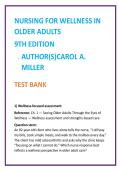
NURSING FOR WELLNESS IN
OLDER ADULTS
9TH EDITION
• AUTHOR(S)CAROL A.
MILLER
TEST BANK
1) Wellness-focused assessment
Reference: Ch. 1 — Seeing Older Adults Through the Eyes of
Wellness — Wellness assessment and strengths-based care
Question stem:
An 82-year-old client who lives alone tells the nurse, “I still pay
my bills, cook simple meals, and walk to the mailbox every day.”
The client has mild osteoarthritis and asks why the clinic keeps
“focusing on what I cannot do.” Which nurse response best
reflects a wellness perspective in older adult care?
,A. “Aging usually means loss, so we need to identify your
deficits first.”
B. “Let’s build on the activities you still do well and identify
supports that help you stay independent.”
C. “Most people your age need help with daily tasks, so
dependence is expected.”
D. “We should focus only on your medical diagnoses to guide
your care plan.”
Correct answer: B
Rationale — Correct answer:
A wellness perspective emphasizes remaining abilities,
independence, and quality of life. The nurse’s role is to identify
strengths, support function, and promote autonomy rather
than frame aging as decline. This approach is patient-centered
and consistent with gerontological nursing.
Rationales — Incorrect options:
A. This reflects ageist thinking and assumes loss is inevitable. It
can discourage self-efficacy and ignores the client’s current
strengths.
C. Dependence is not expected simply because a person is
older. Many older adults remain highly independent.
D. Medical diagnoses matter, but wellness care includes
function, goals, and strengths—not diagnosis alone.
Teaching point:
Focus on abilities, not age-related assumptions.
,Citation:
Miller, C. A. (2023). Nursing for Wellness in Older Adults (9th
ed.). Ch. 1.
2) Avoiding ageism
Reference: Ch. 1 — Seeing Older Adults Through the Eyes of
Wellness — Ageism and stereotypes
Question stem:
During report, a nurse says, “The new admission is 79, so
confusion is probably just old age.” The client is usually alert but
has recently become withdrawn and disoriented after a urinary
tract infection. Which response by the charge nurse is best?
A. “Older adults commonly become confused, so we should
reassure the family.”
B. “Confusion in an older adult should be treated as a new
symptom until proven otherwise.”
C. “This is likely normal aging and does not require urgent
assessment.”
D. “We should wait 48 hours before documenting any mental
status change.”
Correct answer: B
Rationale — Correct answer:
New confusion is not a normal part of aging and may signal
delirium, infection, medication effects, or another acute
problem. The nurse should recognize mental status change as
, requiring prompt assessment and intervention. This reduces the
risk of missed serious illness.
Rationales — Incorrect options:
A. This normalizes an abnormal finding and delays care. Family
reassurance alone is not enough.
C. Confusion is not expected aging. Delaying assessment can
worsen outcomes.
D. Waiting can jeopardize safety because delirium often
requires immediate evaluation.
Teaching point:
New confusion is abnormal until assessed.
Citation:
Miller, C. A. (2023). Nursing for Wellness in Older Adults (9th
ed.). Ch. 1.
3) Strengths-based goal setting
Reference: Ch. 1 — Seeing Older Adults Through the Eyes of
Wellness — Goal setting and independence
Question stem:
An 87-year-old client recovering from pneumonia states, “I want
to get back to taking my own shower, even if it takes longer.”
The client uses a walker and has mild hearing loss. Which
nursing intervention best supports this goal?
OLDER ADULTS
9TH EDITION
• AUTHOR(S)CAROL A.
MILLER
TEST BANK
1) Wellness-focused assessment
Reference: Ch. 1 — Seeing Older Adults Through the Eyes of
Wellness — Wellness assessment and strengths-based care
Question stem:
An 82-year-old client who lives alone tells the nurse, “I still pay
my bills, cook simple meals, and walk to the mailbox every day.”
The client has mild osteoarthritis and asks why the clinic keeps
“focusing on what I cannot do.” Which nurse response best
reflects a wellness perspective in older adult care?
,A. “Aging usually means loss, so we need to identify your
deficits first.”
B. “Let’s build on the activities you still do well and identify
supports that help you stay independent.”
C. “Most people your age need help with daily tasks, so
dependence is expected.”
D. “We should focus only on your medical diagnoses to guide
your care plan.”
Correct answer: B
Rationale — Correct answer:
A wellness perspective emphasizes remaining abilities,
independence, and quality of life. The nurse’s role is to identify
strengths, support function, and promote autonomy rather
than frame aging as decline. This approach is patient-centered
and consistent with gerontological nursing.
Rationales — Incorrect options:
A. This reflects ageist thinking and assumes loss is inevitable. It
can discourage self-efficacy and ignores the client’s current
strengths.
C. Dependence is not expected simply because a person is
older. Many older adults remain highly independent.
D. Medical diagnoses matter, but wellness care includes
function, goals, and strengths—not diagnosis alone.
Teaching point:
Focus on abilities, not age-related assumptions.
,Citation:
Miller, C. A. (2023). Nursing for Wellness in Older Adults (9th
ed.). Ch. 1.
2) Avoiding ageism
Reference: Ch. 1 — Seeing Older Adults Through the Eyes of
Wellness — Ageism and stereotypes
Question stem:
During report, a nurse says, “The new admission is 79, so
confusion is probably just old age.” The client is usually alert but
has recently become withdrawn and disoriented after a urinary
tract infection. Which response by the charge nurse is best?
A. “Older adults commonly become confused, so we should
reassure the family.”
B. “Confusion in an older adult should be treated as a new
symptom until proven otherwise.”
C. “This is likely normal aging and does not require urgent
assessment.”
D. “We should wait 48 hours before documenting any mental
status change.”
Correct answer: B
Rationale — Correct answer:
New confusion is not a normal part of aging and may signal
delirium, infection, medication effects, or another acute
problem. The nurse should recognize mental status change as
, requiring prompt assessment and intervention. This reduces the
risk of missed serious illness.
Rationales — Incorrect options:
A. This normalizes an abnormal finding and delays care. Family
reassurance alone is not enough.
C. Confusion is not expected aging. Delaying assessment can
worsen outcomes.
D. Waiting can jeopardize safety because delirium often
requires immediate evaluation.
Teaching point:
New confusion is abnormal until assessed.
Citation:
Miller, C. A. (2023). Nursing for Wellness in Older Adults (9th
ed.). Ch. 1.
3) Strengths-based goal setting
Reference: Ch. 1 — Seeing Older Adults Through the Eyes of
Wellness — Goal setting and independence
Question stem:
An 87-year-old client recovering from pneumonia states, “I want
to get back to taking my own shower, even if it takes longer.”
The client uses a walker and has mild hearing loss. Which
nursing intervention best supports this goal?


