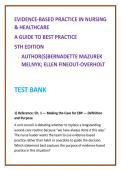
EVIDENCE-BASED PRACTICE IN NURSING
& HEALTHCARE
A GUIDE TO BEST PRACTICE
5TH EDITION
• AUTHOR(S)BERNADETTE MAZUREK
MELNYK; ELLEN FINEOUT-OVERHOLT
TEST BANK
1) Reference: Ch. 1 — Making the Case for EBP — Definition
and Purpose
A unit council is debating whether to replace a longstanding
wound-care routine because “we have always done it this way.”
The nurse leader wants the team to use evidence-based
practice rather than habit or anecdote to guide the decision.
Which statement best captures the purpose of evidence-based
practice in this situation?
,A. It replaces clinical judgment with research findings alone.
B. It integrates the best available evidence with clinical
expertise and patient preferences.
C. It applies the newest study findings regardless of quality or
fit.
D. It prioritizes physician preference over nursing judgment.
Correct Answer: B
Rationale — Correct Answer:
EBP is not research-only decision-making. It intentionally
combines the best available evidence, clinician expertise, and
patient values/preferences to support a sound practice
decision. This is the core logic for changing care that has
traditionally been based on custom.
Rationale — Incorrect Options:
A. EBP does not remove clinical judgment; it strengthens it with
evidence.
C. Newness alone does not equal quality or applicability.
D. EBP is interprofessional, but it does not privilege physician
preference over evidence and patient values.
Teaching Point: EBP = best evidence + clinical expertise +
patient values.
Citation: Melnyk, B. M., & Fineout-Overholt, E. (2023).
Evidence-Based Practice in Nursing & Healthcare (5th ed.). Ch.
1.
,2) Reference: Ch. 1 — EBP Foundations — Three Core Elements
A nurse is selecting an intervention for anxiety management on
a medical-surgical unit. One option is supported by several
studies, but the patient’s cultural beliefs make that approach
unacceptable. The nurse wants to make a defensible EBP
decision. What should guide the final choice?
A. Research findings alone
B. Unit tradition and routine
C. The integration of evidence, clinical expertise, and patient
preference
D. The option that is easiest to implement
Correct Answer: C
Rationale — Correct Answer:
Strong EBP decisions are made by integrating all three
elements, not by treating research as the only input. When
evidence conflicts with patient preferences, the nurse must
individualize care while preserving evidence-informed
reasoning.
Rationale — Incorrect Options:
A. Research is essential but not sufficient by itself.
B. Tradition may be familiar, but it is not a reliable substitute for
evidence.
D. Ease of implementation does not determine clinical
effectiveness.
, Teaching Point: Best care is evidence-informed and patient-
centered.
Citation: Melnyk, B. M., & Fineout-Overholt, E. (2023).
Evidence-Based Practice in Nursing & Healthcare (5th ed.). Ch.
1.
3) Reference: Ch. 1 — Spirit of Inquiry — Recognizing Practice
Gaps
During bedside shift report, a nurse notices that postoperative
patients on one unit receive early ambulation more consistently
than similar patients on another unit, yet outcomes appear
better on the first unit. The nurse wonders whether the
difference is due to practice variation rather than patient acuity.
What is the nurse demonstrating?
A. A refusal to accept accountability
B. A spirit of inquiry
C. A completed evidence appraisal
D. A quality indicator dashboard review
Correct Answer: B
Rationale — Correct Answer:
A spirit of inquiry is curiosity that leads clinicians to question
current practice and look for better ways to improve outcomes.
The nurse is noticing variation and asking whether there is a
better evidence-based approach.
& HEALTHCARE
A GUIDE TO BEST PRACTICE
5TH EDITION
• AUTHOR(S)BERNADETTE MAZUREK
MELNYK; ELLEN FINEOUT-OVERHOLT
TEST BANK
1) Reference: Ch. 1 — Making the Case for EBP — Definition
and Purpose
A unit council is debating whether to replace a longstanding
wound-care routine because “we have always done it this way.”
The nurse leader wants the team to use evidence-based
practice rather than habit or anecdote to guide the decision.
Which statement best captures the purpose of evidence-based
practice in this situation?
,A. It replaces clinical judgment with research findings alone.
B. It integrates the best available evidence with clinical
expertise and patient preferences.
C. It applies the newest study findings regardless of quality or
fit.
D. It prioritizes physician preference over nursing judgment.
Correct Answer: B
Rationale — Correct Answer:
EBP is not research-only decision-making. It intentionally
combines the best available evidence, clinician expertise, and
patient values/preferences to support a sound practice
decision. This is the core logic for changing care that has
traditionally been based on custom.
Rationale — Incorrect Options:
A. EBP does not remove clinical judgment; it strengthens it with
evidence.
C. Newness alone does not equal quality or applicability.
D. EBP is interprofessional, but it does not privilege physician
preference over evidence and patient values.
Teaching Point: EBP = best evidence + clinical expertise +
patient values.
Citation: Melnyk, B. M., & Fineout-Overholt, E. (2023).
Evidence-Based Practice in Nursing & Healthcare (5th ed.). Ch.
1.
,2) Reference: Ch. 1 — EBP Foundations — Three Core Elements
A nurse is selecting an intervention for anxiety management on
a medical-surgical unit. One option is supported by several
studies, but the patient’s cultural beliefs make that approach
unacceptable. The nurse wants to make a defensible EBP
decision. What should guide the final choice?
A. Research findings alone
B. Unit tradition and routine
C. The integration of evidence, clinical expertise, and patient
preference
D. The option that is easiest to implement
Correct Answer: C
Rationale — Correct Answer:
Strong EBP decisions are made by integrating all three
elements, not by treating research as the only input. When
evidence conflicts with patient preferences, the nurse must
individualize care while preserving evidence-informed
reasoning.
Rationale — Incorrect Options:
A. Research is essential but not sufficient by itself.
B. Tradition may be familiar, but it is not a reliable substitute for
evidence.
D. Ease of implementation does not determine clinical
effectiveness.
, Teaching Point: Best care is evidence-informed and patient-
centered.
Citation: Melnyk, B. M., & Fineout-Overholt, E. (2023).
Evidence-Based Practice in Nursing & Healthcare (5th ed.). Ch.
1.
3) Reference: Ch. 1 — Spirit of Inquiry — Recognizing Practice
Gaps
During bedside shift report, a nurse notices that postoperative
patients on one unit receive early ambulation more consistently
than similar patients on another unit, yet outcomes appear
better on the first unit. The nurse wonders whether the
difference is due to practice variation rather than patient acuity.
What is the nurse demonstrating?
A. A refusal to accept accountability
B. A spirit of inquiry
C. A completed evidence appraisal
D. A quality indicator dashboard review
Correct Answer: B
Rationale — Correct Answer:
A spirit of inquiry is curiosity that leads clinicians to question
current practice and look for better ways to improve outcomes.
The nurse is noticing variation and asking whether there is a
better evidence-based approach.